




- Industrial CMBS issuance reached $14.93B through August, representing 17.01% of total 2026 CMBS volume.
- SASB deals accounted for $13.24B of industrial issuance, compared with just $1.69B through conduit transactions.
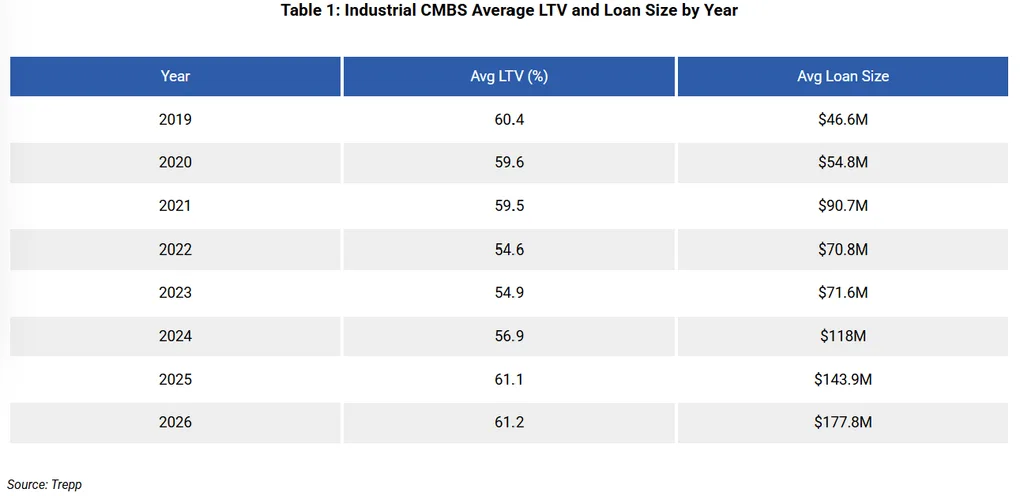
- Average industrial CMBS loan size rose to $177.8M, while average LTV remained elevated at 61.2%.
Industrial real estate is taking a larger share of the CMBS market in 2026, Trepp reported. Its 2026 issuance analysis shows $14.93B of industrial loans securitized through August, with SASB transactions dominating volume.
Get Smarter about what matters in CRE
Stay ahead of trends in commercial real estate with CRE Daily – the free newsletter delivering everything you need to start your day in just 5-minutes
The Details
Industrial loans represented 17.01% of this year’s $87.75B in total CMBS issuance, according to Trepp. That compares with a 14.55% share of last year’s $127.56B total.
SASB issuance accounts for most industrial securitization volume this year. Single-asset, single-borrower deals contributed $13.24B through August, versus only $1.69B through conduits.
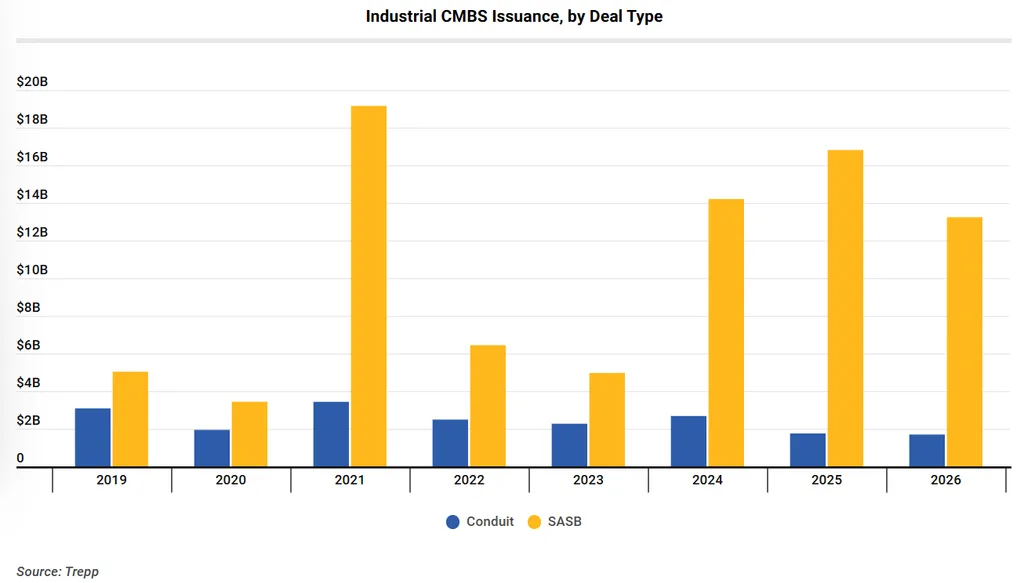
Trepp expects full-year industrial volume to exceed the $18.56B securitized in all of 2025. The current mix shows the market leaning heavily toward large-property and portfolio transactions.
SASB transactions typically finance one large property or portfolio for a single borrower. Conduit deals generally pool smaller loans secured by individual properties into one securitization.
A Large Portfolio Shows the Scale
MTN Commercial Mortgage Trust 2026-LPFX was backed by a $1.28B loan within a $1.62B financing. The collateral included 90 industrial properties totaling 19.2M SF.
The financing replaced a $1.4B loan securitized in 2022. Since then, the collateral pool expanded by eight properties and its appraised value rose from $2.1B to $2.35B.
Leverage also increased. The new financing carried a 68.9% loan-to-value ratio, up from 66.8% on the 2022 transaction.
Larger Loans Carry More Leverage
Across industrial CMBS, average LTV reached 61.2% in 2026. That was nearly unchanged from 61.1% in 2025 but above 56.9% in 2024 and 54.9% in 2023.
Average securitized industrial loan size climbed more sharply. Trepp reported $177.8M this year, compared with $143.9M in 2025 and $118M in 2024.
The increase has occurred as industrial construction has retreated from its 2022 peak. Trepp said the shift suggests lenders have become more comfortable with industrial collateral as supply conditions stabilize.
The longer-term series shows how quickly average loan size has expanded. It was $46.6M in 2019, $90.7M in 2021, and $70.8M in 2022 before accelerating again.
Average industrial LTV was 60.4% in 2019 and 59.5% in 2021. It fell to 54.6% in 2022 before rising through the latest cycle.
Why It Matters
The 2026 industrial CMBS market is larger, more concentrated in SASB deals, and built around bigger average loans. Those traits make portfolio-level financings especially important to issuance totals.
Leverage is also higher than in 2023 and 2024. That does not erase lender demand, but it changes the credit profile behind the sector’s growing CMBS share.
For industrial owners, securitization remains an active financing channel. The data also shows conduit volume playing a much smaller role than large SASB executions this year.
The mix also makes headline industrial issuance sensitive to a relatively small number of very large financings. A few portfolio deals can materially change the sector’s annual total.
What’s Next
Trepp expects industrial securitization to surpass 2025’s full-year total before 2026 ends. The key question is whether that growth broadens beyond SASB transactions.
Average leverage and loan size will also remain important measures. Both indicate how aggressively lenders are financing industrial assets as the construction pipeline normalizes.