



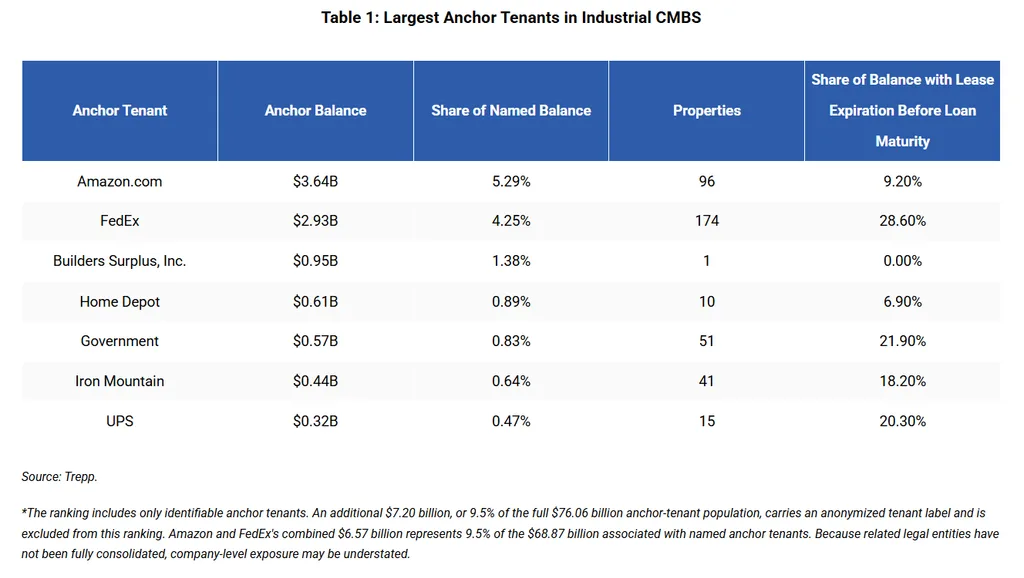
- Amazon and FedEx anchor $6.57B of industrial CMBS tied to identifiable major tenants, equal to 9.5% of the named balance.
- FedEx has 28.6% of its anchored balance facing lease expiration before loan maturity, versus 9.2% for Amazon.
- FedEx plans to close more than 475 stations by the end of 2027, increasing the need to monitor lease timing without predicting specific closures.
FedEx carries a heavier near-term lease rollover profile than Amazon across industrial securitized loans. Trepp’s analysis shows Amazon and FedEx together anchor $6.57B of industrial CMBS exposure tied to identifiable major tenants. That equals 9.5% of the $68.87B named-anchor balance, with the two companies exceeding the next 10 largest tenants combined. Trepp also identified $7.20B of anchor-tenant balance under anonymized tenant labels, bringing the full anchor population to $76.06B.
Get Smarter about what matters in CRE
Stay ahead of trends in commercial real estate with CRE Daily – the free newsletter delivering everything you need to start your day in just 5-minutes
Industrial CMBS Exposure Is Concentrated
Amazon accounts for $3.64B across 96 properties, while FedEx accounts for $2.93B across 174. The difference appears in lease timing. Trepp found 28.6% of FedEx’s anchored balance has a reported lease expiration before the associated loan matures. Amazon’s comparable share is 9.2%.
By property count, 84 of 174 FedEx-anchored assets, or 48.3%, have leases expiring before loan maturity. Trepp says those expirations are more common among smaller FedEx properties. The median FedEx-anchored asset is 144,168 SF, compared with 219,000 SF for Amazon, and 31% of FedEx properties are below 100,000 SF.
FedEx also has the largest named-tenant share in Trepp’s single-tenant rollover subset at 11.6%. It represents another 1.7% of balance tied to significant anchors at multi-tenant properties, again the largest share among named tenants.
Exposure drops sharply after the two largest tenants. Builders Surplus represents 1.4% of named-anchor balance, followed by Home Depot at 0.9%. Government tenants account for 0.8%, Iron Mountain 0.6%, and UPS 0.5%.
The Details
FedEx is also consolidating its physical network through Network 2.0. By the end of 2027, the company plans to optimize more than 900 stations and close more than 475. That would reduce its US and Canadian station footprint by about 30%. FedEx had already closed more than 200 stations by its February 2026 investor day.
Trepp stressed that the overlap between consolidation and lease rollover does not identify which properties will close. The CMBS data show timing and tenant-concentration risk, not individual facility outcomes.
Three Loans Show the Range of Exposure
A Lansing, Michigan, FedEx Ground property secures an $11.8M loan and is 100% leased through September 2032, about four months before its February 2033 maturity. In Groveport, Ohio, a FedEx distribution center secures a $21.1M loan. Its lease expires in August 2027, about six months before the loan matures. The loan reports a 1.91x DSCR and 47.7% LTV.
The largest single-tenant FedEx loan in Trepp’s sample is a $45.1M loan on a 210,321 SF property in Redmond, Washington. That lease expires in July 2028, roughly 17 months before the loan’s January 2030 maturity. The Groveport loan reports a 2.10x DSCR and 66.6% LTV. The Redmond loan reports a 2.18x DSCR.
Why It Matters
The concentration means tenant decisions can directly affect refinancing options for single-tenant assets. FedEx also represents the largest named-tenant share in both Trepp’s single-tenant rollover subset and significant-anchor multi-tenant group. That keeps industrial CMBS stress closely tied to lease renewals and local re-leasing conditions.
Amazon presents less near-term rollover exposure despite its larger dollar balance. Trepp also cautioned that Amazon’s robotics investments do not prove older facilities will become obsolete.
Amazon’s industrial footprint is also changing through robotics and newer fulfillment facilities. Trepp cited the company’s more than 3M SF Shreveport facility, but noted automation is being deployed in both new and existing buildings. That prevents a simple conclusion that older Amazon sites face imminent obsolescence.
What’s Next
Trepp recommends watching lease timing, building functionality, local leasing conditions, and tenant plans as the loans approach maturity. FedEx’s Network 2.0 schedule makes that surveillance more urgent through 2027. However, the available data does not support a forecast that any specific FedEx lease will terminate.
Loan surveillance will therefore need to separate broad network changes from evidence tied to each individual property.