



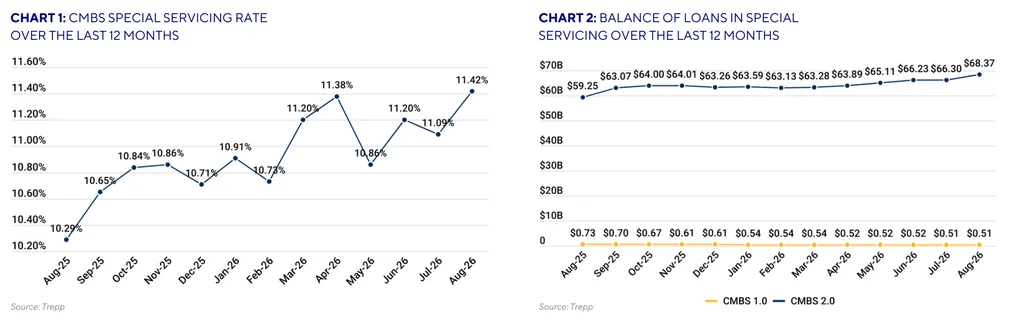
- The overall CMBS special servicing rate rose 33 basis points in August to 11.42%, its highest level since February 2013.
- New transfers totaled $3.16B across 32 whole loans, with large office and mixed-use maturities driving most of the increase.
- Only about $500.7M across 14 loans exited special servicing, leaving upcoming office and mixed-use maturities as the key near-term pressure point.
Trepp’s August report shows that large maturity defaults pushed the CMBS special servicing rate higher after July’s decline. The overall rate increased 33 basis points to 11.42%, the highest since February 2013. New transfers reached $3.16B across 32 whole loans, nearly twice July’s total. Loans that cured, returned to master servicing, or paid off totaled only about $500.7M across 14 whole loans.
Get Smarter about what matters in CRE
Stay ahead of trends in commercial real estate with CRE Daily – the free newsletter delivering everything you need to start your day in just 5-minutes
The Details
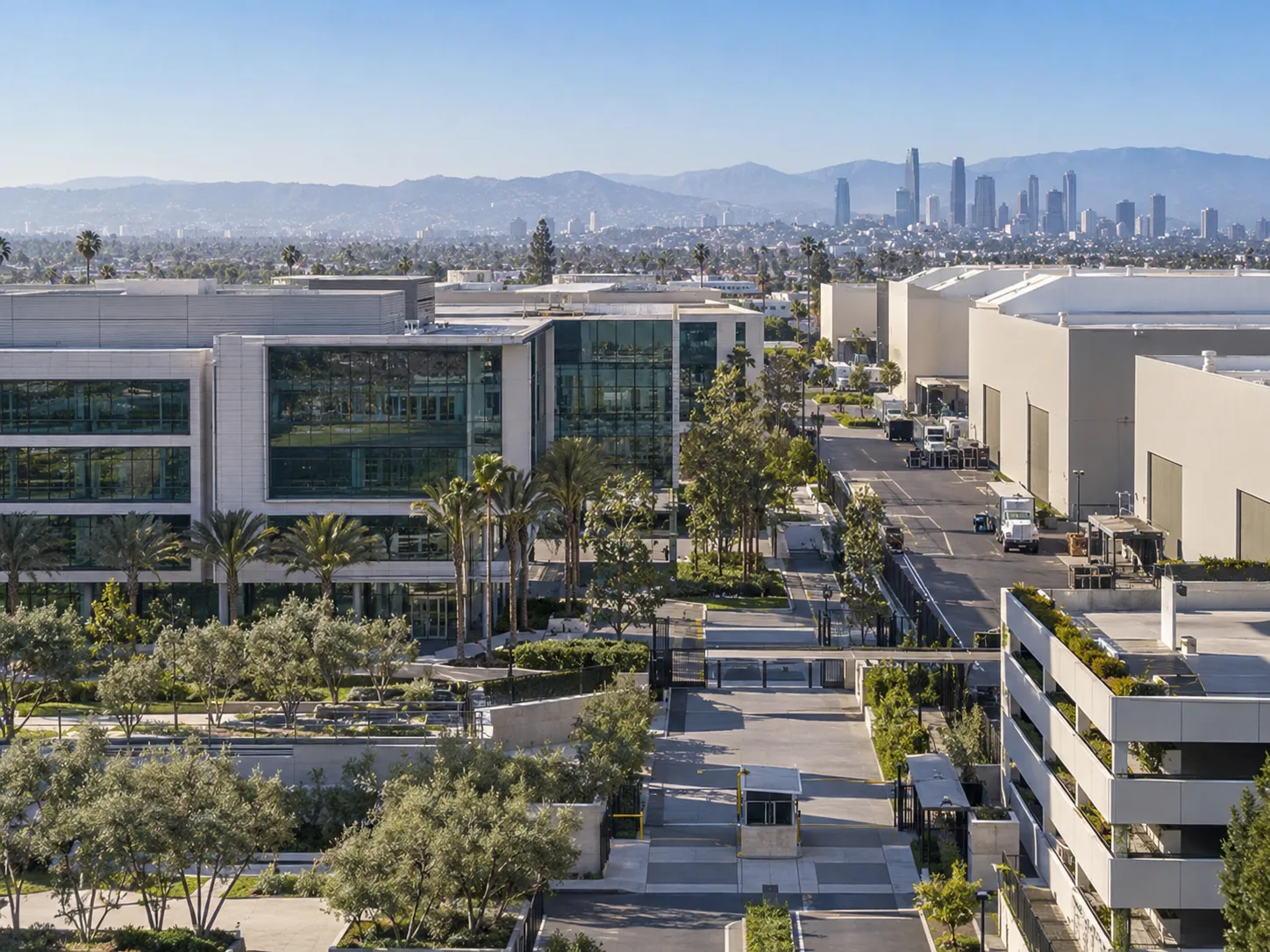
The biggest transfer was the $1.10B Los Angeles Office/Studio Portfolio, which Trepp had identified as August’s largest hard maturity. The floating-rate loan is backed by a Hollywood studio-and-office portfolio and represents the full BXHPP 2021-FILM single-asset deal. It transferred before its August 9 maturity after exhausting extension options.
The loan remained current at maturity and reported a 1.45x debt service coverage ratio on net cash flow. The borrower and special servicer agreed on a framework for a longer extension and executed a 30-day extension while documents were completed. Because Trepp classifies the collateral as mixed-use, the loan accounted for essentially the entire 154-basis-point jump in that category.
Office Stress Remains Concentrated
The second-largest transfer was the $377.6M Project James loan, secured by eight office buildings in greater Washington, DC. It moved to special servicing for an imminent balloon and maturity default. Unlike the Hollywood portfolio, the loan failed to pay off at maturity and carried a non-performing matured balloon status. Its latest DSCR was 1.30x.
Other large transfers included 111 Livingston Street and 60 Madison Avenue in New York, the Hyatt Regency New Orleans, Fresno Fashion Fair Mall, and Harlem USA. Trepp noted that several loans were still current when transferred. That pattern shows how August’s rise was driven heavily by refinancing and maturity pressure rather than only missed monthly payments.
The increase extends CMBS special servicing pressure that has remained elevated across office and retail collateral.
Property Types Move in Different Directions
Office special servicing rose 32 basis points to 16.90%. Retail also climbed 32 basis points to 13.60%, while lodging added 11 basis points to reach 8.74%. Mixed-use jumped 154 basis points to 13.47% because of the Los Angeles portfolio.
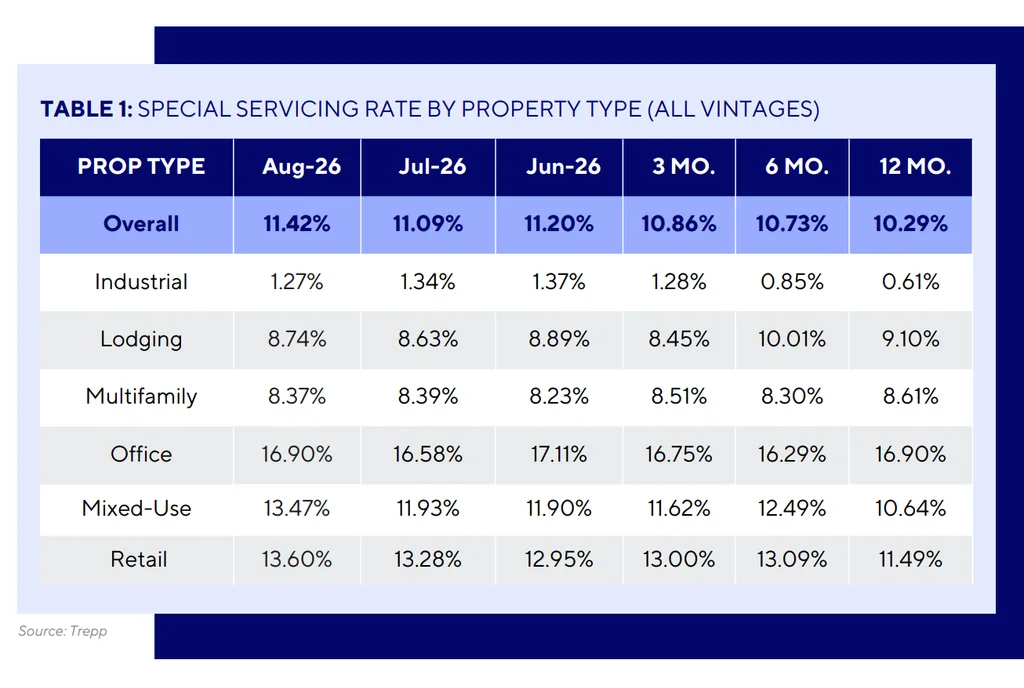
Industrial and multifamily were the only property types to improve. Industrial fell seven basis points to 1.27%, while multifamily edged down two basis points to 8.37%. The overall CMBS 2.0-plus rate reached 11.35%, up from 10.18% one year earlier.
The old CMBS 1.0 pool remains much more distressed, with a 61.96% special servicing rate in August. That was down from 67.30% one year earlier but above 60.85% six months earlier. Trepp’s CMBS 2.0-plus rate, which covers post-financial-crisis issuance, stood at 11.35% versus 10.18% a year ago.
Exits Stay Well Below New Transfers
The largest exit was $117.3M of the Penn Square Mall loan. Two conduit pieces returned to master servicing after a March 2026 modification. The borrower contributed $30M of new equity, mostly for principal reduction, and the maturity was extended to January 2028 with an excess-cash-flow sweep.
An $88M portion of the $182M 3 Park Avenue office loan was the second-largest exit. It returned to the master servicer, while the remaining pieces were expected to follow. No other single exit exceeded $60M, leaving the volume of resolutions far below the month’s new transfers.
What’s Next
Trepp said the upcoming hard-maturity schedule is weighted toward large office and mixed-use loans. Their ability to refinance will determine whether the special servicing rate keeps climbing or whether maturity-driven transfers begin to ease.
August demonstrated how quickly a handful of large loans can move sector rates. It also showed that a loan can enter special servicing while still current if its maturity arrives without a clear refinancing or repayment path. For CMBS investors and borrowers, the next wave of large maturities is therefore the key near-term test.