




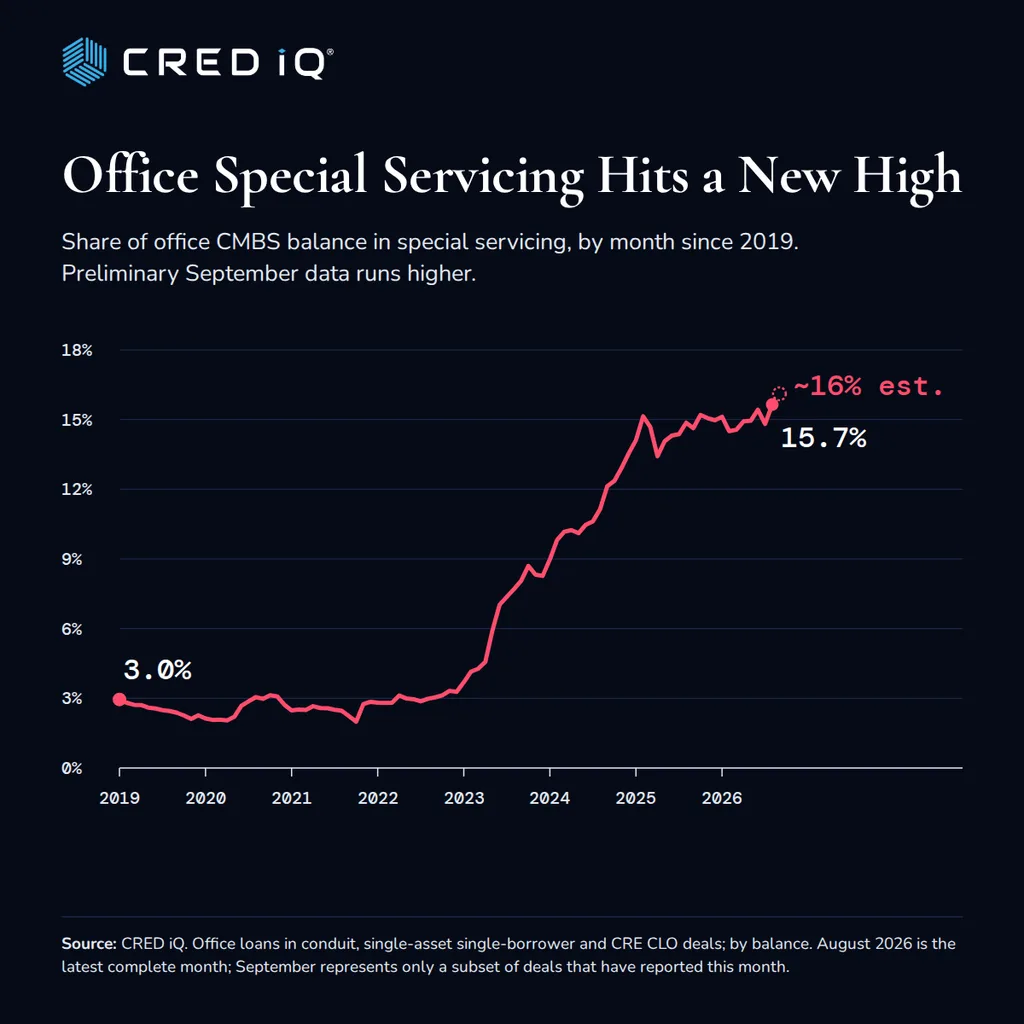
- Office CMBS delinquency reached 13.2% in August, while the special servicing rate hit 15.7%, both highs since at least 2019.
- About 71% of distressed office balance is tied to failed or imminent refinancing rather than missed monthly payments.
- CRED iQ found 51% of office transfers over the past year were current at transfer, typically about 11 months before maturity.
CRED iQ says office distress reached new highs in August as more loans moved into workout channels before payment defaults. Its August office CMBS distress analysis puts delinquency at 13.2%. The special servicing rate reached 15.7%. Both are the highest readings since at least 2019. The data cover $189.6B of office debt across conduit, single-asset single-borrower, and CRE CLO transactions.
Get Smarter about what matters in CRE
Stay ahead of trends in commercial real estate with CRE Daily – the free newsletter delivering everything you need to start your day in just 5-minutes
Refinancing Risk Drives the Distress
Office delinquency rose from 8.1% in July 2024. It is now about 1.6 times the 8.2% rate across all property types. Excluding performing matured loans, office delinquency is 9.8%. The special servicing rate increased from 10.6% in July 2024 and 14.9% a year ago.
Most of the increase occurred between mid-2024 and mid-2025. Delinquency then held between 11.5% and 12.5% from September 2025 through July 2026 before jumping again in August. Conduit office is the weakest segment. It is 14.4% delinquent and 18.5% in special servicing. SASB office is lower at 10.7% delinquent and 11.5% in special servicing.
The Details
Maturity problems are the dominant trigger. CRED iQ says 71% of distressed office balance reflects a failed or imminent refinancing, not missed payments. Over the past 12 months, 51% of office loans sent to special servicing were still current at transfer. The share was 42% in the prior 12 months.
The median transfer came about 11 months before maturity. That suggests borrowers and master servicers are increasingly addressing refinancing problems before a balloon date passes. One SoHo Square, backed by roughly $469M of CMBS notes, transferred while current. The transfer occurred nearly two years before its 2028 maturity.
Early Transfers Often Foreshadow Default
CRED iQ tracked 93 office loans that transferred while current and ahead of maturity between August 2024 and August 2025. By August 2026, 72% had become at least 60 days delinquent or matured without paying off at some point. About 43% were still delinquent or matured unpaid. Only 15% had returned to the master servicer and were current.
Loans already delinquent at transfer performed worse. About 92% of that group reached serious delinquency. The data suggest a current loan can still carry major refinancing risk. Early transfers increasingly appear to reflect expected maturity problems rather than immediate payment stress.
Why It Matters
The pattern extends the rise in CMBS special servicing led by office distress. Full buildings are not necessarily protected. Crossroads III in Sunnyvale has a $209M loan and reported 100% occupancy. Apple is its largest tenant. The loan went to special servicing in August after one extension and received a default notice on September 1.
In Rockville, Maryland, the $138M GSK R&D Centre loan transferred ahead of its 2027 maturity. Its sole tenant had vacated even though the property still reported full occupancy. The cases show why reported occupancy alone may not capture refinancing risk, particularly when lease rollover or tenant departures threaten future cash flow.
Large Loans Show More Workout Flexibility
Loan size changes the outcome somewhat. Among current-at-transfer loans below $100M, 74% later defaulted at some point. Only 11% were back with the master servicer by August. For loans of $100M or more, the default rate was 63%. About one-third had returned to the master servicer by August, including some that experienced a period of default.
Willis Tower and 1211 Avenue of the Americas both transferred while current and later returned. CRED iQ says early transfer for larger loans can function more as a restructuring entry point than a foreclosure signal. Larger balances may provide more flexibility to negotiate extensions or other workout terms.
What’s Next
The maturity calendar keeps pressure elevated. About $39B of office CMBS matures over the next 12 months. CRED iQ says $13.9B is not yet distressed but already shows warning signs. Those include debt service coverage below 1.25x, occupancy declines of at least 10 percentage points, or recent watchlist additions. The largest include $1.13B at 3 Bryant Park and $1.08B at 280 Park Avenue, where debt service coverage is 0.72x.
Recent vintages show why servicers are acting early. Ten-year office loans originated in 2015 and 2016 paid off at maturity at rates of 47% and 44% by balance. Other property types reached 79% and 76%, respectively. Distress among 2016 office loans also increased 35 percentage points over the past year to 51% of balance.
September reporting so far shows office delinquency above 14% and special servicing above 16%. With another $39B approaching maturity and a sizable share already showing warning signs, early intervention is likely to remain common if refinancing conditions stay difficult.