





- CRED iQ data showed multifamily LTV rose to 62% while its average loan rate fell to 6%.
- Office LTV increased to 49.5%, but weaker coverage metrics show lenders are still underwriting the sector cautiously.
- Retail, industrial and self-storage deals carried lower leverage, pushing more of the capital requirement back to sponsors.
Commercial Observer reports that lenders are concentrating leverage in multifamily and, more selectively, office. Its review of conduit CMBS lending draws on CRED iQ data. CRED iQ data show borrowing rates eased over the past year. Most property sectors still required more sponsor equity. The result is a market that is selective about where cheaper debt translates into higher proceeds.
Get Smarter about what matters in CRE
Stay ahead of trends in commercial real estate with CRE Daily – the free newsletter delivering everything you need to start your day in just 5-minutes
The Details
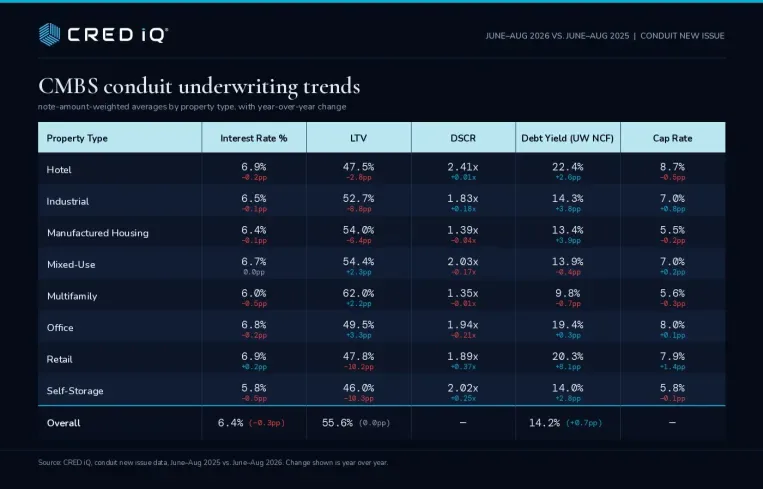
Multifamily received the clearest improvement in terms. CRED iQ found that average loan-to-value rose 2.2 percentage points to 62%. That was the highest level among the property types studied. At the same time, the average rate fell 50 basis points to 6%. Debt yield slipped slightly, meaning lenders accepted somewhat less income cushion while extending more leverage.
Office also gained leverage, but the credit profile was different. CRED iQ reported that office LTV rose 3.3 percentage points to 49.5%. Debt service coverage fell by more than 0.2x to 1.94x, while debt yield increased. Commercial Observer characterized the pattern as more aggressive lending against office collateral without a wholesale return of confidence.
For multifamily borrowers, the combination of higher leverage and lower rates stands out as the clearest positive signal in the dataset.
Other Sectors Give Up Leverage
Retail moved sharply in the opposite direction. CRED iQ data showed retail LTV falling 10.2 percentage points to 47.8%. Debt yield jumped 8.1 points to 20.3%. Self-storage and industrial also posted leverage declines of roughly 6 to 10 points. Debt yield and debt service coverage improved in both sectors.
Hotel remained the most conservative category in the dataset. CRED iQ put hotel debt yield at 22.4%, the highest level among the sectors reviewed. Its rate and LTV eased only modestly, leaving the structure priced for more downside than the headline borrowing cost alone would suggest.
Commercial Observer noted that these lower-leverage sectors are not necessarily distressed. In fact, debt service coverage improved in retail, self-storage and industrial. The shift instead shows lenders using stronger operating coverage to demand more sponsor equity rather than increasing proceeds.
Why It Matters
The blended conduit LTV was unchanged at 55.6%, but CRED iQ said that stability masks a major shift in loan mix. Multifamily increased from about 31% of loan count to roughly 43%. That heavier weighting helps keep the aggregate leverage figure steady even as several sectors receive materially less debt.
The pattern shows that lower rates are not producing an across-the-board loosening in CMBS lending. Sponsors in retail, industrial and self-storage are still being asked to fund more of the capital stack. Meanwhile, multifamily is absorbing a larger share of conduit activity, and office is receiving more leverage with narrower operating coverage.
CRED iQ described the flat blended LTV as a mix effect rather than evidence of stable underwriting. The same average can hide very different risk appetites when multifamily represents a much larger share of conduit loans and other sectors are receiving less leverage.
That concentration also makes office and multifamily performance more important to conduit issuance. Recent office and multifamily distress has already shown how quickly sector-level credit pressure can affect servicing metrics.