







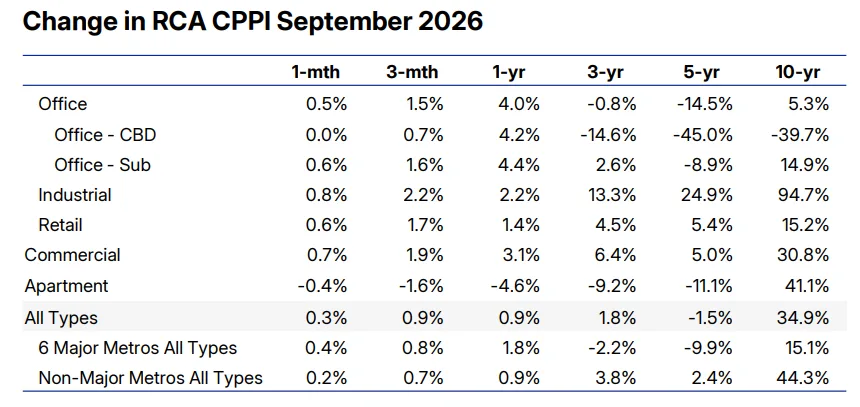
- Prices rose 0.9% over the year through September and 0.9% in the third quarter alone, an annualized 3.6%, even as the Fed raised rates for the first time since 2023.
- Suburban office led with 4.4% annual growth, industrial hit an all-time high in September, and retail gained 1.7% in Q3, lifting non-apartment prices 3.1% over the year.
- Apartment prices fell 4.6%, the fourth straight annual decline, and sit 23% below their July 2022 peak, while Minneapolis, the DC metro and San Francisco gained roughly 11%.
U.S. commercial property prices are 0.9% higher than a year ago through September, the best annual reading since December 2025, per MSCI’s index, as GlobeSt reported.
Momentum is stronger than that headline suggests. The index gained 0.9% over just the third quarter, equal to a 3.6% annual pace, and rose 0.3% in September alone, even though that month brought the Fed’s first rate hike since 2023.
Get Smarter about what matters in CRE
Stay ahead of trends in commercial real estate with CRE Daily – the free newsletter delivering everything you need to start your day in just 5-minutes
Buyers Paid Up Anyway
The old assumption was that values would rebound only after borrowing got cheaper. Instead, CRE financing costs rose in September, hopes for cuts faded, and the Fed’s latest projections point to a higher policy rate by year-end.
GlobeSt’s read is that buyers are showing conviction, but that gains now depend on property performance and pricing, not looser money.
Office, Industrial and Retail Lead
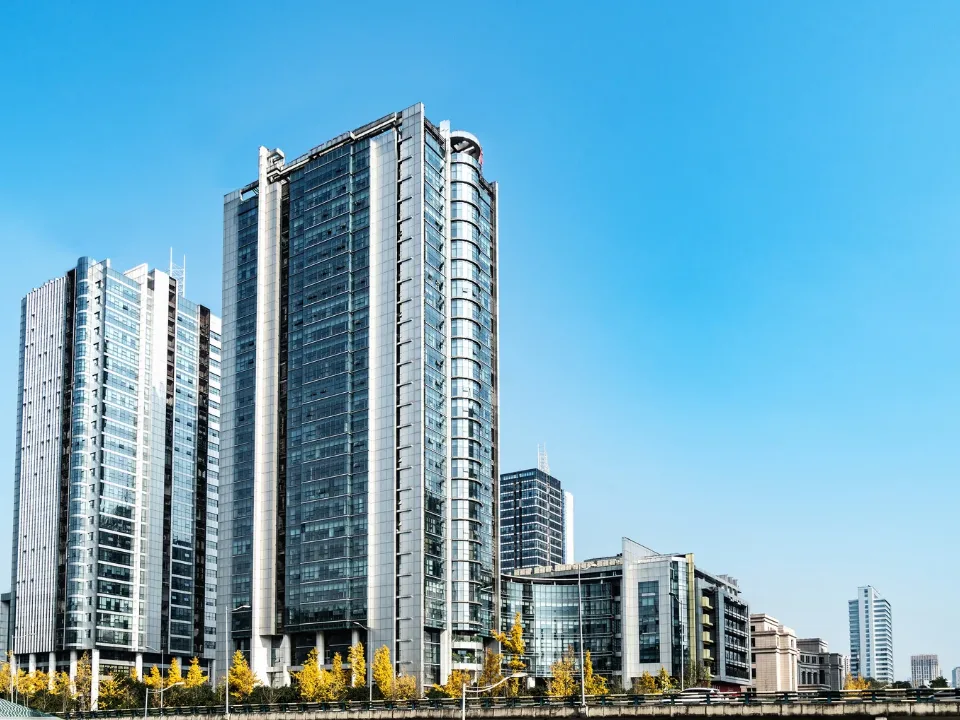
Suburban office posted the best annual growth of any type at 4.4%, including 1.6% in Q3. CBD office is up 4.2% on the year but only 0.7% for the quarter, and it was flat in September.
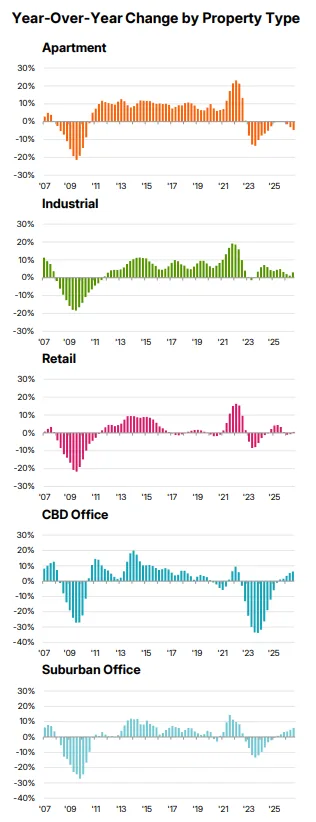
The two segments sit in very different spots relative to their highs. CBD values are 47% under the March 2022 peak, while suburban values are 13% below their July 2022 peak. Downtown has more ground to recover, but the suburbs are moving faster.
Industrial values reached a record in September: 2.2% above last year and 2.2% higher in Q3 alone, which works out to a 9.2% yearly rate. Thirteen straight quarters of annual gains back that up.
Retail is up 1.4% for the year, dragged down by a 1.2% decline in late 2025. The latest quarter added 1.7%, or 7.0% annualized. Take out apartments and the rest of the market gained 3.1% over 12 months.
Apartments Drag
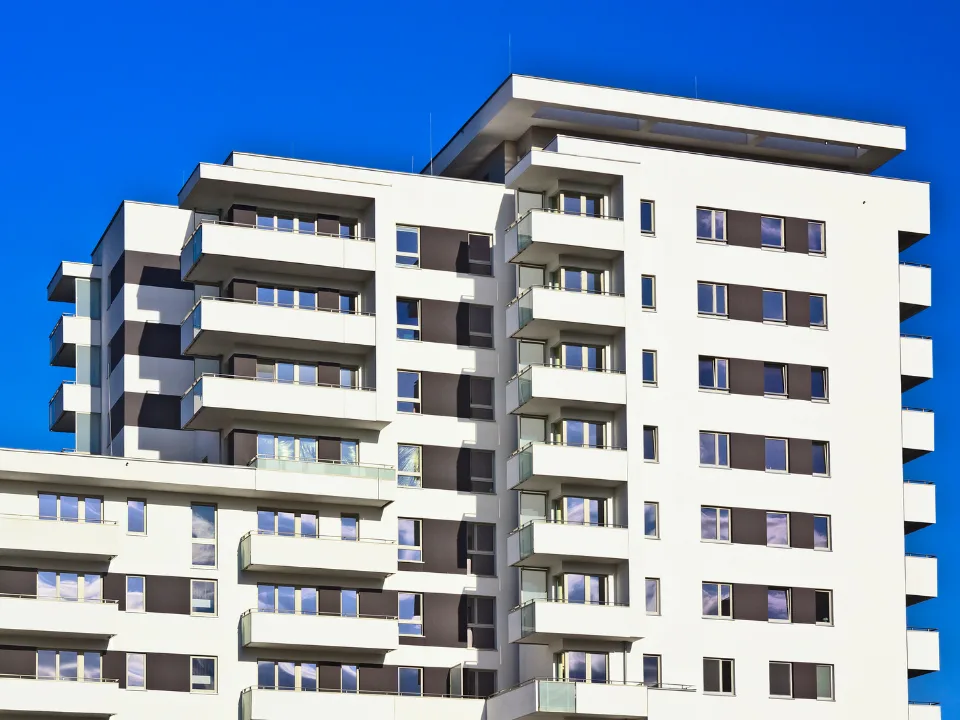
Multifamily is moving the other way. Values are 4.6% below a year ago, marking four straight quarters of annual declines. The third quarter alone cost 1.6% (6.2% annualized), and September subtracted another 0.4%.
At 23% below the July 2022 high, the index is still sliding. CRE Daily recently reported that apartment sales were running 6% behind last year through August with the 10-year Treasury near a 25-year high.
Major Metros Take the Lead
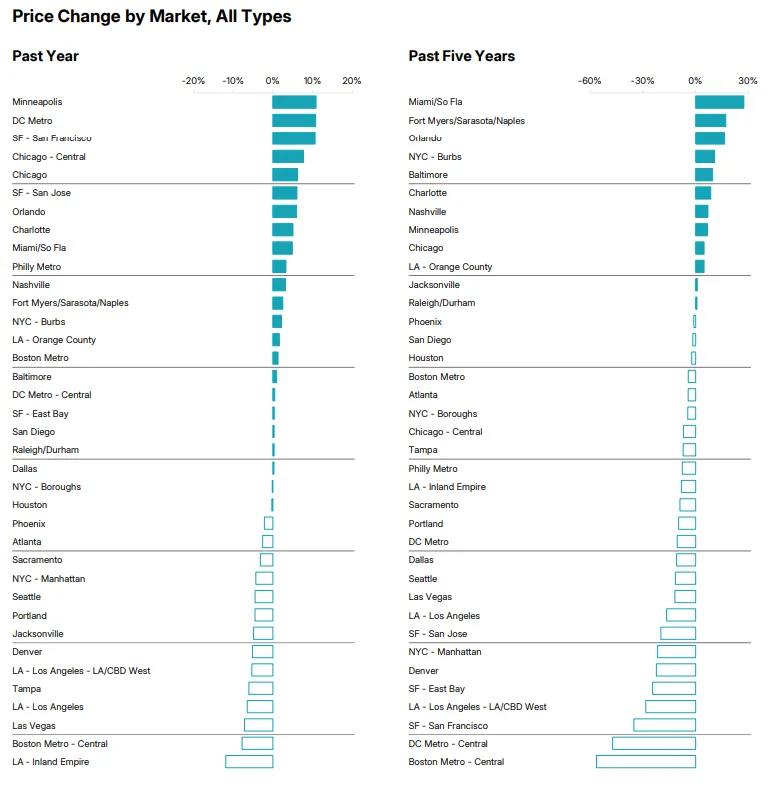
Geography has shifted. The six major metros, including New York and Boston along with Chicago, Los Angeles, San Francisco and DC, combined for 1.8% annual growth, twice the 0.9% in all other metros.
Three markets stood out at roughly 11%: Minneapolis, San Francisco and the DC metro. Central Chicago was up about 8%, while Orlando, San Jose and the wider Chicago area each added around 6%. Charlotte and South Florida landed near 5%.
The worst performer was the Inland Empire at roughly negative 12%, notable given record industrial pricing nationally. Central Boston dropped about 8% and Las Vegas about 7%, with Los Angeles and Tampa each down around 6%.
Metros contain wide internal gaps. DC’s metro area rose about 11% while its center barely changed, and Boston’s metro area edged up about 1% as its core slid about 8%.
Why It Matters
Apartment owners are caught between falling values and expensive refinancing, which makes multifamily the main brake on the broader recovery.
Capital is still available if you are selective. Colliers’ Q3 snapshot, covered by CRE Daily, found capital stays selective while deals kept closing despite higher Treasury yields.
What’s Next
With refinancing costs expected to stay high and Fed projections showing further increases by year-end, the pressure on leveraged owners is unlikely to lift soon.
Two things to watch: whether CBD office keeps gaining after a flat September, and whether the apartment slide continues to accelerate.