









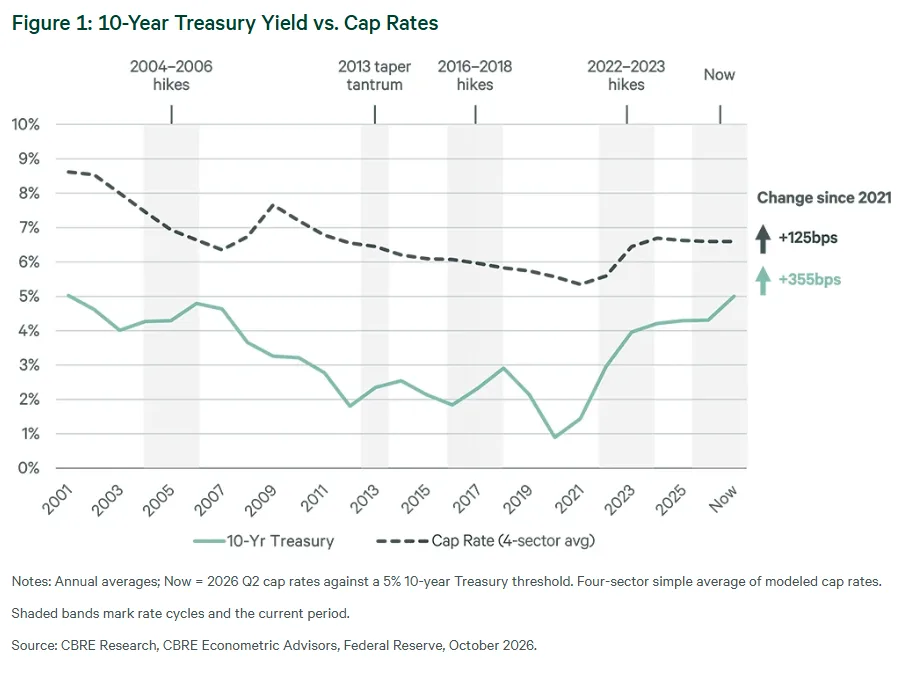
- The 10-year Treasury has held near or above 5% since Sept. 10, compressing the average cap rate spread to about 160 bps, versus a roughly 325 bps long-run average.
- Cap rates should rise at least 40 to 60 bps, implying value declines of 6% to 10%, with multifamily and industrial hit hardest because spreads there are under 100 bps.
- Prime office and retail, CRE debt and discounted Sun Belt multifamily offer the best openings, with investment expected to slow for six months before recovering in the second half of 2027.
CBRE Research projects that cap rates will climb at least 40 to 60 basis points because the 10-year Treasury yield is parked near 5%.
Applied to prices, that implies average values drop 6% to 10%. The Treasury has traded at or above roughly 5% since Sept. 10, a level not seen since 2007.
Get Smarter about what matters in CRE
Stay ahead of trends in commercial real estate with CRE Daily – the free newsletter delivering everything you need to start your day in just 5-minutes
The Spread Has Vanished
CRE cap rates now offer a premium of about 160 basis points over the 10-year Treasury. That’s the thinnest spread on record and roughly half the long-term norm of 325 basis points.
Normally, a wide spread cushions investors when Treasury yields rise. However, that buffer has nearly disappeared. As a result, higher rates now put much faster pressure on property prices.
Buyers and sellers already feel the impact. They are renegotiating contracts, while some owners have replaced planned sales with refinancings.
Who Gets Hit First
Multifamily and industrial properties have the smallest cushions. Their spreads fall below 100 basis points, making them more vulnerable to sharp repricing.
By contrast, prime office and retail properties have wider spreads. Therefore, their cap rates should move less dramatically. Both sectors also face limited new construction, while logistics completions have slowed. Together, these conditions help support demand.
Sun Belt apartments face greater pressure. Too much new supply is competing for tenants, and many loans are approaching maturity.
Zoom Out
CBRE executives made a similar argument during the firm’s third-quarter earnings call. As CRE Daily reported, they said buyers and sellers must reprice deals as interest rates climb.
Why It Matters
Buyers with substantial equity and debt funds have the strongest position. Meanwhile, more expensive financing reduces the number of potential bidders. CBRE also ranks CRE debt as the most compelling investment opportunity right now.
Nevertheless, deals continue to close. Some owners have grown tired of waiting, while others must address upcoming loan maturities. That pressure is mounting. CRE Daily reported that $733B comes due in 2027, as lenders become less willing to extend loans.
What’s Next
Transaction activity could slow over roughly the next six months. However, CBRE expects a recovery once interest rates stabilize.
The firm forecasts lower long-term yields starting in 2027. It also expects the Fed to cut short-term rates in 2028. Consequently, deal volume could rebound in the second half of 2027, provided no major macroeconomic shock occurs.
CBRE believes this cycle differs from the rate hikes of 2022 and 2023. Although risks remain, the firm expects long-term rates to settle more quickly than they did after the pandemic. It attributes that outlook partly to easing inflation from supply shocks.