








- Half of occupiers rate facilities management 8 or higher on strategic impact, a share expected to reach 82% by 2030, while cost-center operators fall from 16% to 6%.
- Some 45% are scaling or optimizing AI in FM today, versus 86% projected by 2030, and robotics use is set to climb from 37% to 71%.
- The workforce is the weak point: nearly 70% report disruption from trades and AI skills gaps, yet fewer than 45% feel prepared, and 75% say procurement lags their FM ambitions.
JLL’s 2026 facilities management report finds half of occupiers already see FM as a source of competitive advantage, and 82% expect to by 2030.
The study, released Oct. 27 and drawn from 1,321 firms in 15 countries, also finds AI adoption accelerating and a workforce gap threatening the plan.
Get Smarter about what matters in CRE
Stay ahead of trends in commercial real estate with CRE Daily – the free newsletter delivering everything you need to start your day in just 5-minutes
From Cost Line to Lever
JLL defines strategic operators as occupiers that rate facilities management (FM) at 8 or higher on a 10-point impact scale. Today, they represent 50% of respondents. By 2030, JLL projects that share will reach 82%.
Meanwhile, companies that view FM as pure overhead are becoming less common. These occupiers rate its impact at 5 or below. Their share is expected to fall from 16% to just 6%. Furthermore, about four in five occupiers expect FM to receive C-suite attention by 2030.
Even skeptics are changing their views. Among occupiers that currently rate FM at 7 or below, 86% expect their score to rise. On average, they anticipate an increase of 2.2 points.
AI and Robotics Scale Up
AI adoption in FM is also accelerating. Currently, 45% of occupiers are scaling or fine-tuning AI. By 2030, that figure is projected to reach 86%. Additionally, 92% of companies still running AI pilots intend to scale up within five years. Robotics adoption is expected to climb from 37% to 71% over the same period.
Strategic operators also plan to invest rather than cut back. Some 64% expect to increase FM budgets, while 58% plan to hire. Another 45% intend to do both. Overall, JLL describes this shift as putting more resources toward a broader range of responsibilities.
Contracts are likely to change as well. By 2030, 87% of respondents expect outsourcing fees to shift away from headcount-based pricing and toward results.
Procurement and Data Lag
Despite these ambitions, procurement remains a major obstacle. Three-quarters of occupiers (75%) say procurement falls behind their FM goals. In addition, 71% split authority over budgets, delivery models and provider selection across two or three functions.
As a result, measuring performance remains difficult. Metrics such as AI productivity gains, energy performance and business continuity can be hard to quantify.
Fragmented data and differences across portfolios create further challenges. A lack of industry standards makes consistent measurement even harder. Meanwhile, no single decision-maker is responsible for reconciling how each function defines success. As companies advance their AI efforts, however, decision-making authority tends to consolidate among fewer, more senior leaders.
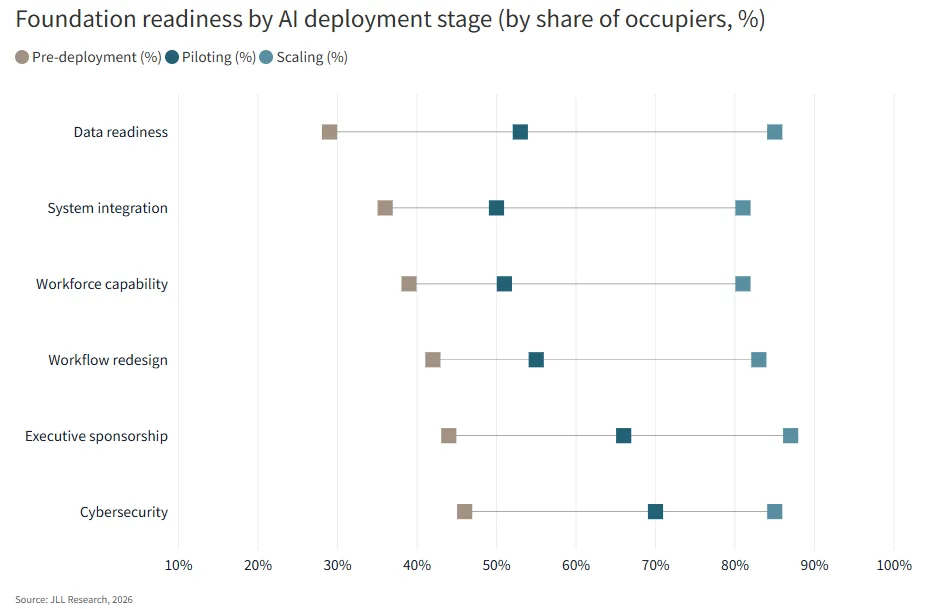
Readiness also varies by stage. JLL identifies six operating foundations needed for progress. Four or more are in place at 32% of pre-AI occupiers, compared with 51% of pilot-stage firms and 85% of those scaling AI. Notably, data remains the weakest link.
Partners Matter More
As AI adoption grows, occupiers increasingly rely on external partners. Among companies scaling AI, 48% consider partners essential. By comparison, only 20% of those yet to deploy AI say the same.
Outsourcing plans show a similar pattern over the next three to five years. Some 58% of scale-stage occupiers expect to outsource more. That compares with 55% of pilot-stage firms and 43% of those before deployment.
However, cost and reliability still dominate vendor selection for some companies. In fact, 39% of AI scalers choose vendors mainly on those factors rather than capability.
The Talent Gap
Workforce shortages remain a major weakness. About 70% of organizations have experienced operational disruptions due to shortages of skilled tradespeople and AI or technical talent. Yet fewer than 45% feel prepared to manage these risks in the medium term.
Several factors are contributing to the problem. Retirements and years of low vocational enrollment have reduced the pipeline of skilled tradespeople. At the same time, modern building systems require more digital expertise.
In response, providers are expanding their capabilities through acquisitions. For example, CBRE’s Onnec deal reflects the industry’s growing focus on AI-driven infrastructure, as CRE Daily reported.
Why It Matters
According to JLL, providers that charge based on labor face growing pressure to price their services based on outcomes. Likewise, occupiers that continue treating FM as a cost line risk falling behind. Owners and operators with clean, reliable data have an advantage as AI adoption expands.
Ultimately, the biggest challenge lies between planning and execution. Strategic operators are increasing budgets, but procurement processes and decision-making authority have yet to catch up.
What’s Next
JLL concludes that execution will determine which companies benefit most. The fastest movers are expanding FM’s role, strengthening their platforms and developing a workforce that can keep pace with changing demands.