







- Colliers says capital is plentiful but elevated base rates are the main hurdle, which pushes underwriting toward income growth and operational upside instead of cap-rate compression.
- Quarter-end cap rates ran 5.4% for multifamily, 7.4% for office, 5.1% for industrial and 8.5% for hotels, with multifamily and mall prices lower year over year.
- Industrial volume averaged $34B a quarter versus a $27B long-run pace, while 12.16% office CMBS delinquency shows the gap between winning and challenged assets will persist.
Money is available for commercial real estate. What it costs is the issue, according to Colliers’ Q3 2026 capital markets snapshot.
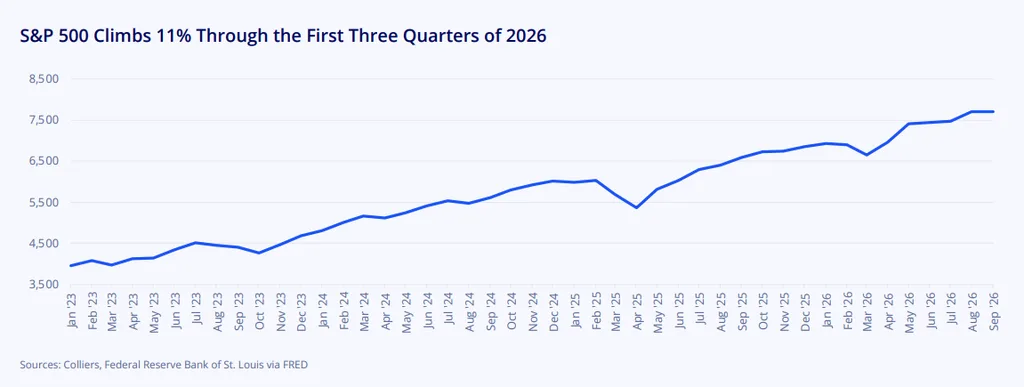
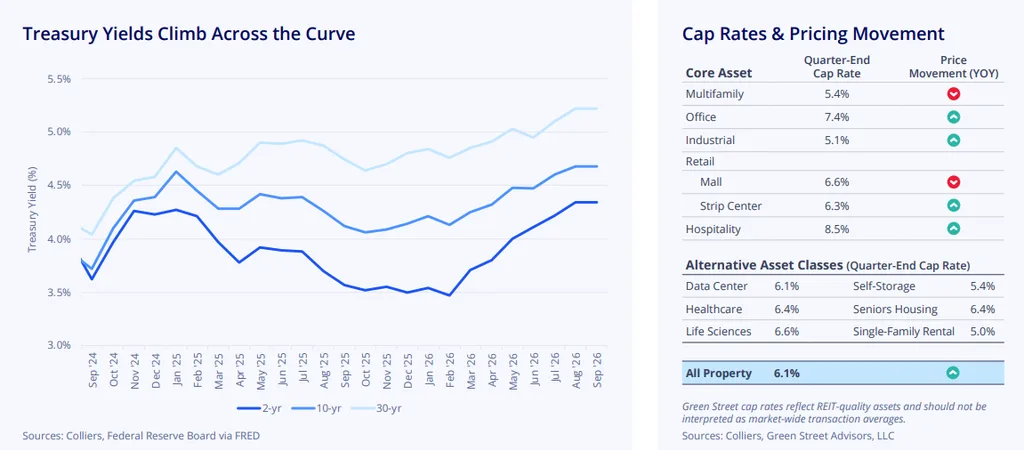
Banks, insurers, private credit and securitized lenders all stayed active, and competition kept credit spreads attractive. Elevated base rates did the damage, especially to long-duration assets. Even so, risk appetite held: the S&P 500 gained 11% through the first three quarters and transaction activity survived higher Treasury yields.
Get Smarter about what matters in CRE
Stay ahead of trends in commercial real estate with CRE Daily – the free newsletter delivering everything you need to start your day in just 5-minutes
Income Growth Over Cap Rates
Colliers says investors are underwriting rent and cash-flow growth, not cap-rate compression. Capital is clustering around assets with little competition and a clear way to improve operations.
Green Street’s quarter-end cap rates put multifamily at 5.4%, office at 7.4%, industrial at 5.1% and hotels at 8.5%. Malls sat at 6.6% and strip centers at 6.3%, with all property at 6.1%. Colliers notes those figures reflect REIT-quality assets, not market-wide averages.
Multifamily and mall prices fell year over year. Every other type in the table rose.
Multifamily Splits by Coast
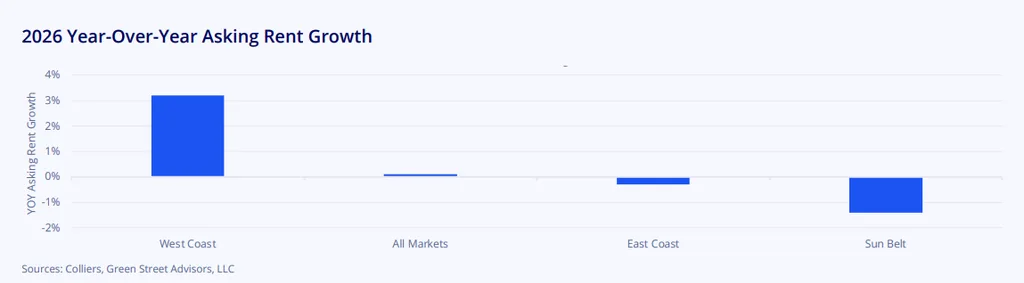
On the West Coast, asking rents climbed 3.2% from a year earlier. The East Coast slid 0.3% and the Sun Belt dropped 1.4%. Colliers credits constrained development and tech demand for the Bay Area’s strength.
Going-in cap rates sit only slightly above borrowing costs, which leaves little positive leverage. Buyers are targeting assets with fading supply pressure. Colliers’ featured multifamily deal was the $233 million sale of the 542-unit Camden Harbor View in Long Beach, Calif.
Office Stress Meets Selective Demand
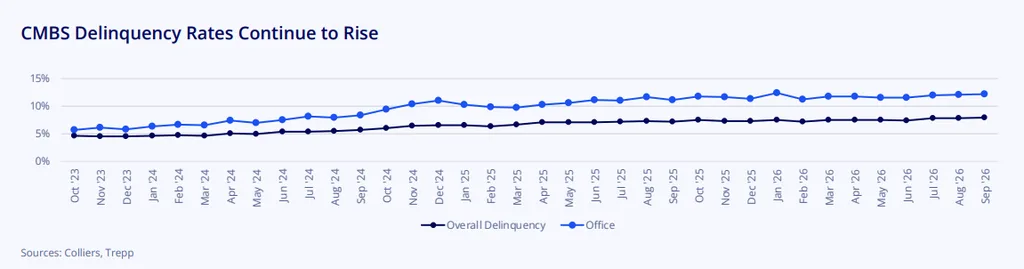
Office CMBS delinquency rose to 12.16% in September, against 8.02% for all CMBS, per Trepp. That tracks with CMBS delinquency reaching its highest level since November 2020.
Colliers says distressed loans are feeding recapitalizations, note sales, restructurings and purchases at reset prices. Underwriting stays disciplined on tenant improvements, leasing commissions, rollover and capital spending, and the most investable deals show a credible path to stabilization without a broad demand recovery. The key office deal was the $435 million sale of One Marina Park Drive, a 525,000 SF Boston property. New York, the Bay Area and Dallas drove activity.
Industrial Stays Liquid
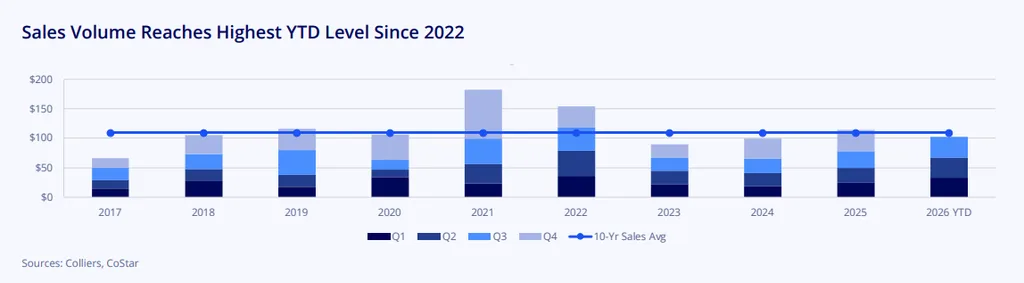
Industrial trading averaged about $34 billion a quarter in the year’s first nine months. The 10-year annual average implies about $27 billion. Bigger portfolio deals boosted the total, and institutions and equity funds are winning back share.
Colliers says supply growth is slowing after years of record construction while positive absorption works through recent deliveries, and high building and financing costs keep speculative development in check. Americold’s nine-property refrigerated portfolio, at $1.3 billion and 3.2 million SF, was the headline sale.
Retail and Hotels Hinge on the Consumer
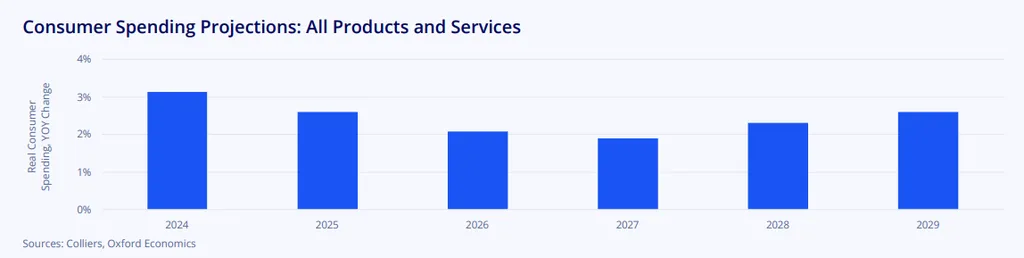
Colliers, using Oxford Economics data, forecasts real consumer spending growth of 2.1% this year and 1.9% next, versus 2.6% in 2025, with a pickup to 2.3% by 2028. Investors still favor grocery and necessity-driven centers. Plaza Bonita, a 1.03 million SF mall in National City, Calif., sold for $202 million.
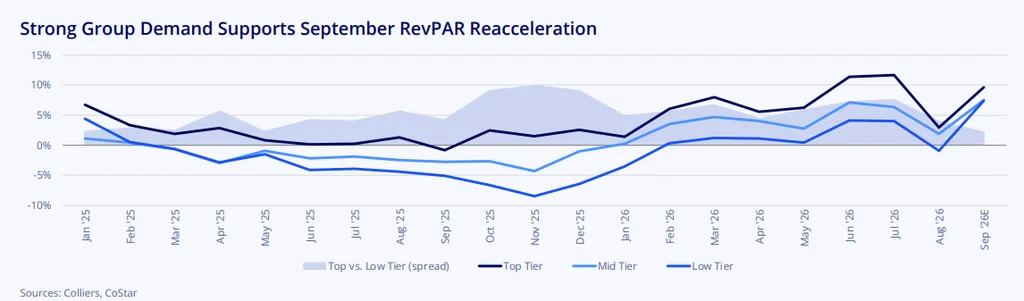
In hotels, the World Cup boosted summer results through June and July, growth cooled in August, and group travel powered a September rebound. Top-tier hotels kept stronger pricing power, while labor, insurance, taxes and utilities squeeze margins. Trinity Investments’ two-property, 1,594-room Orlando portfolio traded for $1.3 billion.
Why It Matters
The recovery is real but narrow. Colliers says the next phase rewards selective deployment and active management, not a market-wide rebound.
Higher rates also keep exposing deals that no longer pencil. That helps explain why retrades are rising as buyers ask for price cuts after bond yields climbed.
What’s Next
For multifamily, Colliers is watching how rents diverge by region, how occupancy recovers and whether CMBS delinquencies climb. For office, it points to AI leasing demand and the inflation trajectory.