



- Public Storage’s $10.5B merger with National Storage Affiliates cements its leadership, boosting market share and highlighting rapid REIT consolidation.
- Advertised self storage rates increased 0.7% month-over-month in June, but annual growth stayed negative at -1.7% as supply growth remains uneven.
- Sun Belt markets face the steepest annual rent declines as new deliveries fuel competition, while Midwest metros like Chicago and Minneapolis post stronger rate resilience due to lower supply levels.
Consolidation Reshapes Sector
Yardi Matrix’s July 2026 National Self Storage Report underscores accelerating industry consolidation. Bisnow reports that Public Storage closed its $10.5B acquisition of National Storage Affiliates (NSA) on July 22, marking the nation’s second-largest self storage transaction ever. With this deal, Public Storage regains the top-ranked footprint in US self storage, now owning 14% of the total SF tracked by Yardi Matrix. The addition deepens PSA’s exposure in Portland, Oklahoma City, and Detroit, all now exceeding 25% local market share. Meanwhile, new locations—mostly in the secondary and tertiary Sun Belt—extend the company’s reach. The sector’s landscape has shifted quickly: smaller mom-and-pop owners with fewer than three stores saw market share fall from 48% in 2014 to just 31% in 2026, while REITs climbed from 23% to 30% of the market, according to Yardi Matrix.
Private equity and third-party management platforms are gaining ground, too: operators with more than 50 stores have doubled their footprint in the last decade, now controlling 22% of US supply. REITs are accelerating this trend, managing nearly half of all new facilities built during the sector’s busiest-ever expansion cycle. For many, the wave of consolidation means fewer independents and higher barriers to entry than at any point in recent memory.
Get Smarter about what matters in CRE
Stay ahead of trends in commercial real estate with CRE Daily – the free newsletter delivering everything you need to start your day in just 5-minutes
The Details
Public Storage’s deal brought its US market share to 14%, per Yardi Matrix, and added 20 new markets to its portfolio. PSA crossed the 25% market share threshold in Portland, Oklahoma City, and Detroit. This merger comes as overall REIT influence expands: the market share of large and midsize private operators also doubled since 2014. Nationally, Yardi Matrix tracks 2,482 self storage projects in various development stages—608 under construction, 1,579 planned, and 295 prospective. Nationwide, new construction activity in June equaled 2.2% of existing inventory, unchanged from May. Meanwhile, the Yardi Matrix database now covers 33,122 completed US facilities, with the total dataset at 35,604 properties.
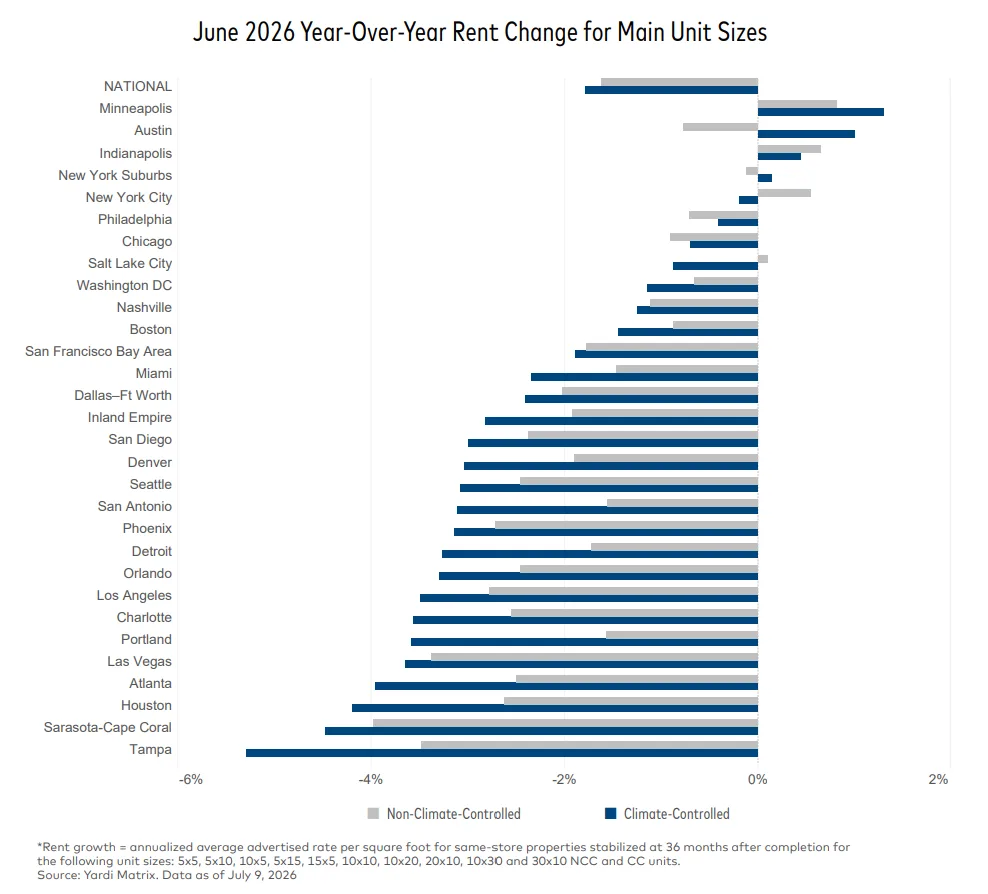
On the rent front, the national average advertised rate for June stood at $16.48 PSF—up 0.7% from May but down 1.7% year-over-year. Eleven out of the top 30 metros saw year-over-year rate improvement compared to the previous month, though the majority remained negative. Midwest locations like Minneapolis and Indianapolis showed rare annual rate growth for both climate-controlled and non-climate-controlled units, while nearly every Sun Belt market continued to report annual declines above the national average.
Rate Pressure Amidst Uneven Supply
While seasonal demand fueled a 0.7% national rate jump between May and June—matching last year’s summer gain—annual rent recovery remains elusive. Yardi Matrix found that advertised rates for climate-controlled units were down 1.8% and for non-climate-controlled units down 1.6% year-over-year. REITs are adjusting pricing more aggressively than private operators: their asking rents dropped 2.8% year-over-year in June, compared to a 1.2% decline for non-REIT players, but REITs logged a stronger sequential gain during the busy leasing season (1.3% vs. 0.5%).
Rate performance is tied closely to supply dynamics. Midwest metros—including Chicago, Indianapolis, and Minneapolis—continue to outperform due to limited new deliveries and restrained development activity. In Chicago, rates advanced 1.9% month-over-month and fell just 0.8% year-over-year, compared to steep losses in oversupplied Sun Belt metros. Recent data also suggests construction pipelines are slowing, which could gradually reduce competitive pressure in healthier markets. By contrast, markets such as Sarasota–Cape Coral, Tampa, and Orlando saw trailing three-year deliveries reach record highs, making their annual rent declines—ranging from -2.9% to -4.5%—the deepest among major metros despite modest month-to-month improvement.
Why It Matters
The self storage industry is at a pivotal moment: steady seasonal rate recovery is now clashing with the aftereffects of years of record supply expansion and accelerating ownership consolidation. According to the July 2026 Yardi Matrix report, national development pipelines remain active, but new construction is finally slowing in some overbuilt Sun Belt markets. Markets like Phoenix, Sarasota–Cape Coral, and Orlando lead the pipeline (6.9%, 5.4%, and 4.8% of inventory under construction, respectively), contributing to greater lease-up competition and a tougher path to rent growth. Over the past three years, 8.8% of total national inventory has been delivered, with Florida cities accounting for some of the highest delivery percentages ever recorded for their markets. That swelling inventory explains why even a robust spring leasing season cannot fully offset year-over-year rent declines at the national level.
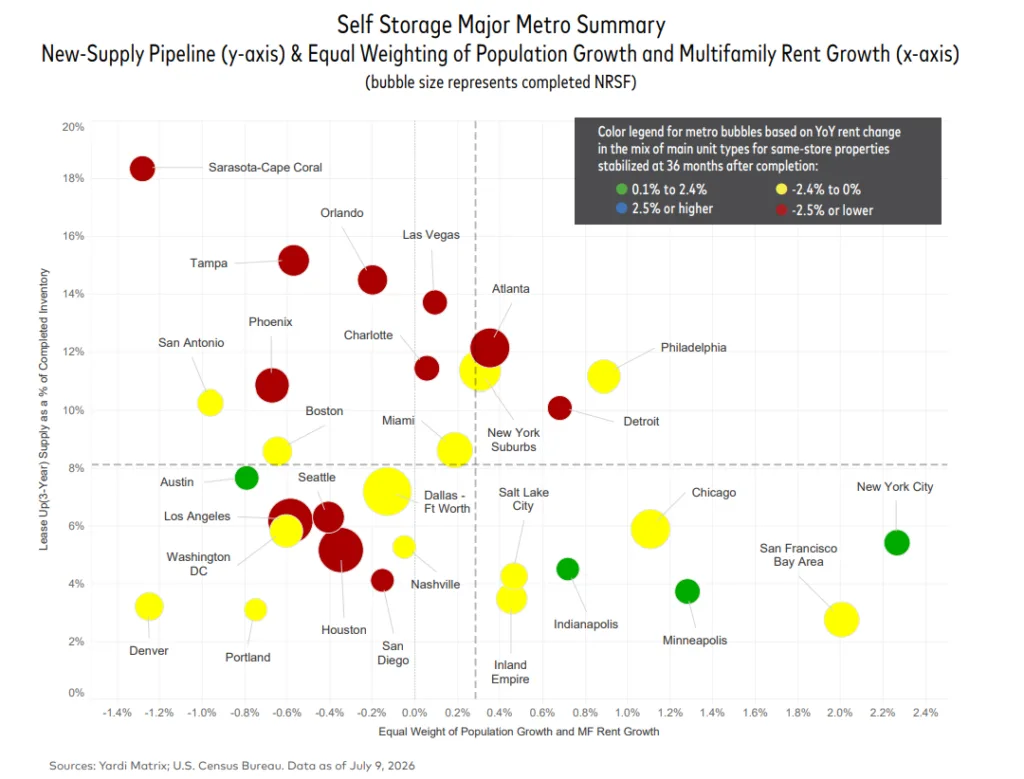
REITs’ outsized share of new management has deepened industry concentration, shifting the competitive landscape for investors, developers, and third-party managers. For smaller owners, the barriers to profitable new development have rarely been higher, especially in overbuilt metros. Meanwhile, several Midwest and core coastal markets are outpacing the Sun Belt on rent growth due to more disciplined supply. The bifurcation between saturated and undersupplied regions makes local supply analysis more important than ever for underwriting or acquisitions—a trend unlikely to reverse quickly.
What’s Next
National self storage supply pipelines are projected to shrink 19% year-over-year in 2026, per Yardi Matrix forecasts—a potential turning point after a decade of breakneck expansion. While overall construction activity is cooling, Sun Belt markets such as Phoenix and Miami still face significant deliveries in the coming months.
Conversely, markets like Minneapolis, Portland, and San Francisco Bay Area show limited ongoing construction, suggesting stronger rate support as new inventory slows. Industry watchers will be tracking whether continued consolidation among major REITs translates into more stable rent performance or further raises the barriers for independent and private operators. The big question: will slowing supply finally spark a sustainable rebound in annual rate growth?