







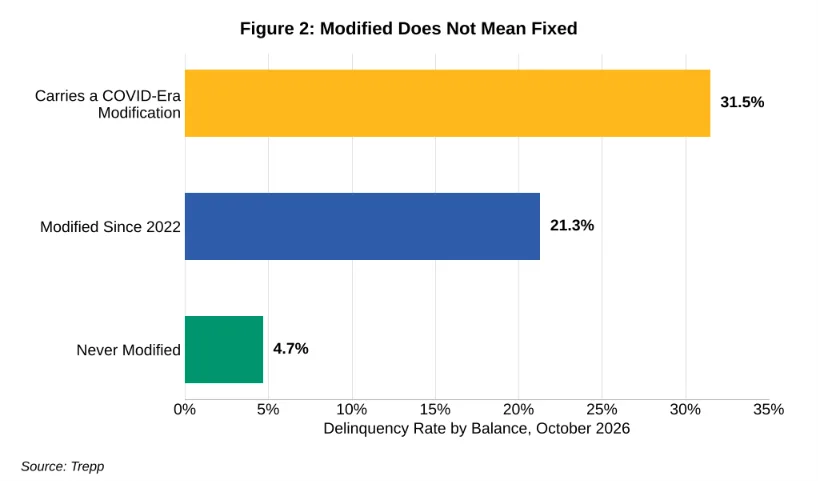
- Servicers have modified 966 CMBS loans with $98.3 billion of balance since January 2022, and 21.3% of the $49.8 billion still outstanding is delinquent.
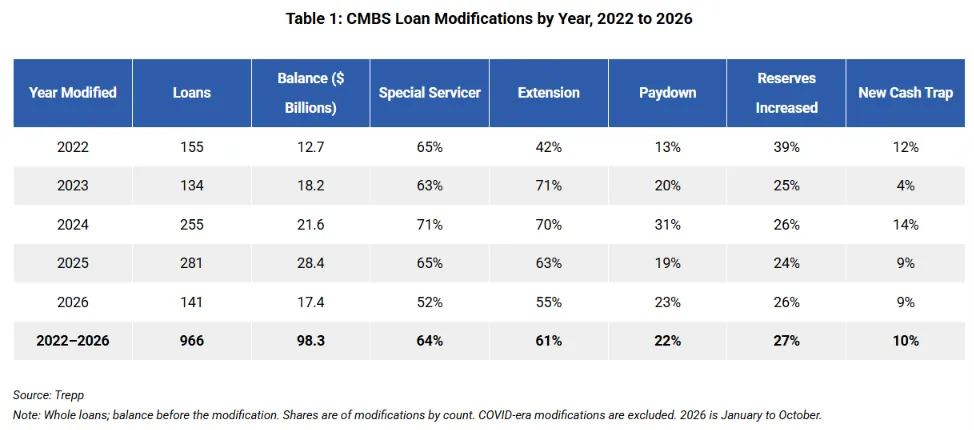
- Most deals only buy time: 61% extended the maturity, typically by 12 months, while just 22% required a paydown and 27% raised reserves.
- Delinquency on modified loans runs more than four times the 4.7% rate for loans never modified, with mixed use the worst major type at 43%.
Since 2022, servicers have reworked $98.3 billion of CMBS loans, and about one in five dollars left on those deals has slid back into delinquency, according to Trepp.
About $49.8 billion of that balance remains. A little over 21% of it is delinquent, versus 4.7% for loans never modified.
Get Smarter about what matters in CRE
Stay ahead of trends in commercial real estate with CRE Daily – the free newsletter delivering everything you need to start your day in just 5-minutes
A Growing Pile of Modified Debt
Trepp tallies 966 modified loans since January 2022. The peak came in 2025, when servicers reworked 281 loans carrying $28.4 billion. So far in 2026, the count is 141 loans and $17.4 billion through October.
Late reporting will push that 2026 figure up, but the year is still tracking behind 2025. Earlier years ran from $12.7 billion in 2022 to $18.2 billion in 2023 and $21.6 billion in 2024.
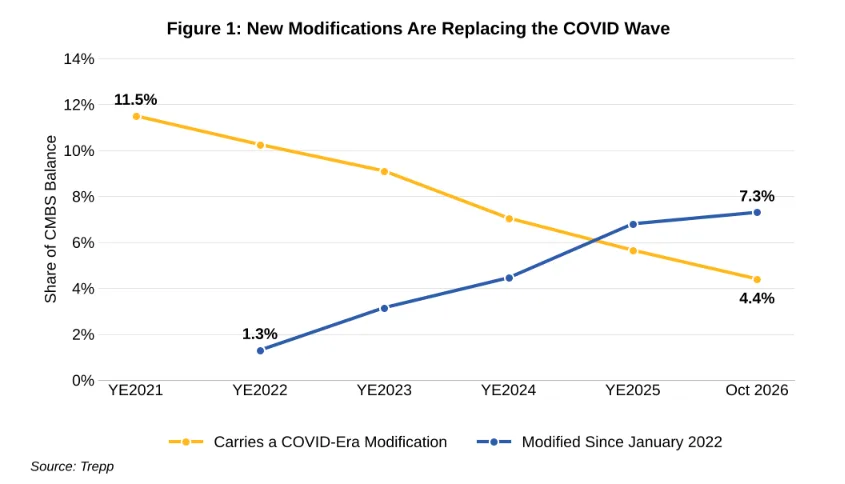
Their weight has grown fast: 7.3% of the CMBS market today, up from just 1.3% when 2022 ended.
Time, Not Money
Servicers mostly bought borrowers time. About 61% of deals pushed out the maturity, usually by a year, and 24% were forbearance agreements.
New money was scarcer. Only 22% of modifications came with a paydown, typically around 5% of the balance, while 27% raised reserves and 10% added a cash trap. By Trepp’s math, at most 49% demanded either, and in some cases the reserves were funded from property cash flow, not fresh borrower equity.
Office Takes Over the Queue
Since 2022, office accounts for 36% of the modified balance, with retail at 21%. Lodging topped the list in 2022 at 31% and has shrunk to 8% this year.
These are not healthy loans. Half had fallen behind on payments sometime in the half-year ahead of the deal.
Modified, Not Fixed
Outside office, the gap is stark. Retail loans that were modified are 24% delinquent, against 2% for retail never touched. Lodging runs 26% versus 1%.
Office looks shaky regardless, at 19% versus 10%. Mixed use fares worst among the big categories at 43%.
Loans still carrying a pandemic-era modification look worse yet. Close to a third of that balance is delinquent, and 47% sits with a special servicer.
Zoom Out
An earlier Trepp study of how loans exit special servicing, which we covered, found modifications shrinking to 37% of resolved balance in 2026 from 54% in 2024, while foreclosures climbed to 23%.
This follow-up shows why servicers are backing away. The loans they did rework are slipping back at a high rate.
Why It Matters
Trepp points to one 2023 office deal as typical: roughly two more years for the borrower, for $500,000 down and $1 million in leasing reserves.
Terms depend on who handles the loan. Paydowns showed up in 28% of special servicer deals but only 10% of master servicer ones, and reserve increases in 36% versus 12%.
Master servicers now handle 48% of modifications, up from 34% in earlier years. That sits against a special servicing rate of 11.74%, a 13-year high, we covered earlier this month.
What’s Next
Special servicer deals often post late, so the gap between servicer types may narrow with more data. Trepp’s takeaway is blunt: extra time alone does not guarantee a lasting fix.