






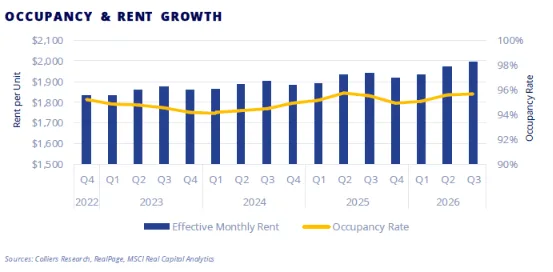
- Occupancy across the top 60 markets edged up to 95.7% in Q3 2026, and effective rent rose to $1,996 a month, per Colliers.
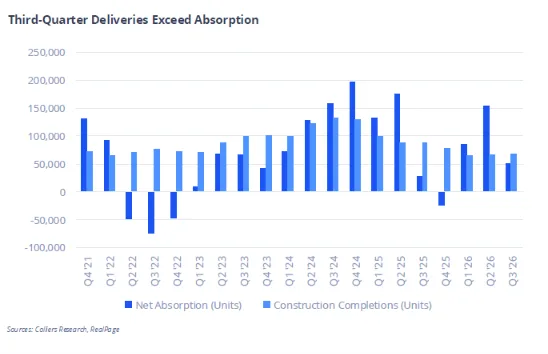
- Units under construction dropped to about 504,000, but absorption of roughly 50,000 units still trailed 69,000 deliveries.
- Excluding the AvalonBay-Equity Residential merger, sales volume fell and prices slid, so operating gains have not reached the capital markets.
U.S. apartments posted 95.7% occupancy in the third quarter of 2026, according to Colliers.
That’s up from 95.6% in Q2 and 95.5% a year earlier, and average effective rent across the top 60 markets climbed to $1,996 a month.
Get Smarter about what matters in CRE
Stay ahead of trends in commercial real estate with CRE Daily – the free newsletter delivering everything you need to start your day in just 5-minutes
Leasing Cools After a Hot Spring
Net absorption slowed to about 50,000 units in Q3, down from roughly 153,000 in Q2. It was still nearly double the 27,000 units absorbed in Q3 2025.
Deliveries outran demand, though. About 69,000 new units opened, so operators are still filling recently finished buildings. Colliers argues the market can keep healing without a repeat of the post-pandemic rush, since fewer new buildings are coming.
The Pipeline Keeps Retreating
Units under construction fell to about 504,000 from 536,000 in Q2 and 540,000 a year earlier. That’s a 6% drop in one quarter.
Trailing four-quarter effective rent growth reached 1.1%, and 40 of the 60 markets saw higher rents than a year ago. Colliers pins the gains on supply-constrained coastal and Midwest metros, while several high-delivery Sun Belt markets are still cutting rents.
Supply Risk Is Concentrated
A handful of big metros hold much of the active development: Northern/Central New Jersey, Dallas, New York, Miami and Phoenix. Colliers expects that to widen the gap between tight markets and those still leasing up.
Vacancy barely varies by class. Class A fell to about 4.7%, and Class B and C finished near 4.9%, as newer buildings filled up and concessions kept renters shopping across price points.
Deals and Prices Haven’t Followed
MSCI Real Capital Analytics counted $114.1 billion in apartment sales in Q3, up 139% year over year. But $69.6 billion, or 61%, came from entity-level deals, chiefly the AvalonBay and Equity Residential merger that formed Vivmark. We covered how the Vivmark merger lifted RealPage’s sales tally to $208.1B for the year ending Q3.
Strip those out and Top 60 volume fell nearly 12% to $30.3 billion. Single-asset sales slipped 10%, and portfolio sales dropped 20.1%. Apartment prices are down 4.6% from a year ago on the RCA index, and the hedonic cap rate crept up roughly 20 basis points to 5.9%.
Distress Is Building at the Edges
Multifamily CMBS delinquency hit 8.04%, up from 2.62% in Q4 2023, per Trepp data in the Colliers report. Colliers says the weakest loans share a few traits: imminent maturities, heavy leverage, floating rates or a glut of new competing buildings.
We saw it play out when Brookfield handed back the Beaudry, a Los Angeles tower with a $357M mortgage. For buyers with cash, Colliers sees more chances to buy at a lower basis.
Seniors Housing Steals the Spotlight
Colliers’ Q3 spotlight found seniors housing occupancy at 90.7%, a 10-year high, with average rent up 4.7% to $5,699 a month. Active construction is just 26,108 units, down 64% from the early 2020 peak.
Capital has noticed. Sales hit a record $20 billion year to date at a 7.4% average cap rate.
Why It Matters
Operators are in better shape than owners and lenders. Occupancy is climbing and the pipeline is shrinking, yet prices are lower than a year ago and refinancing risk stays high.
Colliers says a real recovery in sales would show sustained growth in single-asset deals alongside stable prices. That hasn’t happened yet.
What’s Next
Colliers expects occupancy to edge lower in 2027 as the 500,000-plus units still underway keep delivering. Rent growth will hinge on local supply and how fast renters absorb new buildings.
Inflation is the other wildcard. It could cap rent increases while pushing up operating costs, which would keep real NOI growth under pressure. The same dynamic shows up in Yardi’s forecast of a 22% drop in 2026 deliveries.