






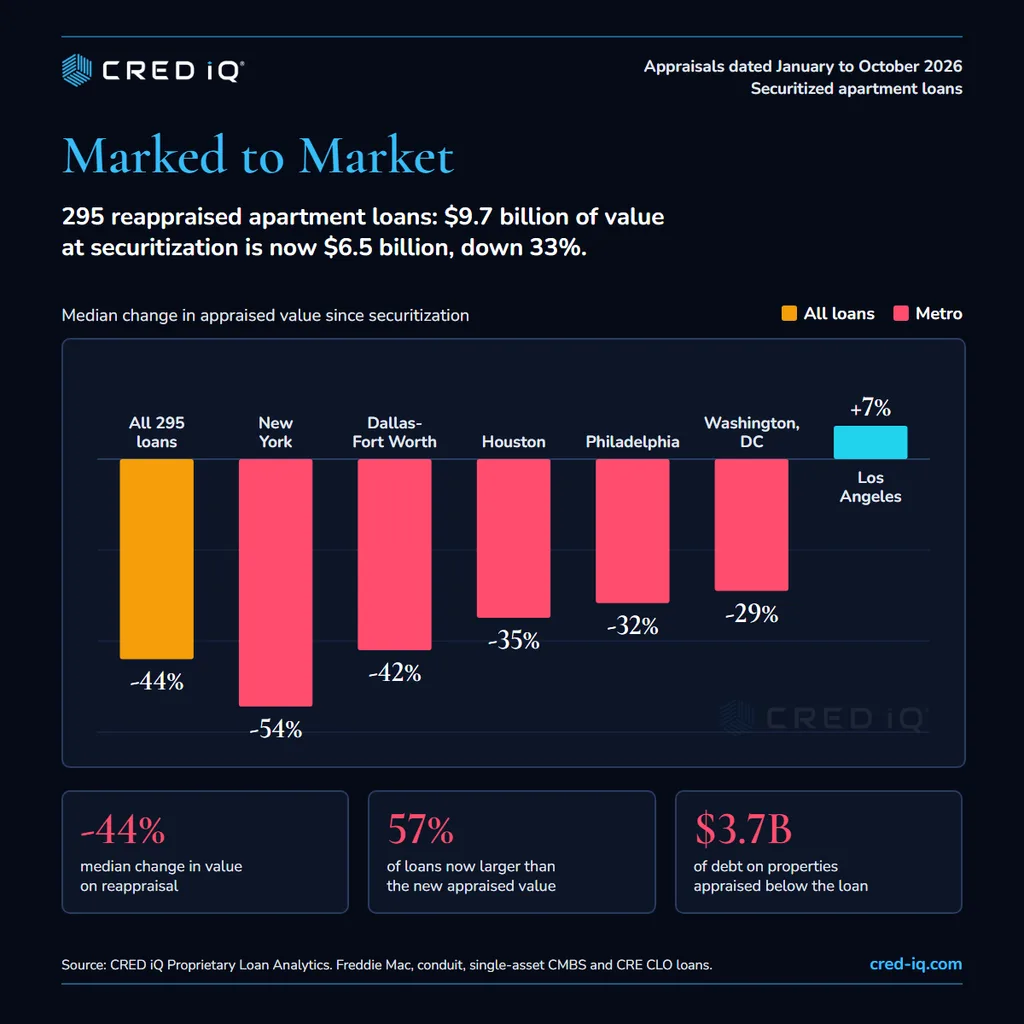
- CRED iQ found 295 securitized apartment loans reappraised in 2026 fell from $9.7 billion at securitization to $6.5 billion, a 33% drop, with a 44% median loss.
- Most of these loans were already troubled: 92% were delinquent or in special servicing, and their median loan-to-value ratio rose from 63% to 101%.
- The deepest cuts hit small New York buildings, where the median property lost 54%, while 2023 through 2026 vintages lost 39% in aggregate.
New appraisals on 295 securitized apartment loans this year show values down 33%, to $6.5 billion from $9.7 billion when the loans were packaged, according to CRED iQ.
More than half of them, 57%, now carry more debt than the property is worth. That adds up to $3.7 billion of loans.
Get Smarter about what matters in CRE
Stay ahead of trends in commercial real estate with CRE Daily – the free newsletter delivering everything you need to start your day in just 5-minutes
Trouble Triggers the Appraisal
Appraisals tend to follow trouble. Nearly all of this group, 92%, was already late or in special servicing. Among the 272 distressed loans, the typical property shed 45% of its value and leverage jumped from 63% to 101% of value.
CRED iQ stresses this is a distressed slice of the market, not all apartments. The 23 loans still performing went the other way, gaining 24% at the median.
One Ohio property is the extreme case: Euclid Apartments. It was appraised at $77.0 million in 2024 against a $48.0 million loan, then at $18.1 million in April. A receiver appointed by the court now manages the building, which was about one-third occupied.
By Deal Type
Freddie Mac deals dominate the sample with 211 loans. Values there fell 33% and 62% of the loans are underwater. Conduit CMBS follows with 68 loans, down 32%, 38% underwater.
The 10 single-asset loans lost 35%, with 80% underwater. The six CRE CLO loans dropped 27%, with 67% underwater.
New York’s Small Buildings Took the Deepest Cuts
The New York metro supplies 130 loans, and the typical property there lost 54%. Most are small, around 22 units with a $4.6 million loan. Outside the metro, the typical loss was a third.
In New York, 105 loans came from Freddie Mac’s small-balance program, and 83 were packaged in 2019. Dallas-Fort Worth saw a typical 42% cut and Houston 35%, while Los Angeles stood alone among large metros with a rising median.
Floating-rate Freddie Mac loans from 2022 took big hits. One in Glendale, Ariz., dropped from $137.0 million to $62.5 million, and one in Grand Prairie, Texas, from $155.4 million to $82.9 million.
Big and New Loans Are Not Spared
Parkmerced in San Francisco now carries a $1.43 billion valuation, below its $1.46 billion in debt and far from the $2.11 billion appraisal of 2019. A $225 million Queens loan was marked at $178.6 million, versus $322.5 million in 2021.
Newer loans fared no better. The 45 from 2023 through 2026 deals lost 39% in aggregate. A Michigan conduit property once valued at $73.0 million now carries a $19.4 million appraisal, under its $28.8 million loan.
Zoom Out
Office has seen the same math. We covered how the 26 Broadway appraisal fell 68% to $147 million after the loan went to special servicing.
Apartments are following a similar path, from a lower starting point of stress.
Why It Matters
CRED iQ argues that delinquency shows which loans are in trouble and appraisals show what remains. The 44% median loss exceeds the equity cushion these loans began with, at 63% leverage.
That shapes workouts. When Brookfield handed back the Beaudry in Los Angeles, CMBS apartment delinquency had already hit 8%.
What’s Next
With $3.7 billion of debt sitting above appraised value, CRED iQ says any workout now begins from the new valuation, not the figure in the offering documents. October data is preliminary.