






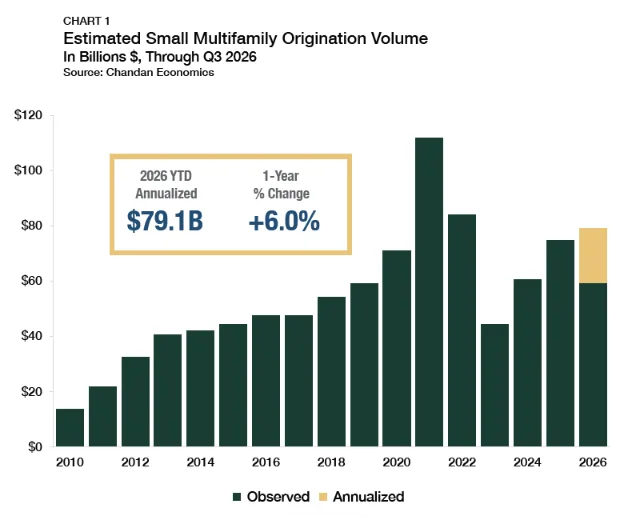
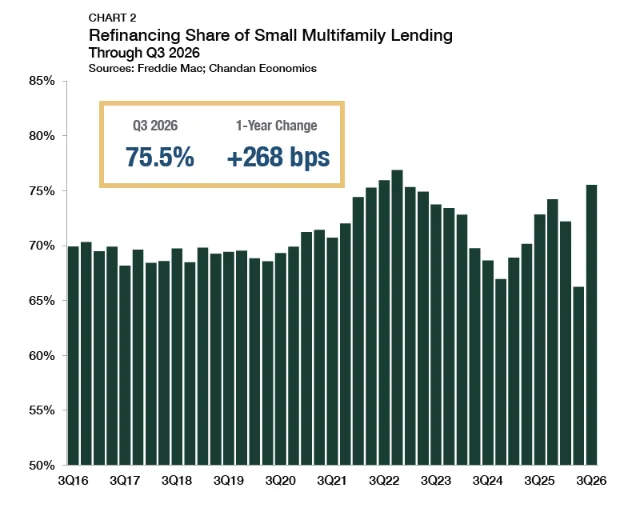
- Originations of loans between $1 million and $10 million are annualizing at $79.1 billion, 6.0% above 2025, with refinancing at 75.5% of volume.
- The Arbor Small Multifamily Price Index fell 0.6% in Q3 and 1.3% year over year, as cap rates held at 6.1% and expense ratios rose to 42.3%.
- The risk premium over the 10-year Treasury narrowed to 132 basis points, so Arbor says valuation gains need relief in Treasury yields.
Small multifamily lending is on pace for $79.1 billion in 2026, about 6.0% above last year’s total, according to Arbor Realty Trust’s Q4 2026 report with Chandan Economics.
But refinancing drives the volume, and prices are slipping.
Get Smarter about what matters in CRE
Stay ahead of trends in commercial real estate with CRE Daily – the free newsletter delivering everything you need to start your day in just 5-minutes
Refinancing Takes the Lead
Refinancing made up 75.5% of Q3 originations, up from 66.2% in Q2. Arbor says the rebound looks like borrowers addressing maturities, not the rate-driven reset seen after the pandemic.
The report now defines small multifamily as loans of $1 million to $10 million, in line with Freddie Mac’s Conventional Small product. Arbor restated its historical series to match.
Prices Drift Lower
Arbor’s own price index slid 0.6% from Q2 and 1.3% from a year earlier. Arbor describes pricing as rangebound since early 2024.
Cap rates averaged 6.1%, basically flat, and have sat close to 6% for over two years. The spread over the 10-year Treasury shrank to roughly 132 basis points as yields rose. The 10-year briefly topped 5.1% in September.
Acquisition cap rates slipped from 6.2% to 6.1%, and refinance cap rates inched up from 6.0% to 6.1%. The spread between small and all multifamily cap rates widened to 59 basis points, above the 10-year average of about 46.
Costs and Credit Tighten
Expense ratios rose to 42.3% from 41.7%, about 230 basis points above a year earlier. Occupancy among financed properties slipped 0.3 points to 96.0%, still well above the 92.7% national rental rate Census reported for Q2.
Debt yields ticked up to 9.4%, and loan-to-value eased to 65.0%. Arbor calls underwriting modestly tighter.
Leverage has crept back up, sitting about 240 basis points over its 2024 low of 62.6%. The spread between debt yields and cap rates widened five basis points to 329, though it is below a year earlier.
Why Expenses Matter
Arbor says the first-quarter expense spike looked like an unusually high underwriting cohort, but Q3’s rise suggests costs have not fully eased. The National Apartment Association’s tracking shows expenses taking a larger share of rental revenue between 2023 and 2025.
Zoom Out
Arbor’s regional cap rate spread has narrowed to about 66 basis points, with the Midwest highest at 6.4% and the West lowest at 5.8%. We covered how Raleigh and Charlotte topped Arbor’s multifamily investment list earlier this month.
Capital availability, not demand, is the issue. Arbor cites an October NMHC survey in which financing conditions weakened sharply.
Why It Matters
Small balance owners often lack the cushion of larger sponsors. Stable occupancy helps, but higher borrowing costs and thin spreads leave little room for value gains.
Refinancing pressure is not confined to small deals. We covered how multifamily maturities hit roughly $250B through 2028.
What’s Next
Arbor expects steady fundamentals into 2027, with completions slowing and Fannie Mae forecasting a 7.5% average 30-year mortgage rate to keep renters renting. Price appreciation and transactions should stay constrained while financing remains the main obstacle.