





- A $100,000 household income opens 77% of U.S. rental listings, versus 31% for the typical renter at $58,000, per a Zillow analysis released October 7.
- At a $2,500 monthly budget, renters get nearly 20% more space and 63% more single-family homes, though the median rent exceeds that figure in several large metros.
- In Memphis a six-figure income rents a 2,119-square-foot home, while in San Jose it secures a 650-square-foot one-bedroom, showing how supply drives affordability.
A $100,000 household income unlocks 77% of U.S. rental listings, compared with 31% for a typical renter earning $58,000, according to a Zillow analysis published October 7.
That is about 2.5 times the share of the market, but what the money buys depends on the metro.
Get Smarter about what matters in CRE
Stay ahead of trends in commercial real estate with CRE Daily – the free newsletter delivering everything you need to start your day in just 5-minutes
What a $2,500 Budget Buys
Following the 30% rule, a $100,000 household can spend about $2,500 a month on rent. Nationally, the typical market rent is $1,932.
However, smaller units tend to list more often. As a result, the median listed rent from January through August 2026 falls to $1,750.
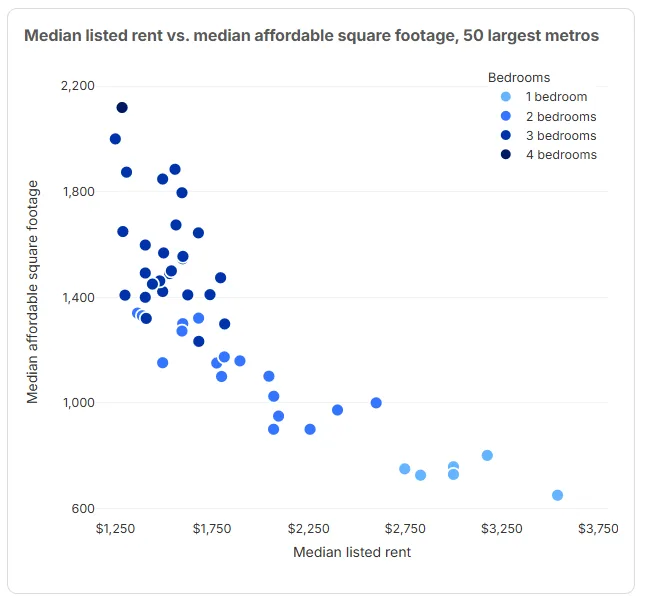
At that budget, renters get nearly 20% more living space. They also have access to 63% more single-family homes than the typical renter.
Among rentals in reach, 30% are single-family homes, 18% are condos and 52% are apartments. By comparison, the broader market breaks down to 19%, 16% and 65%, respectively.
Memphis Versus San Jose
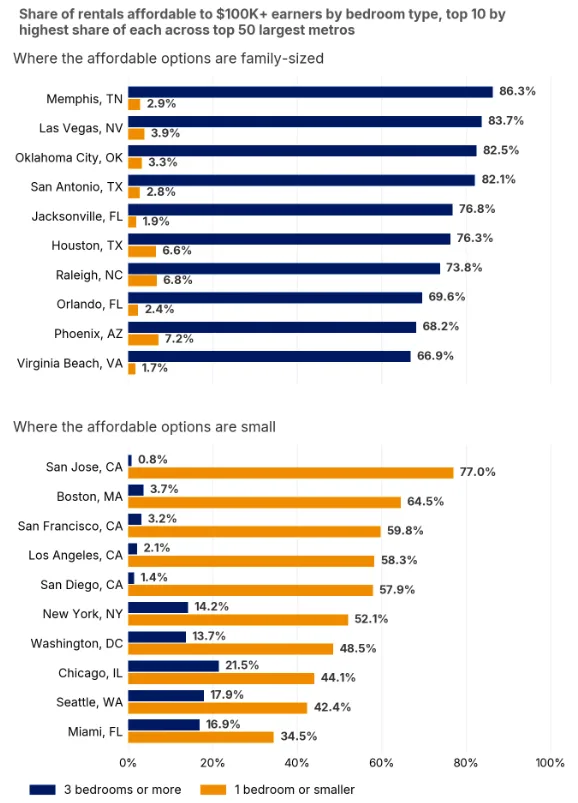
In Memphis, a six-figure income rents a median of 2,119 square feet and four bedrooms. Moreover, 73% of in-budget listings are single-family homes.
Oklahoma City offers 2,000 square feet and three bedrooms. Its median rent is just $1,250.
Raleigh, San Antonio and Houston show a similar pattern. In these markets, high earners can find three-bedroom homes larger than 1,800 square feet.
Houston stands out, with single-family homes making up 62% of listings within that budget.
Coastal Metros Stay Tight
San Jose has the highest median listed rent among large metros, at $3,539. By contrast, a $2,500 budget there secures a median of 650 square feet, one bedroom and one bath.
Additionally, 95% of the available options are apartments or condos.
San Francisco, Boston, Los Angeles, San Diego and New York show similar constraints. At the top of a six-figure budget, median space ranges from 726 square feet in San Diego to 801 in New York. Meanwhile, a typical San Jose rental offers 899 square feet.
Neighborhood Tradeoffs Matter
Even in expensive metros, renters can find more space by searching lower-cost neighborhoods. Such moves can yield roughly 250 additional square feet for the same budget.
However, the tradeoff may involve a longer commute or lower walkability.
Across the 50 largest metros, typical rentals at the six-figure income level exceed 1,000 square feet in 40 markets.
Affordability remains a challenge in coastal California. There, 47% of renter households earning $85,000 to $99,000 are rent-burdened. By comparison, the share falls to 35% among those earning $100,000 to $115,000.
A Look at the Metro Table
Zillow’s table highlights what renters can find near the top of a six-figure budget. That range runs from $2,333 to $2,500 a month.
Nationally, the median rental offers 1,152 square feet and two bedrooms. Single-family homes account for 30% of listings, while 27% have one bedroom or less.
Meanwhile, Sun Belt metros offer more space. Dallas has a median of 1,490 square feet and three bedrooms. Atlanta offers 1,644 square feet, while Phoenix has 1,546.
Single-family homes account for 43% of listings in Dallas, 48% in Atlanta and 55% in Phoenix.
At the other end, smaller units dominate several coastal markets. One-bedroom units or smaller make up 52% of in-budget listings in New York, 58% in Los Angeles, 64% in Boston, 60% in San Francisco and 58% in San Diego.
San Jose leads the group at 77%.
Why It Matters
A six-figure salary often draws workers to major economic hubs for higher-paying jobs. However, Zillow notes that these locations also tend to have the highest rents.
Zillow identifies housing supply as a key factor in affordability. Where builders responded to pandemic-era demand, particularly across the Sun Belt, new inventory has given renters more options.
As a result, additional supply has helped moderate rent growth.
This trend aligns with a broader shift in demand. CRE Daily has reported on rental demand migrating toward lower-cost markets.
By contrast, renters have fewer choices where housing supply has lagged. Even a strong salary may not overcome that shortage.
What’s Next
Watch whether new construction pipelines in high-cost metros expand enough to give six-figure earners more options.
Ultimately, Zillow’s data suggests that renter affordability depends on housing supply, not just income.