




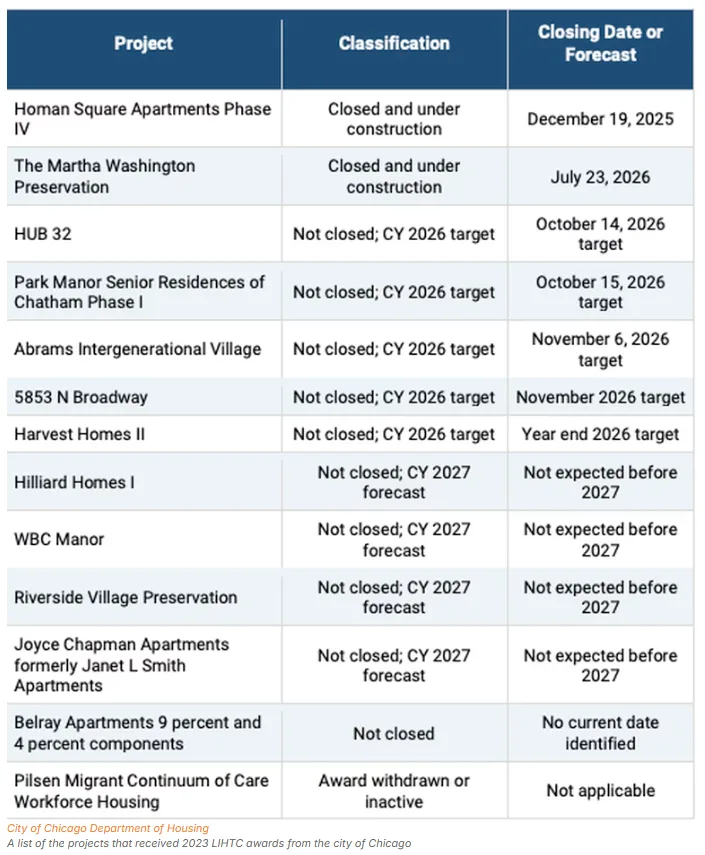
- As of mid-September, only two of 13 projects awarded credits in Chicago’s 2023 LIHTC round had closed and started construction, and both were rehabilitation deals.
- Five more projects are expected to close by year-end, four are not expected before 2027, one has no date and one was withdrawn or is inactive.
- Delays are lifting costs, with Hub 32 rising to about $796K per unit from $732K, and Chicago projects can run over 50% costlier than in comparable cities such as Houston.
Only two of the 13 projects awarded credits in Chicago’s 2023 LIHTC funding round have closed and gone under construction, according to city records obtained by Bisnow.
That is as of mid-September, 30 months after the city announced the awards in March 2024.
Get Smarter about what matters in CRE
Stay ahead of trends in commercial real estate with CRE Daily – the free newsletter delivering everything you need to start your day in just 5-minutes
A Slow Path to Closing
Both projects that closed were rehabilitation deals designed to preserve existing units. In Chicago LIHTC projects, rehab and preservation cost hundreds of thousands of dollars less per unit than new construction, according to A City That Works.
Five more projects are expected to close before year-end. However, four are not expected to close until 2027. One has no identified closing date, while another is classified as withdrawn or inactive.
City officials expected projects to close within 18 to 36 months. They projected March 2027 as the end date. Although that initial window has not ended, the deadline is approaching quickly.
Costs Rise With the Delays
In March 2024, the city estimated total development costs for the 13 projects at $562M. That figure covered both public and private funding sources.
Since then, rising construction costs have likely pushed the total higher.
Hub 32, a 51-unit project in Garfield Park, carried a 2023 price tag of about $732K per unit. By February 2026, that cost had climbed to nearly $796K per unit, according to A City That Works.
Why Chicago Takes Longer
Rachel Rhodes of the National Equity Fund said Chicago has significantly more layers of approval. In addition, multiple City Hall departments provide soft financing, which slows each deal.
Chicago is one of only two municipalities, alongside New York City, with its own federal LIHTC allocation. Both the Illinois Housing Development Authority and the city allocate funding to Chicago projects. However, each uses separate guidelines.
From 2019 to 2023, state-funded LIHTC projects in Chicago averaged $454K per unit. That was about 15% below the $519K average for city-allocated projects.
Moreover, projects funded through either source can cost more than 50% above comparable projects in cities such as Houston.
How LIHTC Gets Funded
The LIHTC program has driven U.S. affordable housing finance since its creation in 1986. Through 2024, it had helped build more than 3.9 million units.
Developers typically sell the credits to financial institutions and large companies seeking to reduce their tax liability. In return, the proceeds provide equity for development projects.
State housing authorities, including the Illinois Housing Development Authority, allocate federal housing dollars through the program. They review developer proposals and use different processes to determine who receives credits.
Chicago officials have highlighted the city’s investments in affordable housing. However, slow closings make it difficult to measure how much of that investment will actually result in new housing.
Why It Matters
Chicago’s apartment construction pipeline has slowed to historic lows while rents continue to climb. As a result, tax credit deals remain a key source of new affordable housing.
However, slow closings keep that potential supply on paper.
Housing Action Illinois found that nearly 440,000 low-income renter households live in Illinois. Yet just over 150,000 affordable rental homes are available to them.
The shortage is also severe in the Chicago metro. There, only 31 affordable and available homes exist for every 100 extremely low-income renters.
What’s Next
The city’s projected March 2027 deadline for closing the 13 deals is approaching. Meanwhile, Mayor Brandon Johnson’s administration has promoted the Cut the Tape initiative to speed up approvals.
However, some commercial real estate professionals say the initiative has not gone far enough.
The Department of Housing has also revised parts of its building codes and its approach to awarding credits. These changes aim to shorten the time between an award and closing.
Ultimately, it will take time to determine whether the changes accelerate project delivery.