







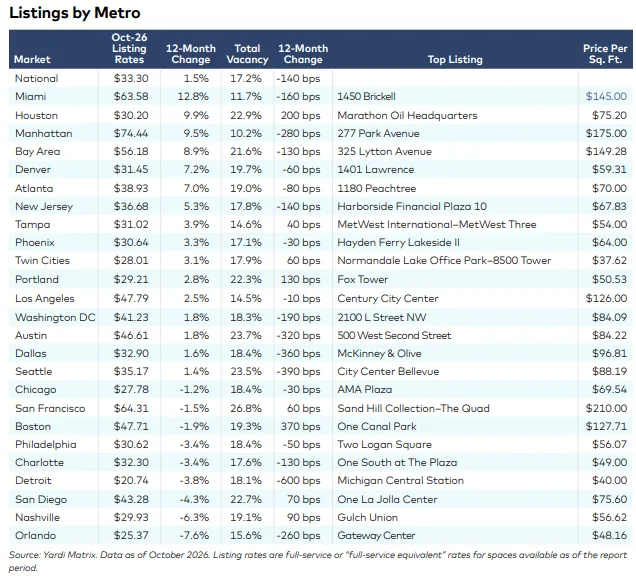
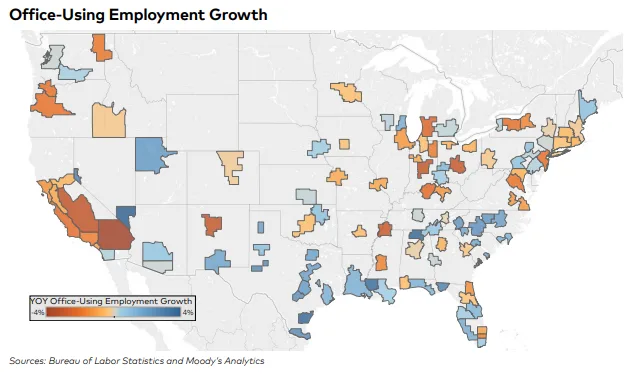
- Since January 2021, San Francisco office employment fell 4.5% while inventory grew 9.2%, pushing October vacancy to 26.8%, the highest in the nation versus 21.6% for the Bay Area.
- Miami’s office jobs grew 22.1% against 5.3% more supply and vacancy fell to 11.7%, while Austin added 30.4% more jobs and 17.0% more space and vacancy rose to 23.7%.
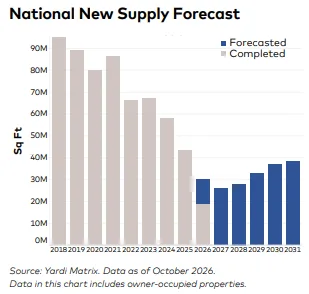
- Completions should bottom out in 2027, but Yardi says the oversupply of less desirable space will remain as new Class A product absorbs demand at older buildings’ expense.
Job growth isn’t enough to fill offices when supply grows faster, according to Yardi Matrix‘s November office report.
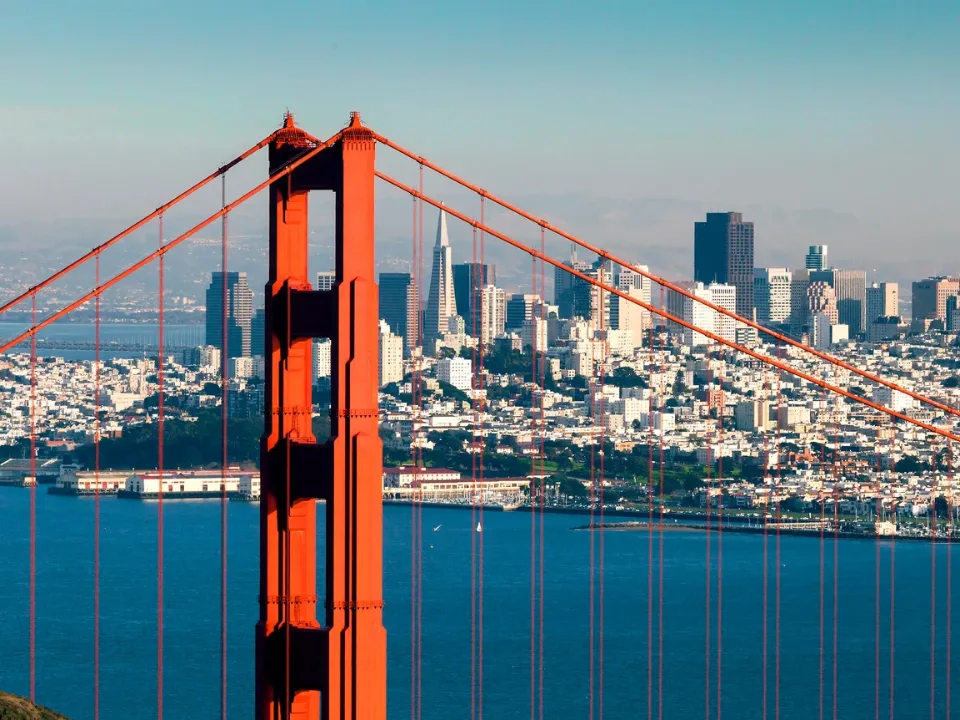
San Francisco’s vacancy reached 26.8% in October, worst among U.S. metros, even as office employment there is down 4.5% since January 2021.
Get Smarter about what matters in CRE
Stay ahead of trends in commercial real estate with CRE Daily – the free newsletter delivering everything you need to start your day in just 5-minutes
Two Metros, Same Job Loss
San Francisco’s office inventory grew 9.2% over that period, according to Yardi’s analysis of Bureau of Labor Statistics data. The Bay Area lost nearly the same share of office jobs, 4.6%, but added only 5.4% more space and has vacancy of 21.6%.
Yardi says that gap shows how excess supply amplifies vacancy in tech-heavy metros where remote work is easy.
Miami vs. Austin
Miami’s office jobs grew 22.1% while inventory rose just 5.3%, so employment outpaced supply 4.2 times. Vacancy there fell to 11.7%.
Austin added more jobs, 30.4%, but also 17.0% more space, a ratio of 1.8 times. Vacancy rose to 23.7%. Yardi’s takeaway: new jobs don’t always become demand.
Quality Over Quantity
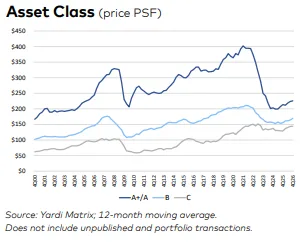
New supply is almost all premium Class A, and tenants want it. Class A listing rates climbed 2.5% in a year, while Class B slipped 0.3%.
The result is that new buildings fill up while older ones lose tenants. Yardi expects completions to hit bottom in 2027, but the glut of less desirable space will linger.
Seattle Stands Still
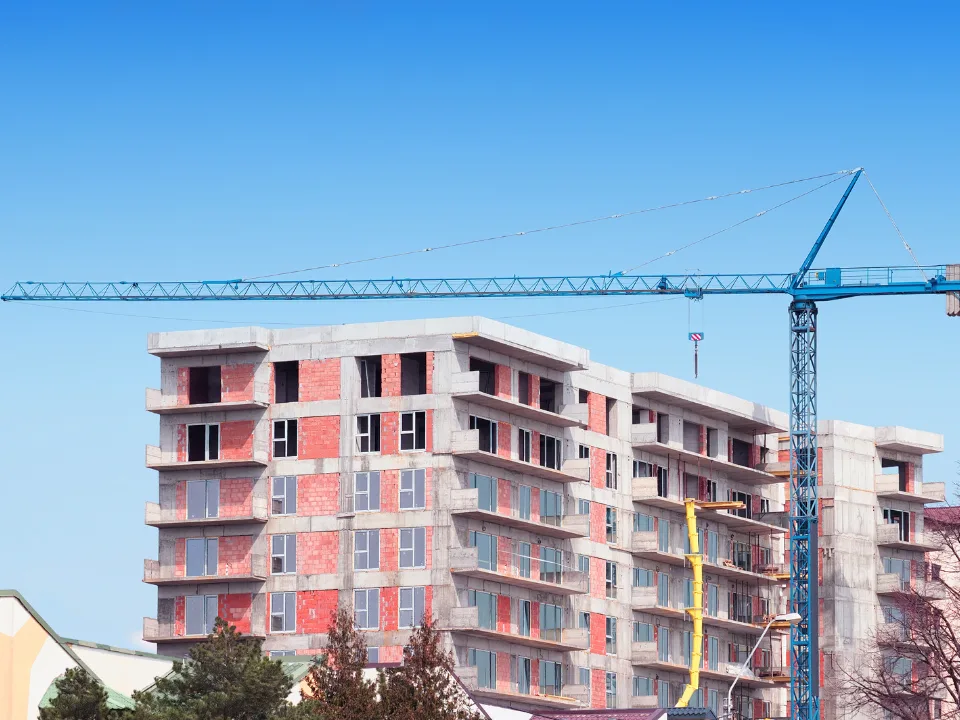
Seattle has no speculative office under construction, only owner-occupied projects. Including planned space, its pipeline totals nearly 4 million SF, or 2.6% of stock.
Nationwide, 32.2 million SF is underway, or 0.5% of stock. Microsoft’s voluntary exit offer, open to as much as 27% of its workforce worldwide, adds pressure in Seattle.
Zoom Out
The national picture is improving. We reported earlier that national office vacancy fell to 17.2% in October, 140 basis points lower than a year ago, with Class A pulling ahead of Class B.
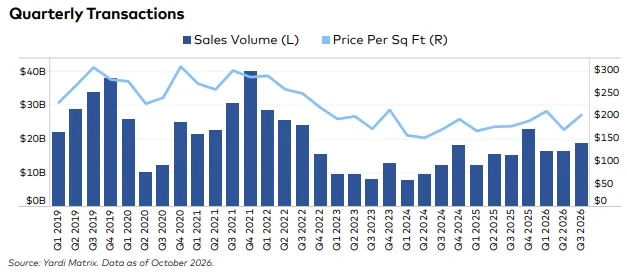
Nashville stands out on pricing: Yardi’s data show office prices more than doubled in a year to $389 per SF, led by Class A, including Shorenstein’s $147 million purchase of 827 19th Ave. South from Portman Holdings.
Why It Matters
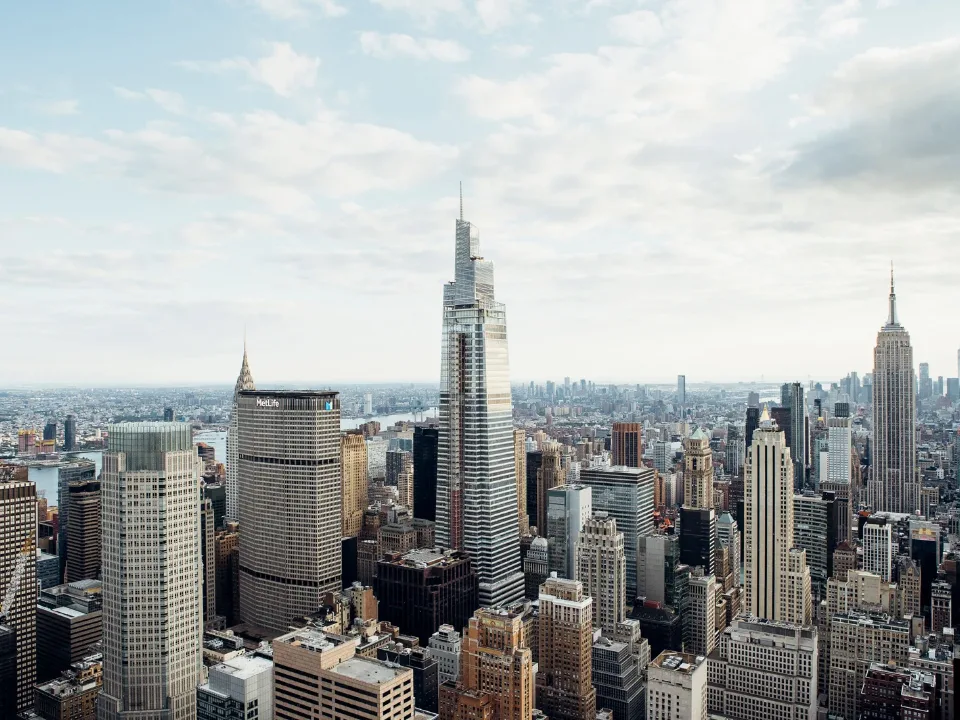
The averages hide wide gaps. In September, Manhattan’s vacancy was 10.2% while San Francisco’s was 26.7%, as we reported in our brief on Manhattan office vacancy.
Supply discipline, not hiring headlines, is separating the winners from the laggards.
What’s Next
Yardi expects completions to bottom out in 2027. That should ease vacancy pressure, but older, weaker buildings will stay oversupplied.