






- Manhattan’s office vacancy fell 260 basis points year over year to 10.2% in September, the lowest of the top 25 U.S. markets and far below the 17.8% national average.
- The borough leads the country in office construction, investment volume, pricing and asking rents, yet only one project totaling 210,882 square feet delivered through September.
- Tight availability and a thin delivery schedule give landlords pricing power, while San Francisco’s 26.7% vacancy shows how wide the gap between gateway markets has become.
Manhattan now has the lowest office vacancy rate among the top 25 U.S. markets, at 10.2% as of September, according to Yardi Matrix data reported by Commercial Property Executive.
That is 260 basis points tighter than a year ago and well under the 17.8% national average. The borough also passed Boston to hold the nation’s largest office pipeline.
Get Smarter About What Matters in New York
Subscribe to our free newsletter covering the biggest commercial real estate stories across the five boroughs — delivered in just 5 minutes.
A Pipeline That Leads the Nation
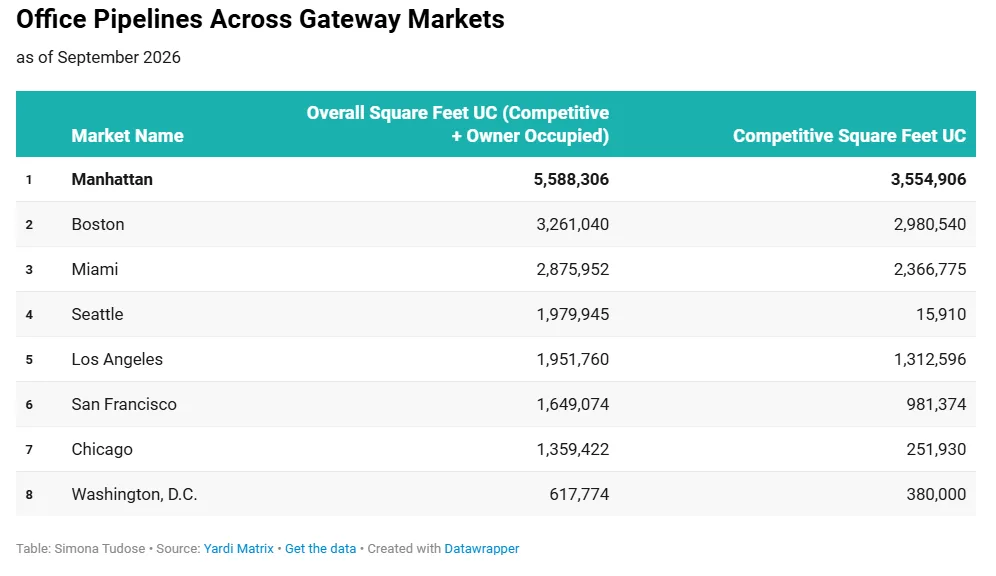
Manhattan had 5.6 million square feet under construction across 11 projects in September, or 1.2% of existing stock. Boston followed with 3.3 million square feet and Miami with 2.9 million.
Competitive space underway totaled 3.4 million square feet, 0.8% of stock versus a 0.5% national average. Four gateway cities sit below 1 million square feet, including Chicago at 251,930 and Seattle at 15,910.
The biggest project is Two World Trade Center. Silverstein Properties broke ground in July on the 2 million-square-foot tower, which will hold 1.6 million square feet of office space and serve as American Express’ global headquarters. It is slated to open in 2031.
Deliveries Nearly Dry Up
Only one office project came online in Manhattan through September, a 210,882-square-foot building. That is a 75% drop in year-over-year deliveries.
The project is Rabina Properties’ 520 Fifth Ave., an 88-story mixed-use tower in the Plaza District with 25 floors of office space and 100 condominiums. It opened in June.
Rents and Prices Stay on Top
Asking rents averaged $72.03 per square foot in September, more than double the $33.18 national figure. San Francisco ($64.92) and Miami ($61.26) came next.
Investment volume reached $5.7 billion year to date, the most in the country, at an average $585 per square foot versus $197 nationally. The largest sale so far in 2026 is SL Green’s $730 million purchase of Park Avenue Tower.
Leasing kept pace. General Atlantic took 150,000 square feet at Related Cos.’ 625 Madison Ave. for its global headquarters, and Capital Group signed for a full 70,400-square-foot floor at Rudin’s 345 Park Ave., bringing that tower to full occupancy.
Coworking Holds Its Lead
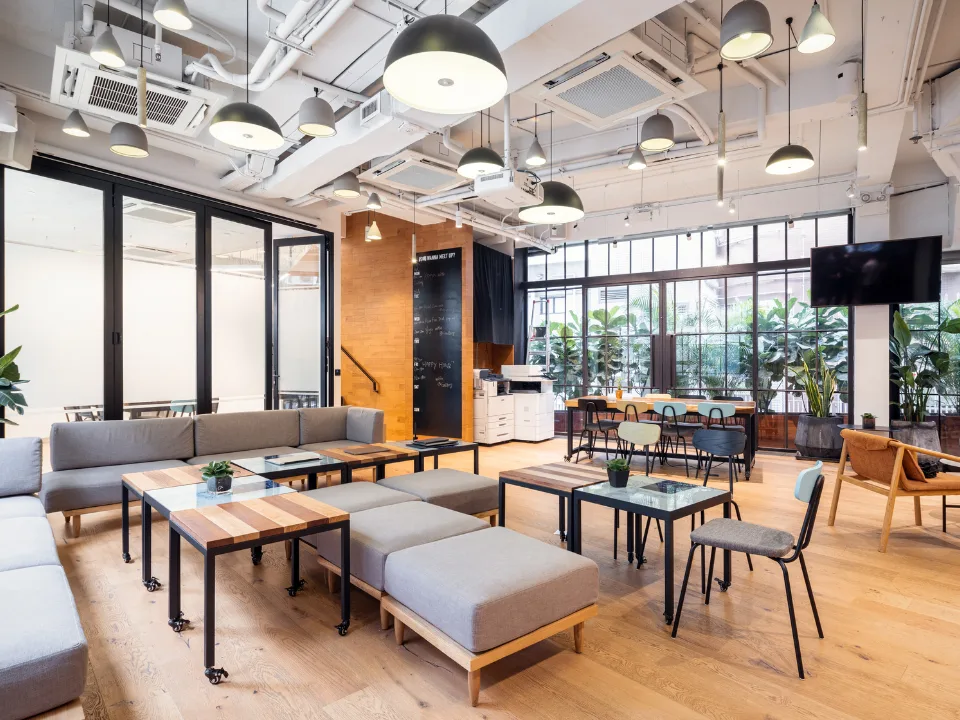
Manhattan’s coworking sector totaled 12.3 million square feet across 307 locations in September, the largest inventory in the country, according to CoworkingCafe. Flex space made up 2.7% of leasable office inventory, above the 2.5% national average.
WeWork leads with 2.2 million square feet, followed by Industrious at 1.7 million, Grand Central Offices (848,640), Studio by Tishman Speyer (828,685) and Regus (669,604).
Foot Traffic and Financing
Office visits in New York were only 4% below 2019 levels, according to Placer.ai, after nationwide attendance hit post-pandemic highs in June.
SL Green’s Park Avenue Tower deal went under contract in October 2025. The 35-story Plaza District building was placed in a $480 million, five-year CMBS pool held by Wells Fargo, with participation from JP Morgan and Bank of America.
Why It Matters
With one delivery in nine months, tenants hunting for space have few new options, which supports rents and pricing. We saw the same pattern when ESRT occupancy climbed to 91.9% in its latest quarter.
The spread between markets is stark. San Francisco still has the highest vacancy in the country at 26.7%, while Miami (11.6%) and Los Angeles (14.5%) trail Manhattan.
What’s Next
The pipeline is concentrated in a few large projects, with Two World Trade Center the marquee delivery years out. Until more space arrives, Manhattan’s tight availability is the number to watch.