







- Median occupancy on 7,597 securitized apartment loans held at 94%, but revenue rose 1.0% against 2.5% higher expenses, so NOI slipped 0.2%, according to CRED iQ.
- Denver revenue fell 5.4% and NOI 11.8%, while Austin revenue fell 5.1% and NOI 10.8%, and loans below 1.0x debt service coverage nearly doubled in both markets.
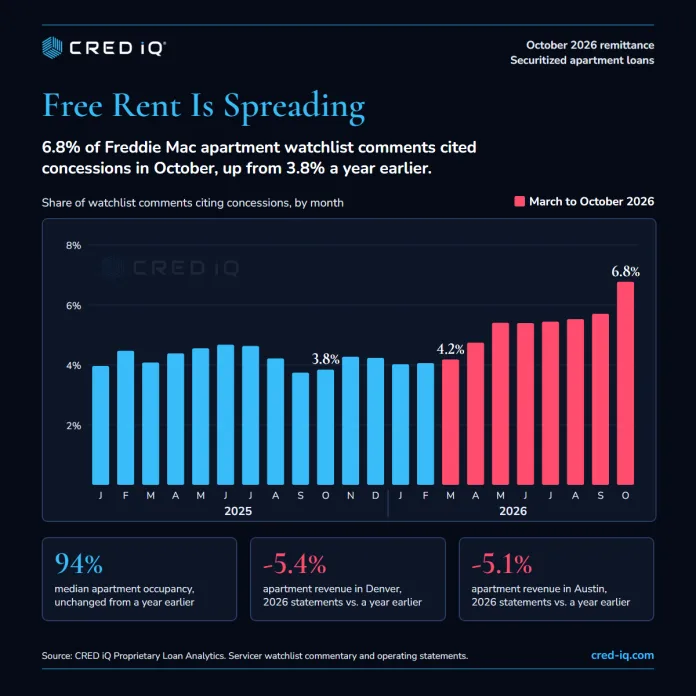
- Concessions appeared in 6.8% of Freddie Mac apartment watchlist comments in October, up from 3.8% a year earlier, and the share rose through spring and summer.
Full apartment buildings can hide weak income, and apartment concessions are the reason, according to CRED iQ’s loan-level data.
Its review of nearly 7,600 securitized apartment loans found median occupancy of 94%, unchanged from a year ago. But revenue grew only 1.0% while costs rose 2.5%, so NOI slid 0.2%.
Get Smarter about what matters in CRE
Stay ahead of trends in commercial real estate with CRE Daily – the free newsletter delivering everything you need to start your day in just 5-minutes
Texas and Denver Take the Hit
Revenue dropped in 29 of 69 metros that have at least 20 loans. Denver is the weakest big market, with revenue off 5.4% and NOI off 11.8%.
Austin posted a 5.1% revenue decline and a 10.8% NOI decline. San Antonio (2.9%), Phoenix (2.4%) and Las Vegas (1.6%) also lost revenue.
Debt Coverage Is Eroding
Denver has 38 of its 138 loans below 1.0x coverage, versus 20 a year ago. Austin’s count rose to 39 of 87, also from 20.
Markets on the coasts and in the Midwest kept growing, led by San Francisco at 6.8%, then New York at 3.6% and Chicago at 2.6%.
The Discounts Behind the Occupancy
Servicer comments tell the story. Concessions or free rent came up in 6.8% of October’s Freddie Mac apartment watchlist notes, up from 3.8% in October 2025.
Counting every deal type, 294 loans carrying $6.3B are affected. The Dallas-Fort Worth area has the most (33), followed by Denver, Austin, San Antonio and Houston. Over half weren’t flagged in July.
What Free Rent Looks Like
A Houston property, Broadstone Energy Park, gives six weeks off every lease and eight weeks on units that sat empty a long time. Antero Apartments in Colorado Springs gives two months free and has seen coverage slide to 0.98x.
In Austin, Mueller Flats’ borrower told the servicer that competitors give up to three months free. The $40.2M Freddie Mac loan now shows 76% occupancy, down from 84%, and 0.60x coverage, down from 0.92x.
Zoom Out
Our coverage of RentPulse’s Q3 data showed the same split: vacancy fell to 7.8% even as concessions rose.
The Sun Belt is the weak spot, which is why MAA trimmed guidance as rent recovery lagged.
Why It Matters
Occupancy alone now overstates how healthy apartments are. Concessions climbed through spring and summer, when demand usually helps landlords.
Most 2026 statements stop in June, so this summer’s free rent hasn’t reached reported revenue yet.
What’s Next
Leasing cools through winter. Landlords in Denver, Austin and large parts of Texas must pick between deeper discounts and emptier buildings, and both will weigh on second-half revenue and on thin coverage.