







- About 2,100 jurisdictions in all 50 states discussed a specific data center restriction from October 2025 to September 2026, and the moratorium led in 37 states with 4,269 documents.
- Eleven distinct tools appear, from bans (2,307 documents) to water rules, noise limits, size caps, setbacks and Pennsylvania’s curative amendments, and state law largely decides which one a town uses.
- Moratorium talk rose from 0.4% of data center documents in October 2025 to 8.7% in July 2026, so developers face a patchwork that changes by state.
Towns are using 11 distinct tools to restrict data centers, and the moratorium is only the best known, according to GatherGov’s review of local meeting records.
Roughly 2,100 jurisdictions in all 50 states brought one up over the 12 months ending in September 2026, per GatherGov’s search of nearly 99,000 agendas, minutes and other local records that referenced data centers.
Get Smarter about what matters in CRE
Stay ahead of trends in commercial real estate with CRE Daily – the free newsletter delivering everything you need to start your day in just 5-minutes
The Toolkit by the Numbers
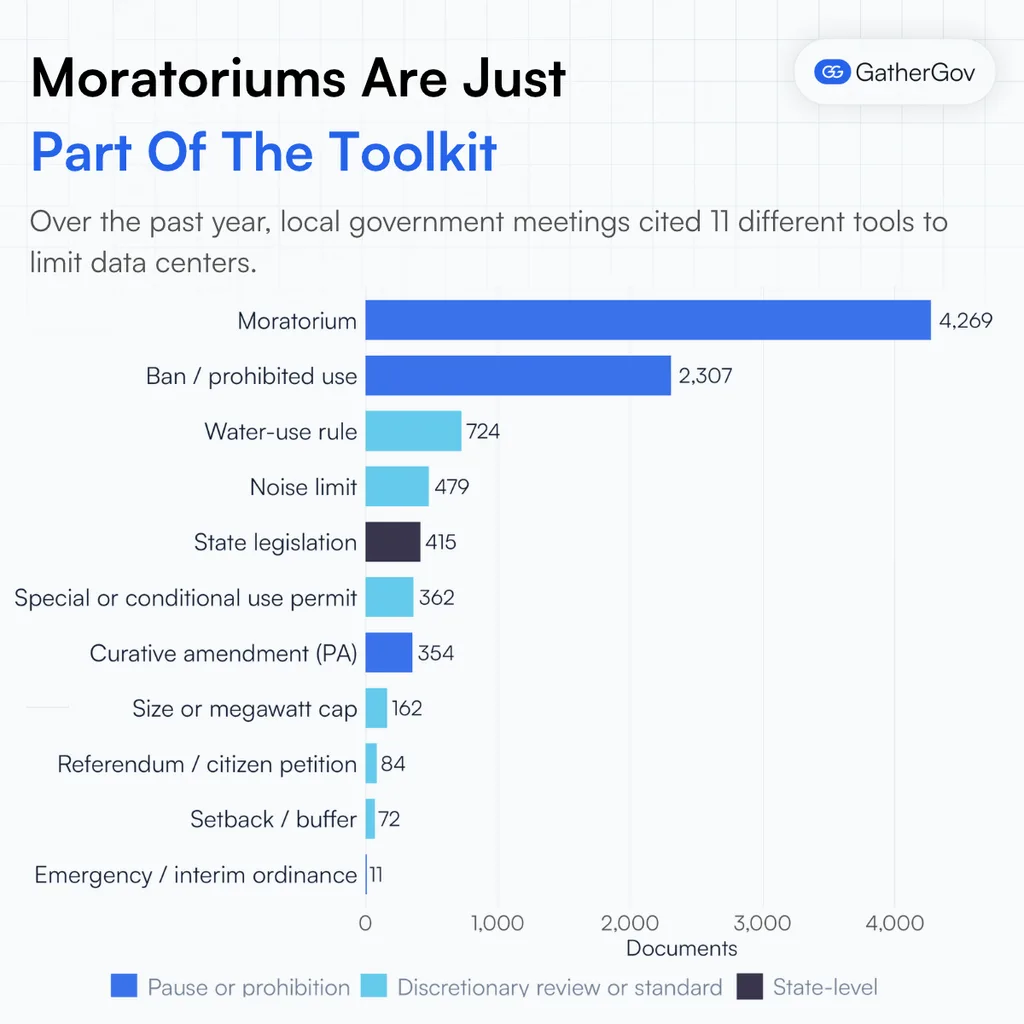
Moratoriums lead with 4,269 documents and are the most-cited tool in 37 states. Georgia, California and North Carolina top the list, with Florida and Wisconsin also generating plenty.
Outright bans or prohibited-use rules appear in 2,307 documents. They are the top tool in six states, among them New Jersey and California, plus Louisiana, Arkansas, Rhode Island and Virginia.
Standards that shape how a project gets built rather than whether it does show up less often: water rules in 724 documents, noise limits in 479 and size or megawatt caps in 162.
The Long Tail
Conditional or special use permits appear in 362 documents and curative amendments in 354, with 353 of those in Pennsylvania. Referendums or citizen petitions turn up in 84, setbacks in 72 and emergency or interim ordinances in just 11.
GatherGov excluded general ordinance chatter, overlay zones and incentive talk, which can cut either way for development.
State Law Picks the Tool
GatherGov’s takeaway is that a town’s tool follows its state’s legal limits more than the intensity of local anger. Georgia counties can pause with a simple resolution, so moratoriums dominate there.
In Pennsylvania, where courts have blocked moratoriums, towns instead call their own zoning defective and rewrite it. New Jersey prohibited development moratoriums back in 1985, so officials move directly to eliminating the use. Texas counties hold little zoning authority, so the debate turns to water.
Talk Is Accelerating
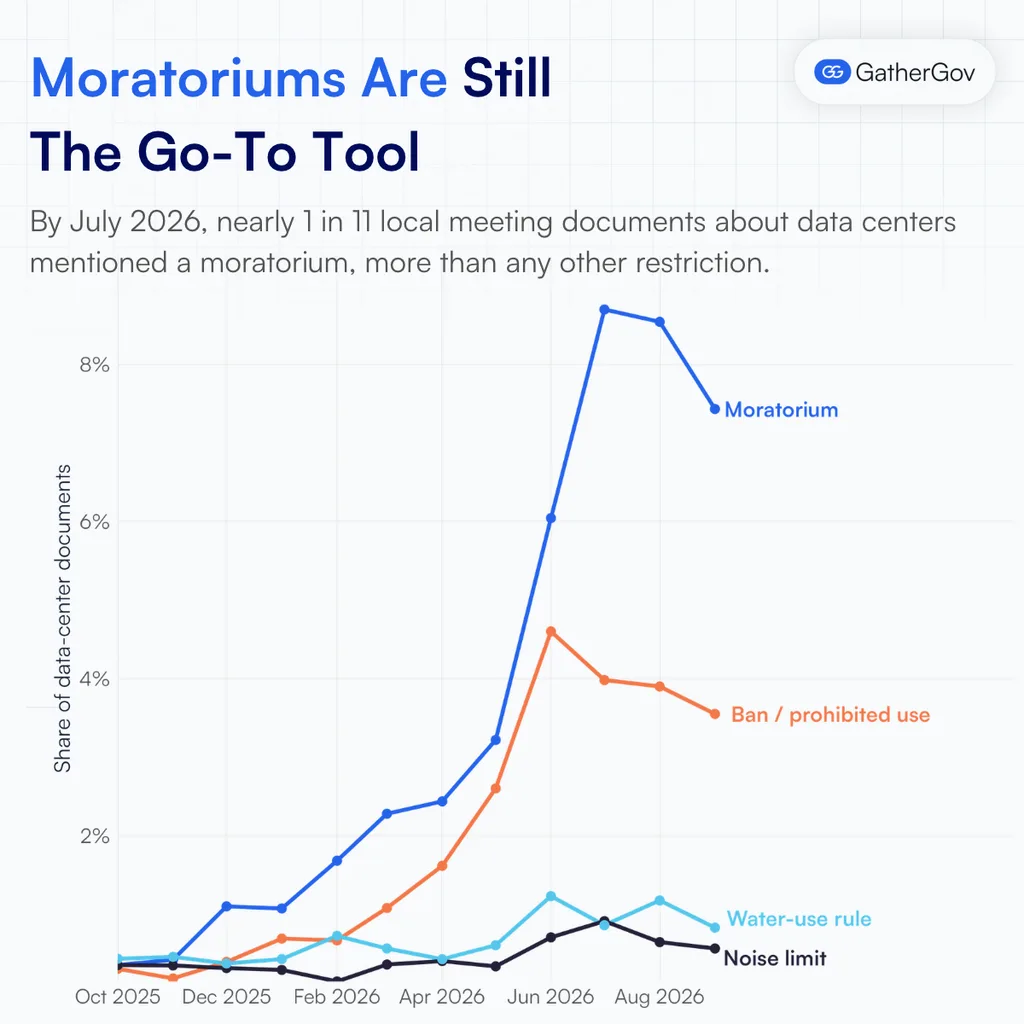
Moratoriums appeared in 0.4% of data center documents when the window opened in October 2025, and in 8.7% by July 2026.
Bans crested earlier, reaching 4.6% in June, then eased while moratorium talk kept climbing. GatherGov says restriction talk grew faster than data center talk itself.
What Officials Are Saying
Upper Mount Bethel, Pa., has a solicitor who explained on July 24 that a township can call its own ordinance defective because it lacks data center rules. Under the state planning code, that stops rival applications for 180 days while a rewrite happens, per GatherGov.
In New Brunswick, N.J., a speaker at the Sept. 2 council meeting warned that zoning in effect when a complete application lands is what applies. Several industrial zones allow data centers by right, so waiting to prohibit them risks being too late. New Jersey logs about 20 restriction documents per 100 data center documents, the highest rate in the country.
In Morton County, N.D., planning staff told residents on April 22 that a multi-mile setback would invite a lawsuit because it would leave nowhere to build. And in Barnes County, N.D., commissioners voted unanimously on May 19 for a six-month moratorium, after the state’s attorney called a year too long. GatherGov says six to 12 months is typical.
Why It Matters
For developers, the same project can face a pause in Georgia, a ban in New Jersey, a curative amendment in Pennsylvania and a water fight in Texas. Site selection now needs a read on state law as well as power and land.
CRE Daily has tracked the pace of it. Data center moratoriums reached formal action in 632 jurisdictions since January, per GatherGov’s earlier count, and Yardi Matrix flagged new state moratoriums in New York and Texas.
What’s Next
Watch for the quieter tools. A Conneaut, Ohio, speaker urged the council to list data centers as a conditional use instead of passing a moratorium, saying it keeps more control and avoids signaling instability. If that argument spreads, expect fewer headline pauses and more hearings on each project.