







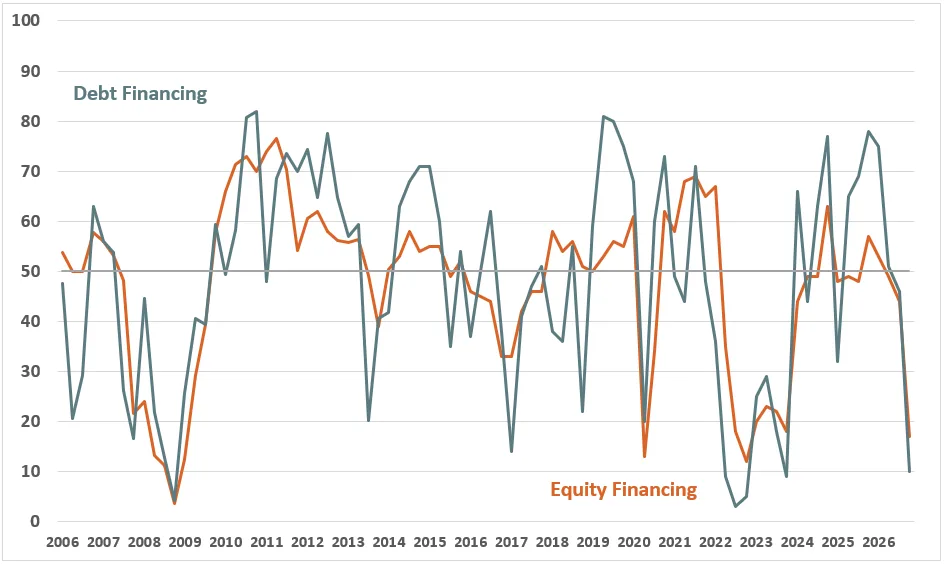
- NMHC’s Debt Financing Index fell to 10 from 46 in July and its Equity Financing Index to 17 from 44, with all four survey indexes now below 50.
- Some 81% of respondents called borrowing tougher, and 61% said deal counts fell, against just 4% who saw more transactions.
- Rental conditions softened far less: 53% saw no change, which points to capital access, not tenant demand, as the next hurdle for owners.
Capital, not renters, is the pressure point for apartment owners, according to NMHC’s October survey results.
The Debt Financing Index fell to 10 from 46 in July, its lowest reading since October 2023. The Equity Financing Index dropped to 17 from 44.
Get Smarter about what matters in CRE
Stay ahead of trends in commercial real estate with CRE Daily – the free newsletter delivering everything you need to start your day in just 5-minutes
Borrowing Gets Harder
Of the 130 senior executives polled Oct. 1 to 15, 81% called it a tougher moment to borrow compared with the prior quarter. Only 2% saw conditions improving.
On equity, 66% reported less availability and 1% reported more. Both indexes were above 50 as recently as January, when debt read 75 and equity 53.
Deals Dry Up
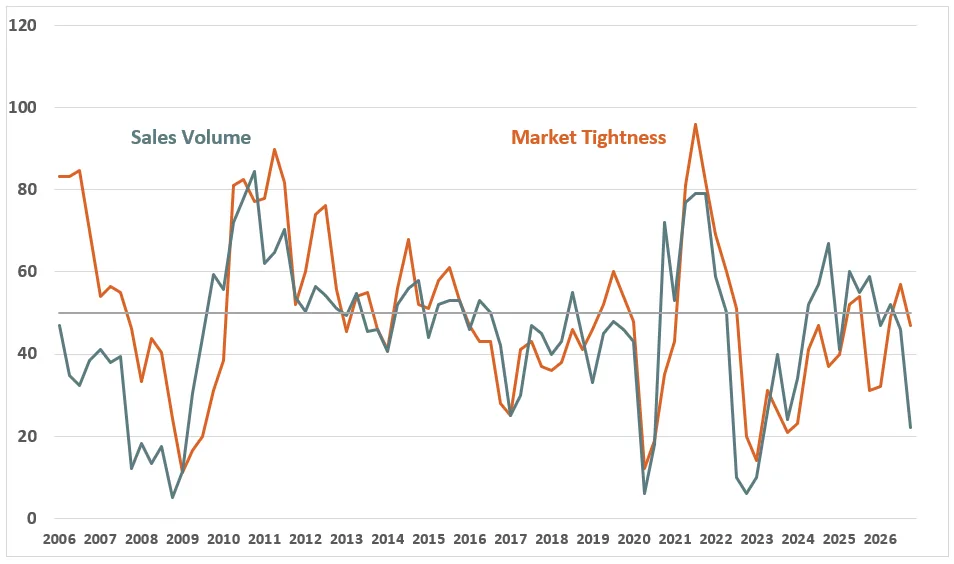
The Sales Volume Index slid to 22 from 46 in July, after reading 52 in April. Some 61% said deal counts fell, while 4% said they rose.
Jonathan O’Kane of Chandan Economics points out that the indexes capture how widely changes were reported, not their size. A reading of 22 doesn’t mean sales fell 22%.
Rents Hold Up Better
The Market Tightness Index slipped to 47 from 57. A majority (53%) saw no shift in rental conditions, while 26% saw looser markets and 21% saw tighter ones.
July looked different. CRE Daily’s coverage of the July survey found tightness at 57, above 50 for the first time in more than a year, as NMHC Chief Economist Chris Bruen tied the gain to stronger job growth and fewer deliveries.
Why It Matters
O’Kane’s read is that the bigger challenge ahead looks like getting capital rather than finding tenants. A property can keep performing and still be hard to refinance or sell.
He also notes the debt index folds in non-rate terms, so it measures overall borrowing conditions, not mortgage rates alone.
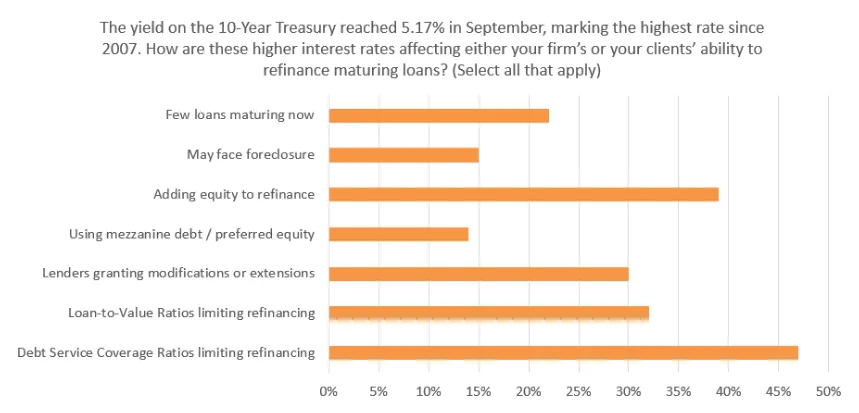
That squares with the maturity math. CRE Daily’s report on the maturity wall said Newmark counts $875B of commercial mortgage maturities in 2026, and about 78% of fixed-rate securitized CRE debt due through 2028 carries coupons well below today’s 10-year Treasury yield.
What’s Next
Watch whether the next NMHC reading shows financing steadying. If it doesn’t, softer rents may follow the capital markets lower.