





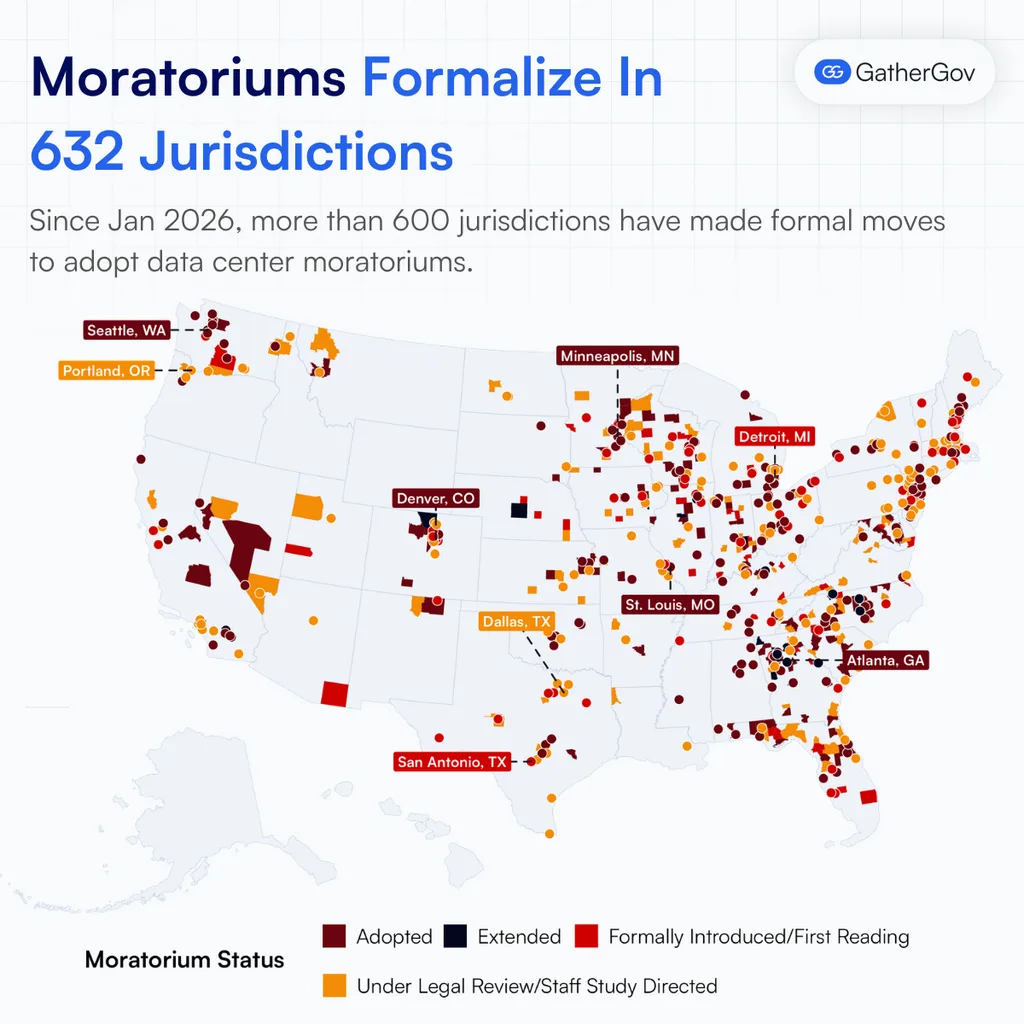
- Since January 2026, 632 jurisdictions have taken formal action on data center moratoriums, including 270 adoptions, 120 first readings, and 232 under legal review.
- California, Georgia, Florida, New Jersey and North Carolina lead moratorium activity, with Florida logging the sharpest ramp: 37 jurisdictions now in formal process.
- Rejections and repeals remain rare at just 9 and 5 respectively, while at least four jurisdictions have moved toward permanent bans on data centers.
More than 600 U.S. jurisdictions have formally advanced data center moratoriums since January 2026, according to an analysis by GatherGov, which tracks local government meetings nationwide. The firm found 1,030 jurisdictions have mentioned a moratorium in meetings, agendas or minutes, with 632 of them taking formal action, from first readings to outright adoption, in just the past six months.
Get Smarter about what matters in CRE
Stay ahead of trends in commercial real estate with CRE Daily – the free newsletter delivering everything you need to start your day in just 5-minutes
From Chatter to Formal Action
GatherGov used Claude Sonnet 5 to tag each jurisdiction into nine stages, from informal mentions and public requests to adoption, extension, rejection or repeal, then manually verified 30% of the dataset. The breakdown shows momentum firmly in one direction: 270 jurisdictions have adopted a moratorium, 25 have extended one, 120 have formally introduced one or held a first reading, and 232 have it under legal review or staff study. Only 9 have been rejected and 5 repealed, suggesting that once moratorium talk starts in a jurisdiction, it usually advances rather than stalls.
The Details
Moratorium durations cluster at six to 12 months, though at least four jurisdictions have moved toward permanent bans. Monterey Park, California, became the first U.S. city to ban data centers by public vote in June 2026, with residents approving a permanent prohibition by more than 88% after a proposed data center conversion project drew months of organized opposition over diesel generators, noise and utility costs. The council deliberately routed the measure through the ballot box to make it harder to challenge in court than a standard ordinance, and the city now appears throughout the dataset as a model other jurisdictions are studying. Geographically, the activity is national but concentrated: California (73 jurisdictions), Georgia (66), Florida (60), New Jersey (51) and North Carolina (50) lead the count, and mention volumes were still climbing through August 2026 with no sign of a peak, meaning the current tally likely understates where the trend ultimately lands.
Zooming Out
Florida has seen the sharpest ramp of any state, moving from almost no moratorium discussion to 37 jurisdictions in formal process, with several counties enacting outright bans in recent months. Walton County approved an outright ban on all data centers, and Jackson County commissioners voted unanimously to do the same, prompting a resident in neighboring Citrus County to cite both examples while urging local officials not to “rush into becoming the ground zero test case.” The pattern echoes what CRE Daily has tracked in Texas data center moratoriums, where similar backlash has spread county by county as residents cite grid strain, water use and property values.
Why It Matters
The legal risk of an outright ban is becoming its own storyline. In Hill County, Texas, the board passed a data center moratorium, a developer sued, and the board rescinded it almost immediately after facing a $100 million lawsuit. In Athens, Alabama, officials cited a federal lawsuit against neighboring Hawkins County, Tennessee, over its data center ban as a reason to avoid an outright prohibition of their own, warning that banning an entire industry “opens us up to lawsuits.” That legal exposure matters for developers weighing where to site projects, even as demand keeps pushing new markets into play, including where Southern California is drawing renewed data center interest despite the broader wave of local pushback. For site selectors, the split means a jurisdiction’s moratorium status is becoming as important a diligence item as power availability or fiber access.
What’s Next
Not every moratorium sticks. In Social Circle, Georgia, the city let its moratorium lapse once new data center regulations passed, a moratorium-to-regulation-to-lift pattern GatherGov says can make a jurisdiction a more predictable place to build after the pause than before it. With mention volumes still rising and another 172 jurisdictions logging public demands for a moratorium, developers should expect the current wave of formal action to keep building well into 2027.