







- Buyers are going back to sellers for lower prices, requesting cuts of 5% to 10% on deals, while accepted retrades have averaged only 3% to 5%.
- Higher borrowing costs, not a shortage of capital, are widening bid-ask spreads: bank loan originations are up 40% year to date and debt fund originations are up 35%.
- Real yields explain 97 basis points of this year’s Treasury rise, and the 10-year is expected to settle between 4.5% and 5%, so income growth should drive most returns.
Commercial real estate buyers are pushing for deeper price cuts on deals, and sellers are giving only part of it, according to GlobeSt, citing Cushman & Wakefield’s October 2026 Market Matters report.
Requested cuts have generally run 5% to 10%. Accepted retrades have averaged 3% to 5%.
Get Smarter about what matters in CRE
Stay ahead of trends in commercial real estate with CRE Daily – the free newsletter delivering everything you need to start your day in just 5-minutes
Where the Gap Comes From
Brokers are seeing wider bid-ask spreads, though results vary deal by deal. Higher borrowing costs are the main cause.
Some sellers have decided not to budge. They are postponing sales or holding off on bringing properties to market.
Initial pricing matters too. The biggest requested cuts landed on properties priced tight from the start, while deals that began at higher yields drew smaller asks.
Another wave may be coming. Cushman & Wakefield says owners who stretched their holds with successive bridge loans have started weighing sales over the past 45 days, which it expects to show up in 2027.
Money Isn’t the Problem
Capital is available. Bank loan originations are up 40% year to date and debt fund originations are up 35%, so the friction is the price of that financing.
Most of that cost is the base rate. CMBS spreads on senior tranches are only modestly wider since the Iran conflict began, with AAA conduit spreads up just 6 basis points, though BBB- spreads have widened more than 80 basis points. Cushman & Wakefield expects a pricing correction far milder than in the first rate hike cycle.
That matches what we covered in October, when CBRE’s CEO said higher rates and rate uncertainty were causing contracted deals to be repriced, delayed or dropped, with some expected sales turning into refinancings.
What’s Driving Yields
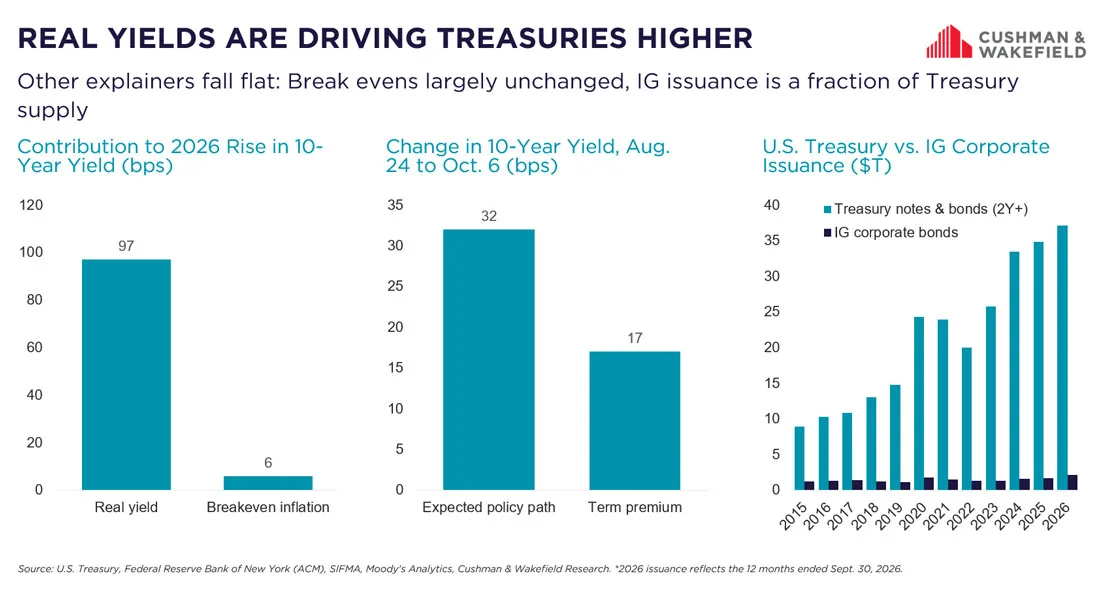
The 10-year Treasury yield rose nearly 70 basis points from its August low to an early-October peak, then eased by almost 30 basis points. Cushman & Wakefield traces most of this year’s increase to real yields rather than inflation expectations.
Real yields account for 97 basis points of the 2026 rise, versus just 6 from breakeven inflation. Since Aug. 24, a higher expected Fed path explains 32 basis points of the move and a rising term premium 17.
Source: Cushman & Wakefield Research, Market Matters, October 2026 (U.S. Treasury, New York Fed, SIFMA, Moody’s Analytics)
The firm also dismisses AI-related borrowing as a driver. Investment-grade corporate issuance totaled about $2.1 trillion over the 12 months ended in September, under 6% of the $37.1 trillion of Treasury note and bond issuance.
Why Sellers Hold Firm
Cushman & Wakefield expects the 10-year to settle between 4.5% and 5% as the energy shock fades and sees a sustained drop well below 4.5% as unlikely. That makes meaningful cap rate compression unlikely too.
Third-quarter fundamentals give sellers something to point to. Industrial net absorption hit 76.6 million SF, the strongest since the first quarter of 2023, and asking rent growth reached 4%.
Multifamily vacancy fell to 8.6%, a three-year low. Office posted a fifth straight quarter of positive absorption, totaling 15.5 million SF over the past year, and retail vacancy held at 5.9% against a 7.4% historical average.
Why It Matters
Buyers are negotiating against prices that have already reset. Commercial property values are down about 17% from their peak, and current values sit 20% to 30% below replacement cost, according to Cushman & Wakefield.
Colliers reached a similar conclusion in October. Colliers’ view was that capital is plentiful but elevated base rates are the hurdle, which pushes underwriting toward income growth instead of cap rate compression.
What’s Next
Sellers are conceding about half of what buyers request. Cushman & Wakefield calls underwriting at current rates the more prudent baseline and says pullbacks in yields, like the one in mid-October, may offer windows to lock in financing.
The main risk it flags is oil staying above $100 a barrel and feeding into core inflation, which would push the whole curve higher.