






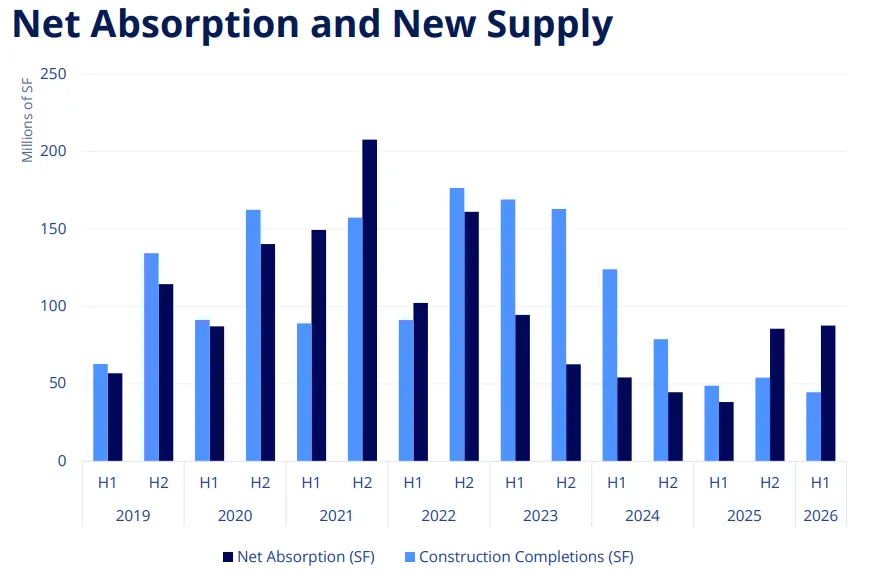
- Big box tenants signed 170.6M SF of leases in H1 2026, up 17% from late 2025 and the best six months since 2022, with net absorption reaching 87.6M SF.
- Vacancy slid to 9.4% from an 11.1% peak, with 750,000-plus SF buildings at 7.1%, as demand absorbed nearly twice the 44.6M SF of deliveries.
- Construction is rebuilding, to 142.6M SF from 113.1M SF in December, but mostly where vacancy has tightened, while average taking rents hit $8.87 per SF, up 3.9%.
Big box industrial tenants signed 170.6M SF of new leases in H1 2026, the busiest six months since 2022, according to Colliers’ mid-year North American Big Box Outlook.
Net absorption came in at 87.6M SF, more than twice the pace of a year ago and close to double the 44.6M SF of new supply.
Get Smarter about what matters in CRE
Stay ahead of trends in commercial real estate with CRE Daily – the free newsletter delivering everything you need to start your day in just 5-minutes
Vacancy Keeps Falling
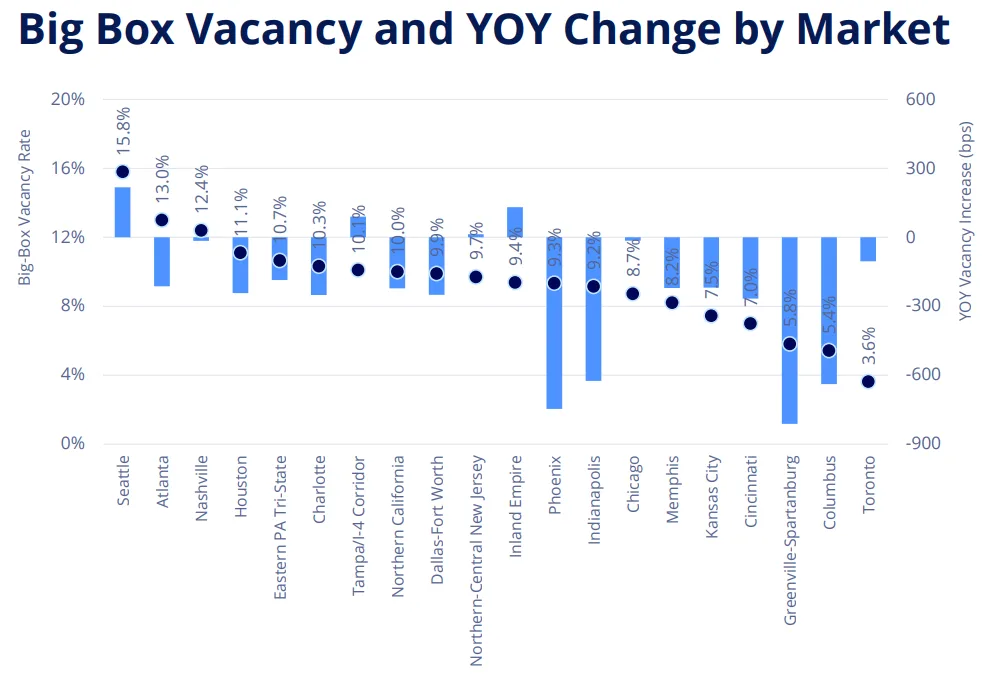
The vacancy rate dropped to 9.4%, 167 basis points below its 11.1% peak. Colliers covers 20 markets and about 4.1B SF of buildings of at least 200,000 SF with 28-foot clear heights.
Size matters. Vacancy is 11.5% for buildings of 200,000 to 499,999 SF, 8.3% in the middle tier and 7.1% for 750,000 SF and up, where absorption reached 36.7M SF.
Leasing volume was 81.1M SF in the smallest tier, 40.6M SF in the middle tier and 48.9M SF among the largest buildings.
Phoenix, Indianapolis, Greenville-Spartanburg and Columbus improved most, as strong absorption eased earlier worries about oversupply.
Market by Market
Phoenix vacancy collapsed to 9.3% from 16.8% a year earlier, and boxes above 750,000 SF are only 1.7% vacant. Recent leases there include deals over 1M SF with AWS, DHL and Fluidstack.
Dallas-Fort Worth vacancy fell 250 basis points since December to 9.9%. A Colliers broker noted that no vacant 1M SF buildings remain in the market, versus more than 10 a year ago.
Large-block deals come mostly from users tied to data centers, 3PLs and advanced manufacturers.
Houston dropped 247 basis points to 11.1%, reversing 2025’s increase. Chicago demand picked up as logistics users favored modern buildings, and a healthy pipeline of build-to-suit projects points to longer commitments.
The Inland Empire is the outlier, with vacancy up 45 basis points to 9.4% as it works through excess space. Nearby Southern California ports move roughly 40% of the country’s inbound freight.
Rents and Construction
Taking rents average $8.87 per SF, up 3.9% from a year earlier. The biggest buildings are cheapest at $7.51 per SF, against $9.36 for the smallest big boxes.
Rents are rising in inland logistics hubs where vacancy is tightening. Several coastal hubs are still digesting extra space and adjusting rents, Colliers says.
Space under construction grew about 26% in six months to 142.6M SF, the second straight increase, though it remains well short of the last cycle’s high. By tier, 61.3M SF is in 750,000-plus SF buildings, 58.3M SF in the smallest tier and 23.0M SF in between.
Zoom Out
The trend matches broader data. JLL reported that industrial leasing reached 202.6M SF in Q3, the best quarter since 2022, with vacancy steady at 6.8%.
The building boom isn’t back. Marcus & Millichap pegged industrial space under construction as down 60% from its 2022 peak.
Why It Matters
The size split matters for underwriting. The largest blocks are getting scarce in several markets, which sharpens competition for modern, well-located space, while smaller big boxes still carry double-digit vacancy.
Developers are following demand. Colliers describes the next phase as more selective and disciplined than the broad expansion of recent years.
What’s Next
With the largest tier carrying the biggest pipeline, the second-half question is whether absorption keeps outrunning deliveries as those projects open.