






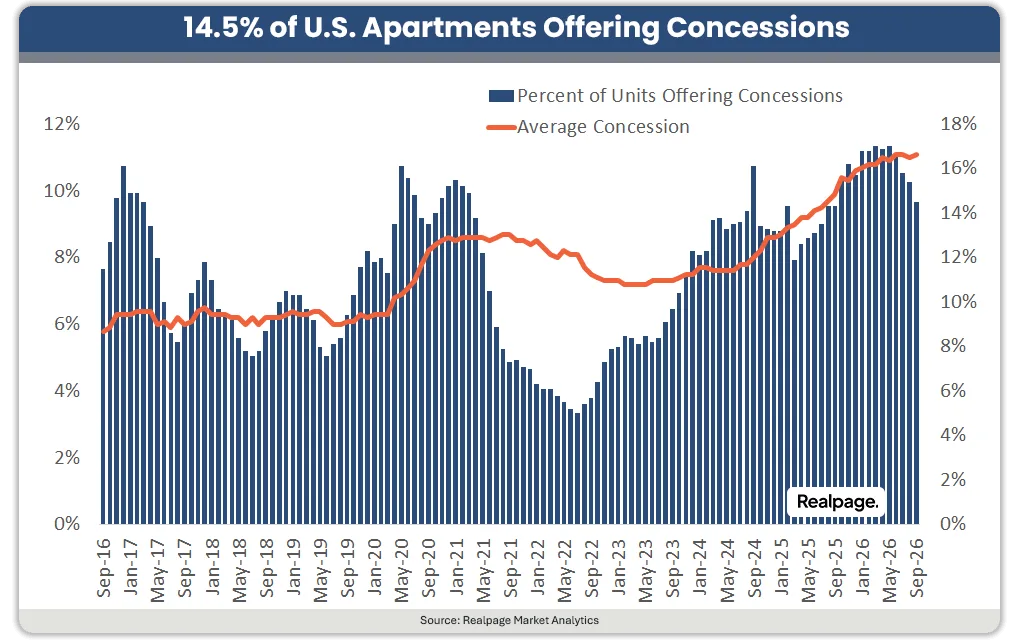
- Concession use fell for a fourth straight month to 14.5% of stabilized U.S. units in September, 2.5 points below its 17% level in May, with declines in every product class.
- The average discount edged up to 11.1%, about 5.8 weeks free on a 12-month lease, so owners are cutting how many units carry an incentive before cutting the incentive itself.
- Occupancy of 95.2% and 1.5% annual effective rent growth show stabilization, but a sustained drop in discount size is the missing proof that fundamentals are rebalancing.
Landlords are handing out fewer perks, but the ones they offer remain large. U.S. apartment concession use dropped for a fourth straight month in September, per RealPage Market Analytics.
Incentives reached 14.5% of stabilized units, the lowest share since September 2025. The average discount still sits at 11.1%, tying the deepest level in over 15 years.
Get Smarter about what matters in CRE
Stay ahead of trends in commercial real estate with CRE Daily – the free newsletter delivering everything you need to start your day in just 5-minutes
Reach Down, Depth Steady
Usage stood at 17% in May and has shed 2.5 points since. September posted the sharpest of the four monthly drops, 0.9 points.
A typical incentive works out to roughly 5.8 weeks of free rent over a one-year lease. Depth has crept up from 10.9% in May.
Class C Leads the Pullback
Class C, the most heavily discounted tier, fell 1.4 points to 18.1%. Class B dropped 0.8 points to 13%, and Class A slid 0.5 points to 12.5%.
That narrowed the Class C premium over Class A to 5.6 points from 6.5. By floorplan, efficiencies are still the biggest discount story: 17.1% of those units carry an average 12.2% reduction.
Echoes of 2010
RealPage notes a post-crisis parallel. In March 2010 the average concession was about 11%, nearly the same as today. The difference is scale: owners then discounted half of the stabilized stock, versus 14.5% now.
The pattern suggests operators first pare back which units get a deal, and only later shrink the deal.
Why It Matters
Underlying demand is steady. September occupancy averaged 95.2%, and effective rents at same-store properties grew 1.5% from a year earlier. Over 12 months, renters absorbed 323,106 units against 317,966 completions.
That fits the broader trend in multifamily rents, which are rising but cooling.
What’s Next
RealPage says calling a national turning point is premature. Evidence would come if both the share of discounted units and the depth of each discount keep falling together.