







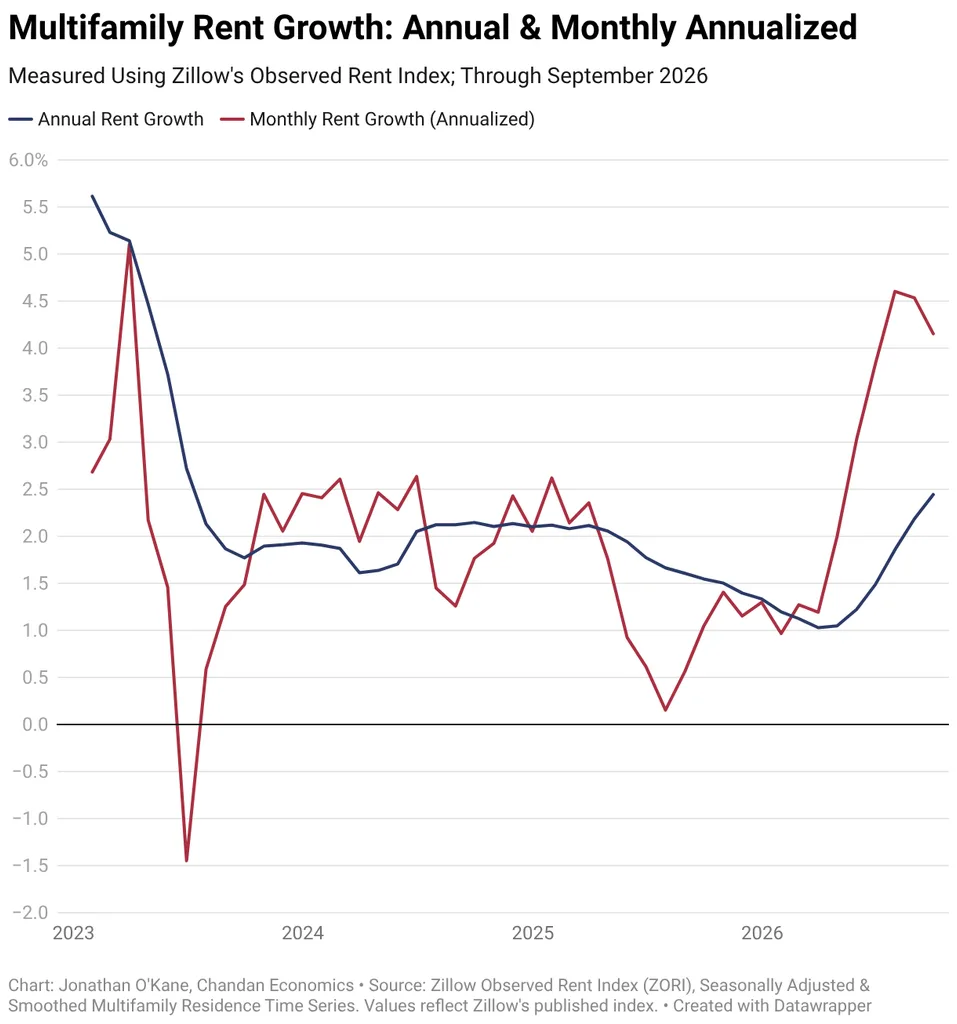
- National multifamily rents rose 2.4% year over year in September, up from 2.2% in August and 1.9% in July, after bottoming near 1.0% in March.
- Annualized monthly growth cooled to 4.15% in September from a 4.60% July peak, and the share of metros with monthly gains fell to 70.9% from 75.7% in June.
- San Francisco leads at 12.7% annual growth while San Antonio, Cape Coral and Houston lag, showing the Sun Belt is not one market and a ceiling for gains is forming.
Chandan Economics’ October update, built on the Zillow Observed Rent Index, puts September’s national year-over-year gain in multifamily rents at 2.4%, an improvement on both August (2.2%) and July (1.9%).
That makes six consecutive months of faster annual growth from a March trough near 1.0%, though Chandan Economics cautioned that some of the summer’s momentum is beginning to ebb.
Get Smarter about what matters in CRE
Stay ahead of trends in commercial real estate with CRE Daily – the free newsletter delivering everything you need to start your day in just 5-minutes
Monthly Momentum Slips
On a monthly basis, rents rose 0.34% in September, or 4.2% annualized, per Chandan Economics. The annualized rate has stayed above 3% since May and above 4% for the latest three months.
The trend is cooling, though. Annualized monthly growth peaked at 4.60% in July and has since stepped down to 4.53% and then 4.15%, Chandan Economics found.
Fewer Markets Are Gaining
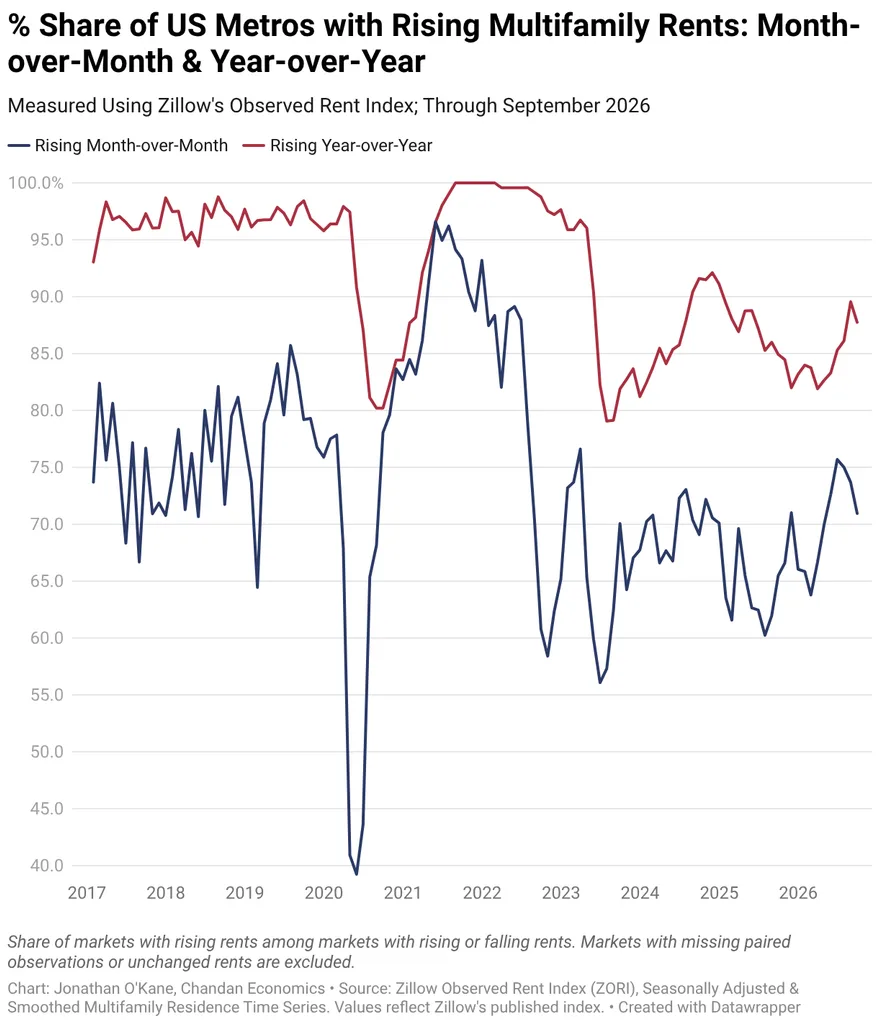
Breadth is narrowing too. Chandan Economics reported that 70.9% of U.S. metros saw rents rise in September, after 73.7% in August and a 75.7% high in June, marking the third monthly drop in a row.
For context, the share beats the 65.5% of a year earlier but trails the 76.4% average of 2017 to 2019, per Chandan Economics. On an annual basis, 87.7% of metros posted gains, compared with 89.6% in August.
Leaders and Laggards
Among the 100 largest metros, 90 registered annual rent increases, per Chandan Economics. San Francisco rents jumped 12.7% year over year, the strongest result, trailed by San Jose (8.9%), Boise City (8.2%), Virginia Beach (8.1%) and Toledo (6.9%).
At the bottom, San Antonio fell 1.7%, with Cape Coral (1.5%), North Port (1.3%), Denver (0.8%) and Houston (0.5%) also below year-ago levels, according to Chandan Economics.
Monthly data tell a more upbeat story for some of them. Of the ten metros with yearly declines, seven still saw rents rise in September, Chandan Economics reported; only Houston, Lakeland and Deltona fell on both measures.
Month to month, 91 of the 100 largest metros saw rents rise and 19 gained more than 0.5%, a pace above 6% annualized if sustained, per Chandan Economics. San Francisco led at 1.5%, followed by Boise City at 1.2%.
How the Data Is Built
The analysis relies on ZORI, with rents seasonally adjusted and smoothed and data running through September 2026, Chandan Economics said. Readers should treat the monthly figures as smoothed estimates, not raw listing prices.
Chandan Economics’ market-share calculations also leave out metros with missing observations or unchanged rents, and its pre-pandemic benchmark is the simple average of monthly shares from 2017 through 2019.
The Sun Belt Isn’t One Market
Several Southeastern metros outpaced the 0.34% national monthly gain, Chandan Economics reported: Durham rose 0.9%, Birmingham and Greenville 0.7%, and Jackson, Mississippi, and Charleston 0.6%. Each also posted annual growth.
Chandan Economics argued that, set against declines in parts of Texas and Florida, these results show why analysts should not treat the Sun Belt as a single rental market. Akron, meanwhile, had the largest monthly drop among the top 100 at 0.4% yet is up 4.1% year over year.
Why It Matters
The annual rate is now over twice its March low, and Chandan Economics said the string of monthly gains points to further annual acceleration in coming months. Monthly pace has stayed above a 4% annualized clip, comfortably ahead of the 2.4% yearly figure.
Chandan Economics’ outlook fits the demand side: CRE Daily reported that Zillow renter demand rose 19.2% as buyers turned to renting.
What’s Next
Chandan Economics sees limits emerging. Month-over-month gains have decelerated twice, fewer metros have posted monthly increases for a third straight month, and fewer also showed annual gains in September.
The yearly figure is still converging on the stronger monthly pace, so Chandan Economics expects it to climb, but near-term momentum is easing for the first time in this recovery.