







- Apartment cap rates averaged 5.39% when federal debt crossed $40T in August 2026, only about 0.7 points above the 10-year Treasury, the slimmest spread at any $10T debt milestone, per RealPage.
- The 10-year ended September at 5.29% after the Fed’s quarter-point hike, and about 13% of multifamily mortgage balances come due in 2026, mostly held by banks, insurers, debt funds and CMBS lenders.
- Sales volume runs near $194B a year, a little over half the 2022 level, while units under construction fell to about 550,000 from a peak of 1.1M in early 2023.
When federal debt passed $40 trillion on Aug. 18, 2026, apartment cap rates sat just a few tenths of a point over the benchmark 10-year note, according to RealPage.
That spread, about 0.7 points, is the slimmest at any of four $10 trillion debt milestones, and Treasury yields have climbed since.
Get Smarter about what matters in CRE
Stay ahead of trends in commercial real estate with CRE Daily – the free newsletter delivering everything you need to start your day in just 5-minutes
$10T in 2008: Demand Falls
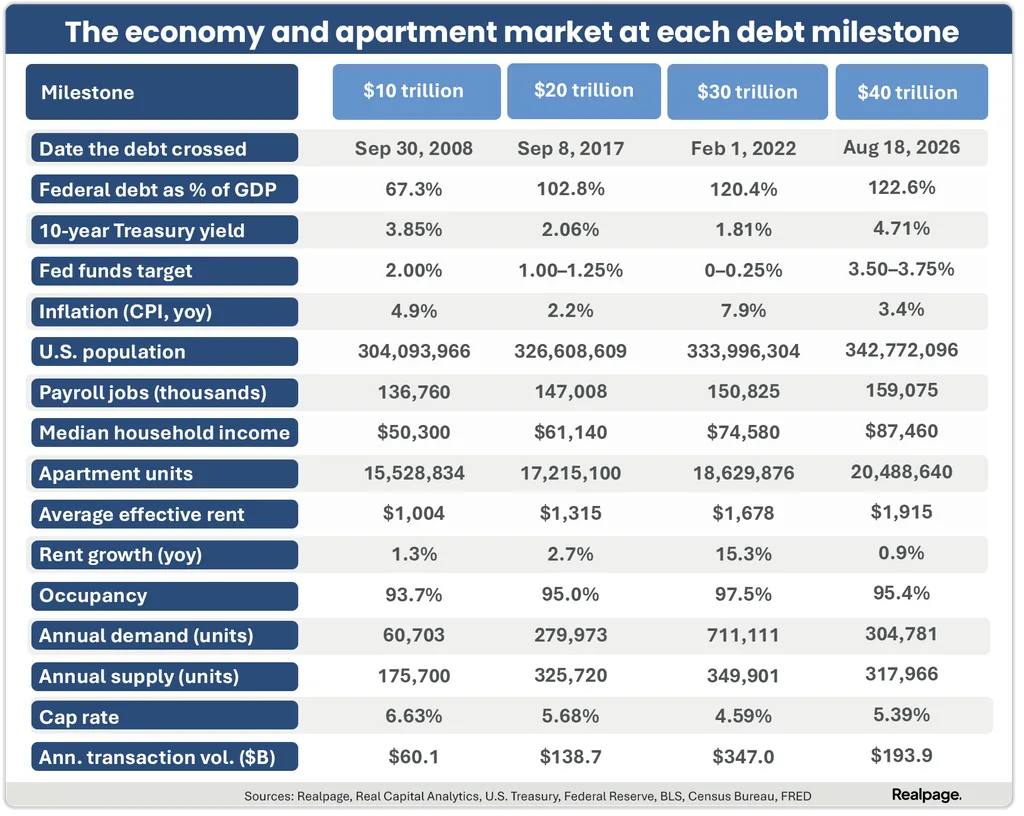
At $10T, in September 2008, the economy was in freefall. Job losses of about 1.6M cut apartment absorption to a mere 61,000 units, well under the 176,000 delivered, and occupancy fell to 93.7%.
$20T in 2017: Building at Full Speed
By $20T in September 2017, builders had opened roughly 326,000 apartments in a year, about double 2008, and renters took 280,000, keeping occupancy at 95%.
With the 10-year near 2% and cap rates at 5.68%, the spread over Treasuries was about 3.6 points, the widest of the four.
$30T in 2022: Record Demand, Cheap Money
At $30T, cheap money and surging demand collided. Absorption of 711,000 units was double completions, occupancy reached a record 97.5% and sales volume hit $347B.
Cap rates fell to 4.59% with the 10-year at 1.81%, and the Fed began tightening six weeks later.
$40T in 2026: Higher Borrowing Costs
At $40T, the apartment stock has grown by 1.86M units in roughly 4.5 years. Renters absorbed 305,000 in the past year versus 318,000 built, with occupancy at 95.4% and rents up 0.9%.
What differs is borrowing cost. Cap rates of 5.39% against a 10-year at 4.71% give the narrowest spread of the four.
Rates Have Moved Since August
A quarter-point Fed hike on Sept. 16 and a 10-year at 5.29% by month-end erased most of that spread on paper, though cap rates lag by several quarters. Freddie Mac’s mortgage rate hit 7.28% on Oct. 1, and sales are running near $194B annually, just over half the 2022 pace.
A spread this thin means buyers are counting on rent growth or prices must still fall, RealPage says. The MBA estimates 13% of multifamily mortgage balances come due this year, compared with about 4% of agency-backed balances, so most 2026 maturities sit with banks, insurers, debt funds and CMBS lenders.
Debt in Perspective
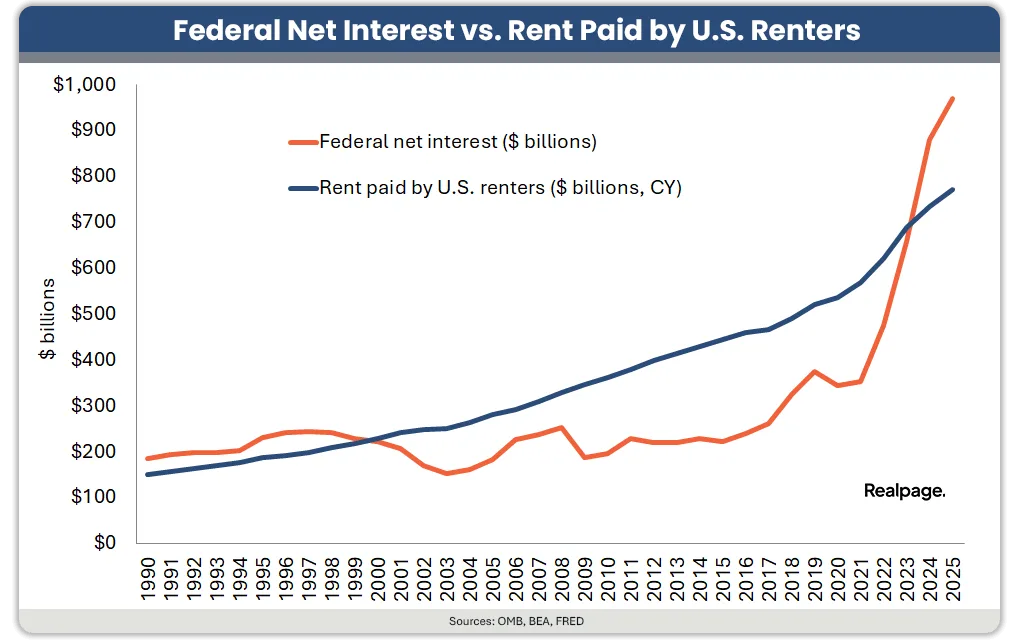
Relative to GDP, federal debt is nearly flat since early 2022, but per household it is more than triple its 2008 level, at about $297,100. Servicing it cost households about $7,200 apiece in fiscal 2025, or roughly 3.8 months of average rent.
Where Developers Built
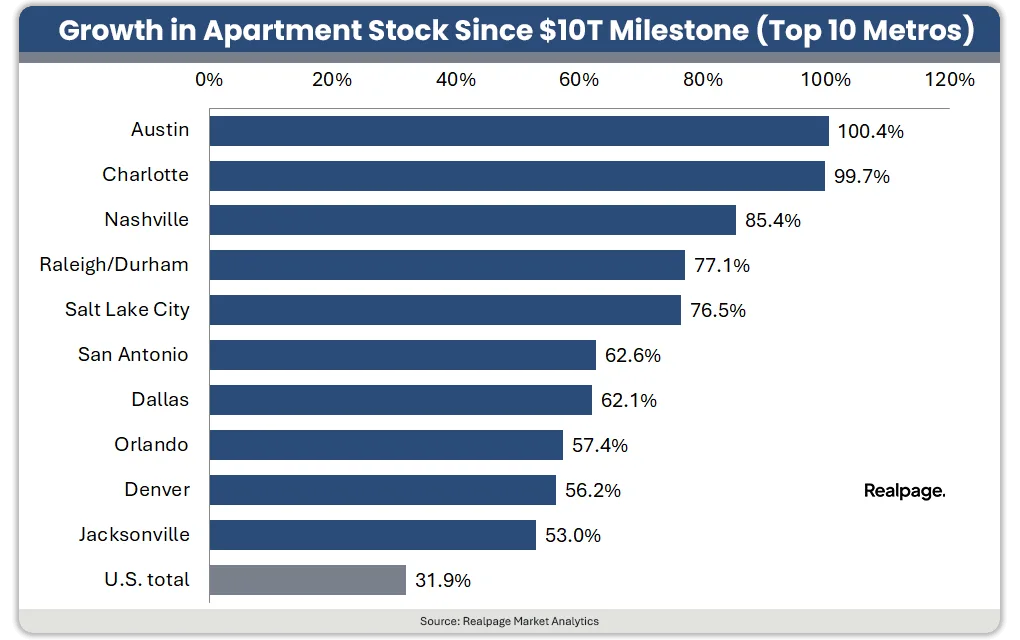
The apartment stock has grown by about 5M units since 2008, against 22M new jobs. The build was lopsided: Austin and Charlotte roughly doubled their stock, and Salt Lake City, Nashville and Raleigh/Durham each rose by more than 75%.
Rents have cooled most where deliveries topped 2% of stock, as in Denver, San Antonio and Charlotte, while San Francisco and San Jose show the firmest rents, with deliveries under 0.5% of stock.
Why It Matters
A thin spread leaves little margin for error because Treasury yields anchor apartment loan pricing and values. Further yield increases would push up financing costs and cap rates, while easing inflation could reverse that.
Fundamentals are holding, as CRE Daily reported when apartment demand neared supply, but financing is a headwind as multifamily distress builds.
What’s Next
The construction pipeline has halved from 1.1M units in early 2023 to roughly 550,000, so deliveries should ease soon. Slower immigration, which fell from 2.7M to 1.3M people in the year through July 2025, may also temper demand.