







- The 2025 One Big Beautiful Bill Act made the Opportunity Zone incentive permanent, with revised tax rules applying to qualifying investments made after December 31, 2026.
- Investors who hold five years can cut the taxed gain by 10%, or 30% in rural zone funds, and a 10-year hold can exclude qualifying appreciation from federal capital gains tax.
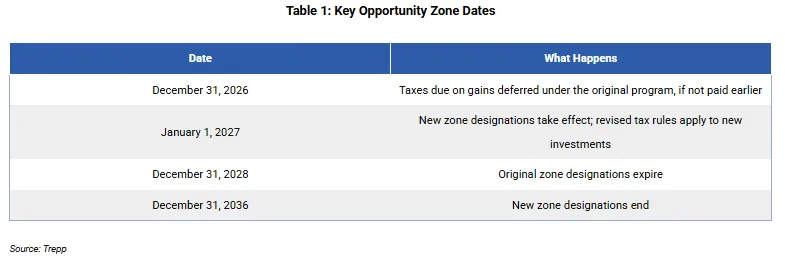
- A new round of zones takes effect January 1, 2027, while first-round designations expire at the end of 2028, so project timing and location now matter more.
Opportunity Zones are now permanent, and the rules that apply to new investments change in 2027, according to Trepp’s Opportunity Zone primer.
Multifamily developers have leaned on the program most, Trepp says, and the 2025 changes reset its terms for ten years. That makes the details worth knowing.
Get Smarter about what matters in CRE
Stay ahead of trends in commercial real estate with CRE Daily – the free newsletter delivering everything you need to start your day in just 5-minutes
How Zones Work
The 2017 tax law created the program to draw investment into struggling communities. Designations in 2018 covered 8,764 census tracts.
An investor with a capital gain has 180 days to roll it into a Qualified Opportunity Fund. At least nine-tenths of that fund’s assets must sit in qualifying zone real estate or businesses.
Existing Buildings vs. New Construction
A building in a zone isn’t automatically eligible. For an existing one, the buyer generally must put real money into upgrades within 30 months, and that spending has to top the building’s tax basis, not counting land. With a $5 million basis, that means more than $5 million of work.
Ground-up projects face no such test. They qualify when a fund that meets the 90% rule builds them in a zone.
What Changed in 2025
Originally, investors could postpone tax on rolled-over gains until the earlier of a sale or the end of 2026. Those who invested by the end of 2021 earned a 10% cut after five years, and those in by the end of 2019 got 15% after seven. Both windows have closed to new money.
The One Big Beautiful Bill Act, enacted in July 2025, turned the incentive into a permanent one, with new rules for money invested from 2027 onward. Deferral now lasts until a sale or the five-year mark, whichever is first.
Hold for five years and 10% of the original gain drops out of taxable income. A qualified rural fund raises that to 30%. At 10 years, an investor can elect to shield gains on the investment itself from federal tax on capital gains.
A Dallas Case Study
Barrett Linburg, founding partner of Dallas multifamily firm Savoy Companies, laid out his strategy in an episode of TreppWire, Trepp’s podcast. Savoy bought eight properties in North Oak Cliff in 2020 and 2021, in a neighborhood Linburg called blighted even though it sits near major employers and the Bishop Arts District.
Savoy now has 22 properties and 800-plus units, more than 90% occupied. Linburg said each acquisition raised the surrounding area and the value of earlier purchases, the outcome he says lawmakers intended.
Why It Matters
Zone maps are about to change. Every original zone loses its status at the end of 2028 unless it is picked again. A new round of designations runs from January 1, 2027, through December 31, 2036, and money invested while a tract was designated keeps its tax benefits.
Texas shows how big the change could be. We looked earlier this month at the newly nominated tracts across DFW’s four major counties: 90 of them, more than triple the first round. Linburg told Bisnow that Dallas alone could add $250 million to $300 million of equity a year.
What to Watch
Trepp lists three open questions. One is whether the end-of-2026 tax bill on deferred gains pushes owners to sell or refinance. Another is how many current zones disappear, and how that hits projects still being planned.
The third is whether the richer 30% reduction pulls capital into smaller markets. The 2027 designations should start to answer that.