







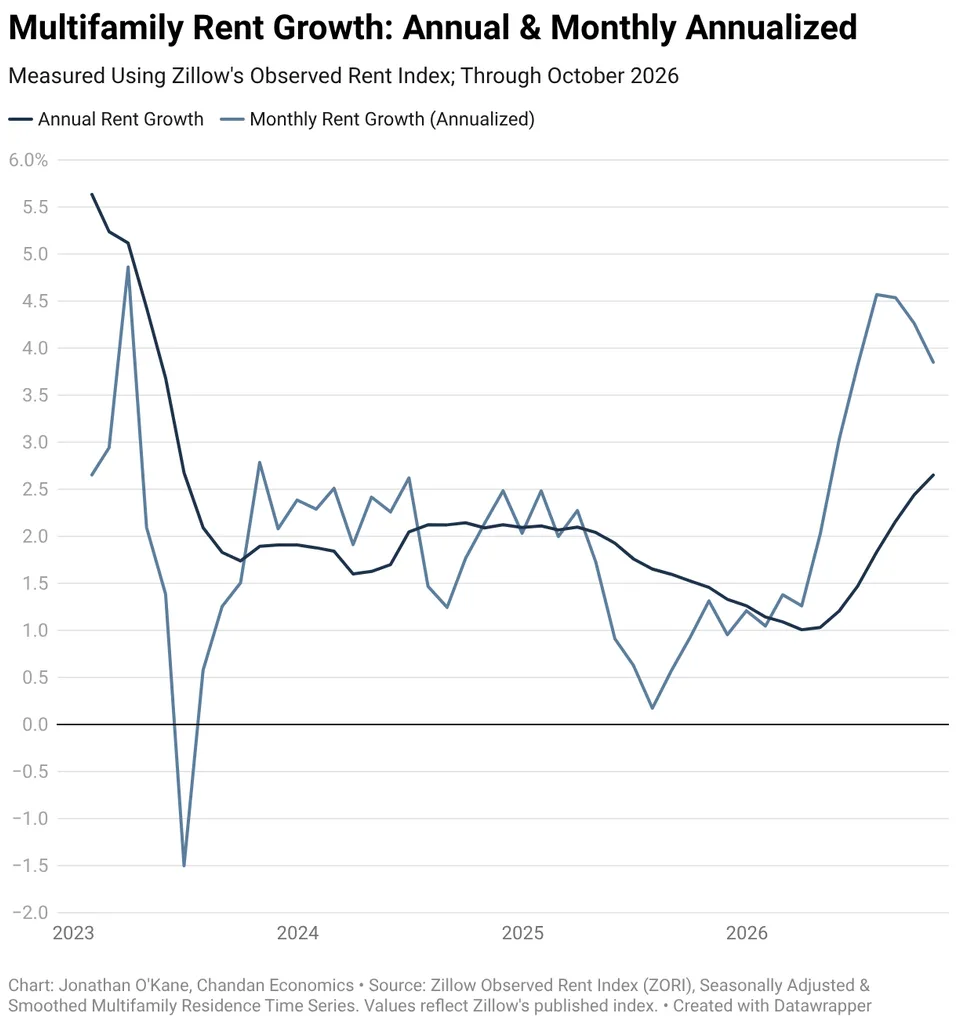
- Zillow’s rent index shows national multifamily rents up 2.7% year over year in October, from 2.4% in September, with annual growth rising every month since a March low near 1.0%.
- Monthly growth slowed to 0.32%, a 3.85% annualized pace and the first reading under 4% since June, and only 69.3% of metros posted monthly increases.
- Chandan expects annual growth to keep rising on easy comparisons, but warns that higher asking rents may not reach property income quickly if owners lean on concessions.
Apartment rents keep recovering, but the momentum is fading. Chandan Economics’ November rent growth update has national multifamily rents 2.7% above their level a year earlier as of October, after a 2.4% reading in September.
The analysis relies on Zillow’s rent index, seasonally adjusted, with data through October.
Get Smarter about what matters in CRE
Stay ahead of trends in commercial real estate with CRE Daily – the free newsletter delivering everything you need to start your day in just 5-minutes
Annual Gains Build
The yearly rate has climbed monthly since a March trough near 1.0%. Each step is smaller, though, falling from about 0.33 points in August to 0.21 in October.
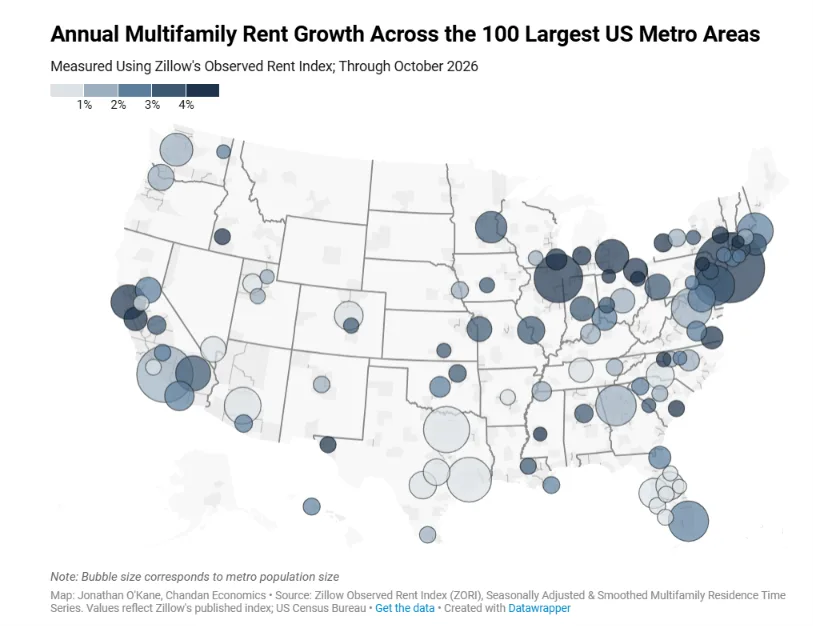
Among the biggest 100 metros, 93 now show annual increases, versus 90 a month earlier. Tampa, Deltona and Salt Lake City crossed back above zero.
Monthly Pace Cools
October’s sequential gain was 0.32%, which annualizes to 3.85%. Summer ran hotter, with annualized paces above 4.5% in July and August, and this is the first reading under 4% since June.
Breadth is thinning too. Only 69.3% of metros in the wider sample logged a monthly increase, the fourth consecutive drop, and 7.4 points below June’s peak of 76.6%.
Thirteen of the top 100 metros flipped from monthly growth to decline, though eight of those dips were smaller than 0.1%. Toledo fell 0.53%, with Madison, Poughkeepsie and Augusta slipping as well.
Winners and Laggards
San Francisco leads at 13.3% annually, followed by San Jose (9.5%), Boise (9.0%), Virginia Beach (8.6%) and Charleston (5.1%). Apartments.com data we covered showed the same pull from AI hiring, with San Francisco rents up 12.4% from March.
Only seven large metros still show annual declines. San Antonio is down 1.0%, North Port 0.7%, Houston 0.3%, Lakeland 0.3% and Denver under 0.1%.
Several weak markets are closing the gap. Cape Coral’s annual drop narrowed from 1.46% to 0.06%, and Houston’s small monthly gain means no top-100 metro fell on both measures.
Why It Matters
Annual figures show ground covered over a year and can hide a change in direction. Toledo is still up 4.3% annually despite October’s steepest monthly drop, while Cape Coral is slightly negative annually despite a strong month.
Chandan also cautions that asking rents may take time to reach property income, since owners can hold advertised rents while offering incentives. CRED iQ’s loan data, which we covered, showed median occupancy of 94% but NOI down 0.2%, with apartment concessions cited as the reason.
What’s Next
The 0.32% monthly gain compares with only about 0.11% a year ago, so annual growth can keep climbing even as the monthly pace eases. The test is whether summer’s momentum returns or the cooling continues.