






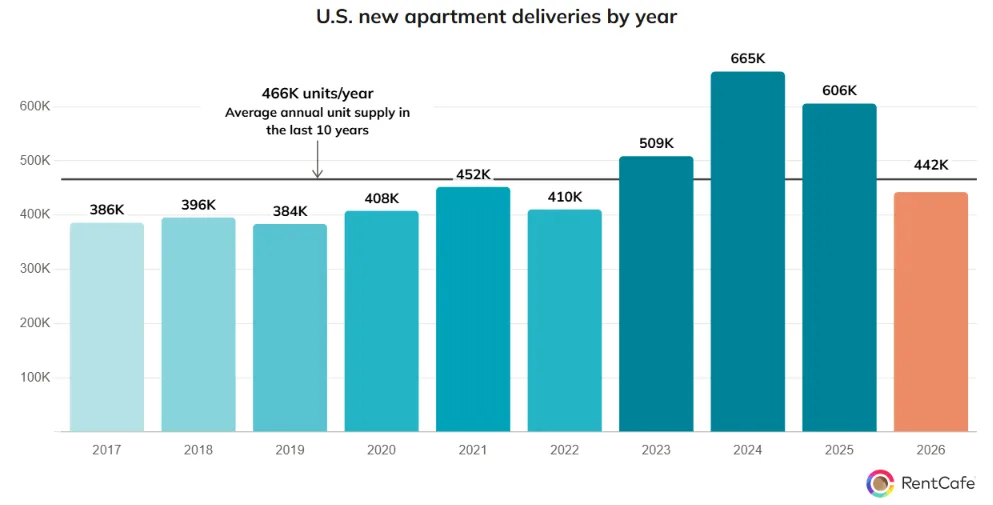
- RentCafe expects 442,395 new apartments in 2026, 27% below 2025’s 605,768 and under the 10-year average of about 466,000 for the first time in four years.
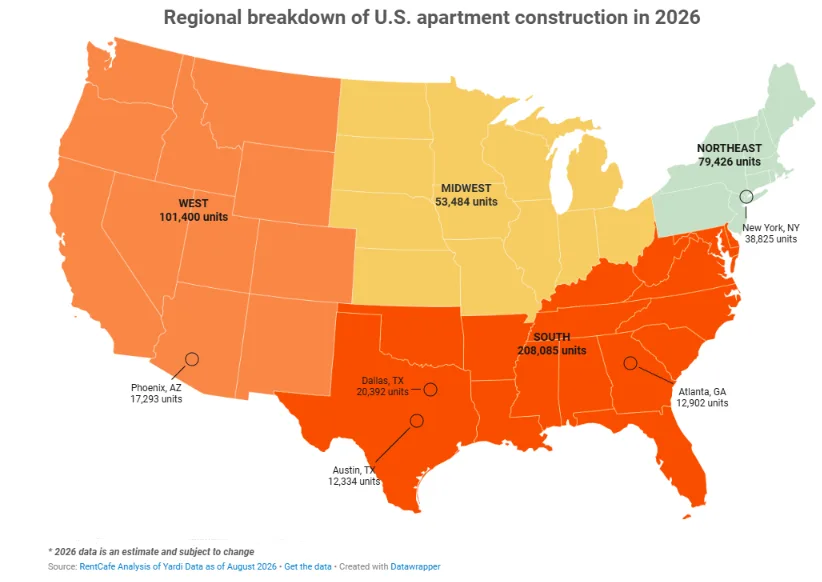
- The Northeast is the only region building more, up 20% to 79,426 units, led by New York metro at 38,825 units and Brooklyn at 13,011, the most of any city.
- Dallas, Austin and Raleigh show steep declines after the Sun Belt wave, which suggests fewer options for renters in those markets heading into 2027.
New apartment construction is cooling fast. RentCafe’s analysis of Yardi data projects 442,395 completions in 2026, 27% fewer than last year’s 605,768.
That total drops under the decade average of roughly 466,000 for the first time since 2022.
Get Smarter about what matters in CRE
Stay ahead of trends in commercial real estate with CRE Daily – the free newsletter delivering everything you need to start your day in just 5-minutes
Regional Split
The South still supplies nearly half the new units, 208,085 or 47%, with Texas (56,394) and Florida (50,392) on top. North Carolina and Georgia follow.
The West adds 101,400, with California at 38,201, and the Midwest adds 53,484, around 12%.
One region bucks the trend. The Northeast is building 79,426 units, 20% more than last year, driven by New York (30,171) and New Jersey (19,289).
New York Leads
The New York metro will open 38,825 apartments, 11.4% above last year and more than any market. Dallas follows at 20,392 and Phoenix at 17,293.
Among individual cities, Brooklyn ranks first with 13,011 units, a 37.3% jump. Jersey City’s 4,637 units mark an increase above 800%, and Queens and Manhattan add 4,072 and 3,944.
Steepest Drops
Lakeland, Florida sees completions fall 74.3% and Jacksonville 72.4%. Raleigh is off 66.1%, Austin 60.4% and Dallas 45.1%.
RentCafe notes that many of those markets are still absorbing recent openings, so renters there can expect concessions even as pipelines shrink.
Zoom Out
The pipeline remains large by historical standards. Yardi Matrix’s count, which we covered, showed 1.2 million apartments under construction nationally, about 85% due by the end of 2027, with Greystar the largest builder. Phoenix, third on RentCafe’s list, is also where TSMC’s $265 billion campus is boosting suburban demand.
Why It Matters
RentCafe frames the slowdown as an end to the post-pandemic supply surge, not weaker renter demand. In places where building is slowing most, choices may narrow heading into 2027.
What’s Next
RentCafe expects 2026 and 2027 to deliver fewer apartments than 2024 and 2025. Affordable and mixed-income projects should account for most growth beyond pre-pandemic levels.