






- Harvard’s Joint Center for Housing Studies proposes 40-year amortizing federal loans covering 90% to 100% of development costs, paired with cost-based rents for affordable housing.
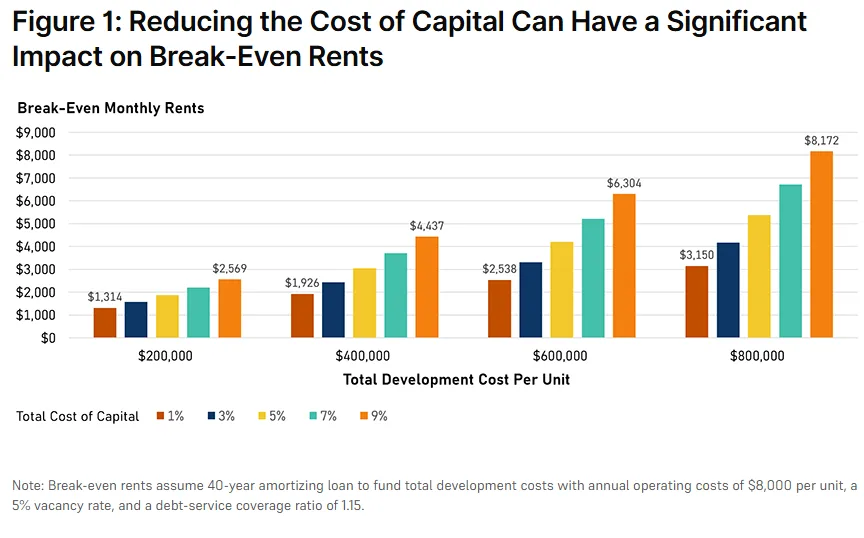
- At a $600,000 development cost, cutting the cost of capital from 9% to 1% saves about $3,800 a month in rent, twice the savings from trimming $200,000 in costs.
- The center’s simulations show $4.5 billion in subsidy could support 60,000 homes affordable at 80% of area median income at $330,000 per unit, but only 20,000 at $470,000.
Harvard’s Joint Center for Housing Studies is proposing a federal loan program to finance below-market rental housing, according to a blog post by the center’s Chris Herbert and Henry Walther.
The loans would run 40 years, cover 90% to 100% of development costs and carry rates between 0% and the federal funds rate.
Get Smarter about what matters in CRE
Stay ahead of trends in commercial real estate with CRE Daily – the free newsletter delivering everything you need to start your day in just 5-minutes
Cost-Rents Explained
The proposal combines cheap, long-term debt with cost-rents. These rents cover operating costs, loan payments, a limited equity return and maintenance reserves.
The authors argue that cheap debt alone can deliver moderate affordability, even in expensive markets. In less expensive areas, it could achieve deeper affordability.
Capital Cost Beats Construction Cost
Consider a $600,000 project financed at a 9% blended cost of capital. Cutting $200,000 in costs through regulatory reform, efficiency gains or donated land reduces monthly rent by roughly $1,900. However, lowering the capital cost to 1% cuts rent by about $3,800.
Therefore, capital costs matter even more as projects become more expensive.
Still, cheap debt has limits. At a 1% capital cost, a $400,000 unit would be affordable at 80% of national median family income. By comparison, a $600,000 unit would require 106% of that income. Deeper affordability requires additional support.
How It Would Work
State and local housing agencies would administer the program. The model would borrow from the LIHTC template, with subsidies allocated by formula. Washington would set affordability floors at 80% of area median income for rentals and 100% for shared-equity homeownership. States could set lower thresholds.
Projects would remain affordable permanently. They would also have to accept vouchers from their lowest-income tenants. Public, nonprofit and for-profit sponsors could all participate.
For funding, the authors propose redirecting a 10-basis-point levy. Fannie Mae and Freddie Mac currently charge this fee on their loans to help fund the infrastructure law. Once that commitment ends in 2030, redirecting the levy could raise an estimated $4 billion to $5 billion annually.
Meanwhile, public housing funding is also advancing at the ballot box. Our report on $67 billion of municipal bonds covered California measures for affordable housing and home-buying assistance.
Lessons From Abroad and at Home
Austria and Denmark have long combined cheap debt with cost-based rents. Ireland has also begun adopting the approach. In the U.S., HUD’s Section 236 produced 540,000 units in five years. Additionally, USDA’s Section 515 supported 500,000 rural rentals from 1962 until new funding ended in 2011.
Why It Matters
In 18 large metros, $4.5 billion in subsidies paired with federal-funds-rate borrowing could support 60,000 homes. Those units would be affordable at 80% of area median income, assuming a cost of $330,000 per unit. At $470,000 per unit, the same subsidy would support just 20,000 homes.
The authors also found that cost-rents paired with low-cost debt kept rents from outpacing incomes in most markets during the recent inflation. For developers, the proposal offers a simple capital stack with stable debt service.
What’s Next
The authors describe the proposal as a starting point for debate. However, setting cost-rents will require more research. The funding source also depends on what lawmakers decide when the 2030 commitment ends.