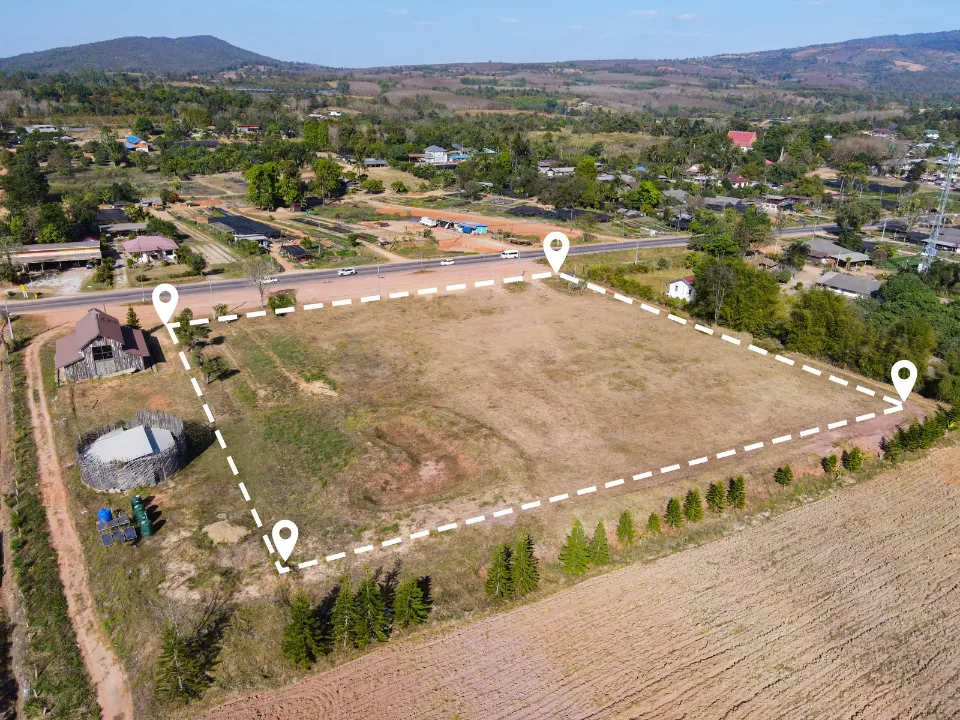





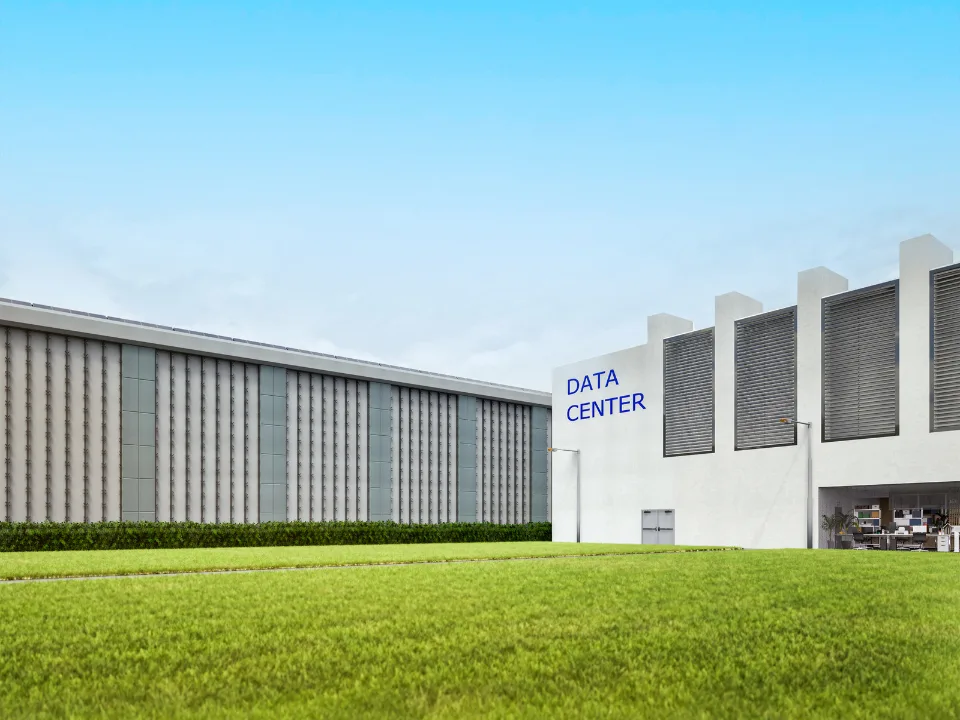



- CBRE Research finds warehouses sitting among 11 or more data centers rent for about 6.8% more than comparable buildings elsewhere, and 9.8% more near clusters of 21 or more.
- The premium peaks near 14% for specialized R&D buildings and drops to about 5% for distribution space, with Northern Virginia and Silicon Valley holding the most in-cluster inventory.
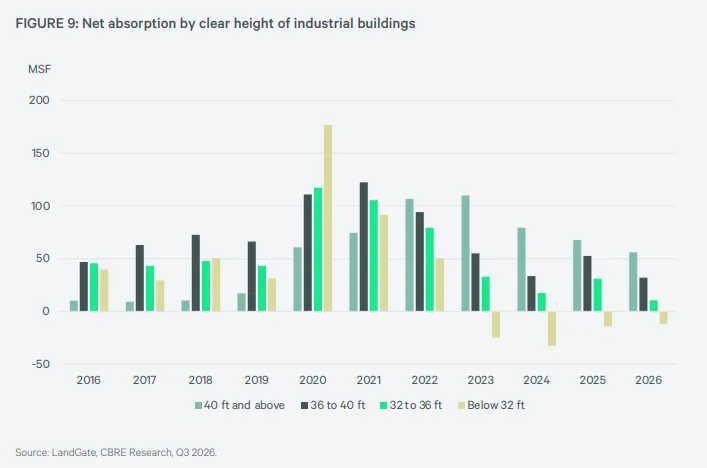
- AI automation is changing the buildings too: warehouses with ceilings of 40 feet or higher have led leasing gains every year since 2022, while older, low-ceiling space struggles.
Warehouses sitting near data center clusters rent for about 6.8% above similar buildings elsewhere, CBRE Research reports in part three of its four-part series on AI and commercial real estate.
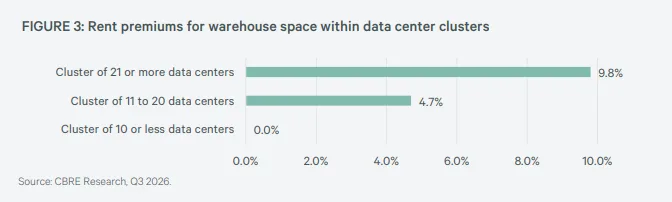
CBRE counts a cluster as 11 or more working data centers inside roughly two miles. Next to 21 or more, the premium grows to 9.8%. Near ten or fewer, there’s none.
Get Smarter about what matters in CRE
Stay ahead of trends in commercial real estate with CRE Daily – the free newsletter delivering everything you need to start your day in just 5-minutes
How CBRE Measured It
CBRE built a model of how quickly a warehouse leases up, using roughly 200 building traits across 50 markets, grouped into 13 categories. Building quality and location rank first and second. Power availability and expense rank right behind.
An operating site is the best evidence that power exists. About 3,100 U.S. colocation facilities, 240 enterprise sites, 200 cloud sites and 119 hyperscale campuses operate today, meaning smaller facilities outnumber hyperscale roughly thirtyfold.
Where the Premium Is Biggest
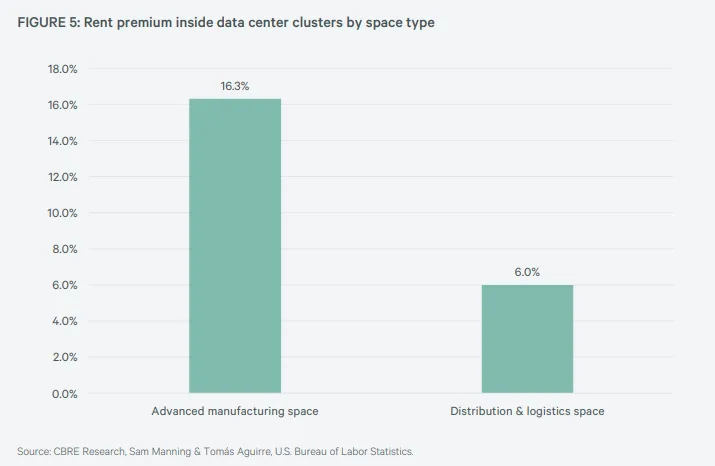
Specialized R&D buildings command about 14% over similar space outside clusters, while distribution buildings get about 5%. Power is a big reason. Per the U.S. Energy Information Administration, R&D buildings burn around six times the electricity per SF of an ordinary non-refrigerated warehouse.
Clusters made up solely of colocation sites carry a premium near 6.0%. Hyperscale campuses tend to sit on the edge of metros, where few industrial buildings exist to compare.
Higher rent doesn’t mean more deals. Leasing inside clusters grew 17.0% in H1, nearly level with the 17.4% gain outside them.
Who Leases There
CBRE reviewed close to 48,000 leases inked from 2025 onward, and about 1,500 sit inside clusters. Tech tenants hold 13.9% of those, compared with 7.1% elsewhere. Specialized R&D users take 35.0% versus 19.0%.
Distribution and logistics firms make up only 37.1% of in-cluster leases, against 55.7% outside. Manufacturers occupy 34% of cluster space, compared with 13% elsewhere.
Demand extends to yards. CRE Daily reported CBRE data showing industrial outdoor storage rents up 32% since 2021.
Warehouse Roofs Are Rising
Robots and automated picking need height and electrical capacity. Space with ceilings of 40 feet and up has driven net leasing growth annually since 2022, adding 67.9M SF in 2025. Buildings under 32 feet saw 14.1M SF of leased space come back to market.
Age is a handicap. CBRE tracks 233,000 industrial buildings, and about 134,000 of them are more than four decades old. A vacancy in one of those has about a 46% chance of lingering three years with no new lease, versus 26% for newer product built in the past five years.
Why It Matters
Because almost nothing is being built inside established clusters, CBRE calls the premium durable. Its pick for investors is R&D-oriented buildings in mature hubs where power is already proven, not land beside a freshly announced campus.
Northern Virginia has nearly 44% of its industrial space inside clusters and Silicon Valley about 34%, versus under 3% nationally. Local rules could also shape where new clusters appear, with many towns weighing data center restrictions.
What’s Next
Nearly half of data centers now being built are hyperscale, against 3.2% of existing ones, so CBRE says the national cluster count could rise about 40%. Most will have few warehouses close by.
Phoenix, Boston and Milwaukee break the pattern, with plenty of existing space. CBRE also flags Atlanta, Chicago, Dallas-Fort Worth and Columbus.
Investors should build the premium into underwriting for warehouses near data centers, CBRE says. Occupiers planning automation should take 40-foot-plus, power-rich space now, since supply tightens each year, and lock in deals while neighboring projects are still in planning. Landlords gain leverage once those centers go live.