






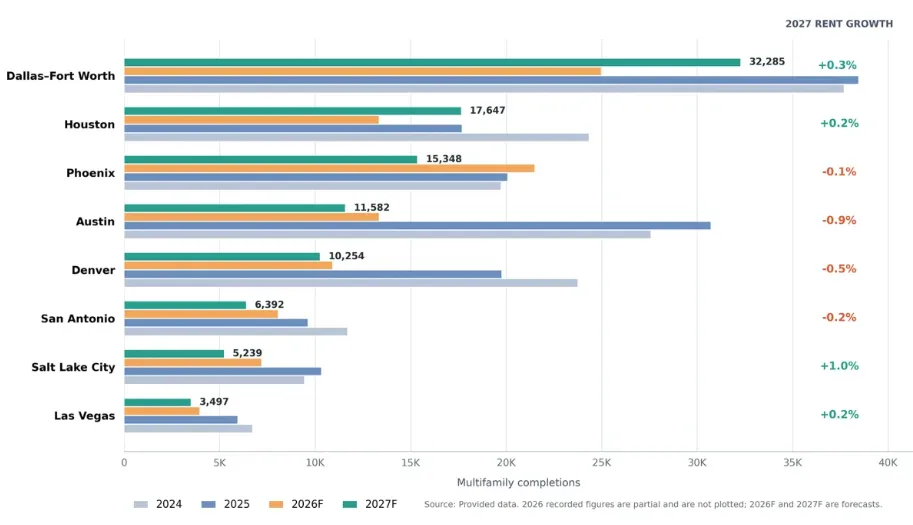
- Sun Belt apartment markets are heading toward balance at different speeds, with Austin and San Antonio furthest along and Dallas-Fort Worth still carrying more than 40,000 units under construction.
- National deliveries peaked at 696,000 units in 2024, fell to 531,000 in 2025, and are on track for about 421,000 in 2026, with CoStar expecting another 24% drop in 2027.
- Cooling domestic migration and weaker immigration are shrinking the renter pool, so tight conditions by 2028 in markets like Phoenix and Austin could be derailed if demand softens.
The Sun Belt multifamily market is working off its construction-boom oversupply at very different speeds, according to Commercial Observer.
Starts have collapsed and deliveries are falling, but slower migration and September’s Fed hike complicate the path back.
Get Smarter about what matters in CRE
Stay ahead of trends in commercial real estate with CRE Daily – the free newsletter delivering everything you need to start your day in just 5-minutes
How the Glut Built Up
Renter migration and cheap financing fueled a pandemic-era building spree. Per Yardi Matrix, rents climbed 30% between 2021 and 2024 while 673,000 units were added.
The industry expected the surplus to clear within two years, but it has not cleared evenly. Yardi first projected positive rent growth in high-supply markets by the end of 2026, then pushed that to year-end 2027 as starts fell and absorption improved.
Starts and Deliveries Plunge
National starts totaled just 55,000 units in Q1 2026, the lowest quarter since 2011 and 73% under its early 2022 high. In the Sun Belt, starts are roughly 75% off their 2022 high and the pipeline of units underway has shrunk to its 2016 size, according to Marcus & Millichap.
Deliveries peaked at 696,000 units in 2024 and fell to 531,000 in 2025. The market is on pace for about 421,000 this year, and CoStar sees another 24% decline in 2027. PwC still flags pipeline imbalances in Orlando, Austin, Miami, Nashville and Phoenix, though Orlando multifamily rebound shows how quickly falling construction can help.
A Market-by-Market Spread
John Orsak of Lincoln Property Company said Austin posted record quarterly absorption this summer with modest rent growth, calling it a huge turnaround. Houston’s third-quarter vacancy gain was its best in roughly five years, and Phoenix absorbed around 17,000 apartments during January through June.
Dallas-Fort Worth absorbed about 25,000 units but still has more than 40,000 under construction, which Orsak expects to test the balance into 2027. Yardi’s absorption-to-completion ratios put San Antonio at 1.7x and Austin at 1.3x.
South Florida is mixed. Miami’s vacancy rate was 6.4% in August, down from 6.8% in July, while Port St. Lucie rose to 7.5% and Tampa reached 8.5%, per Apartment List.
Migration Cools
Redfin data show Tampa’s domestic inflow fell 70% in a year, Orlando’s nearly disappeared and Atlanta flipped to a net loss. Florida’s statewide net domestic migration shrank to about 64,000 from 314,000 in 2022. Texas still led the country at roughly 76,000 in 2024, though that was a 44% drop.
Phoenix and Las Vegas bucked the trend. Phoenix’s inflow grew to 21,364, while Las Vegas more than doubled to 12,225.
Immigration is also fading. The Census Bureau projects net immigration dropping to roughly 321,000 for the 12 months through June 2026, from 1.3 million a year earlier. HUD estimates immigration drove at least two-thirds of net renter household growth from 2021 through 2024.
Why It Matters
Orsak says the Fed’s quarter-point hike cuts both ways: cheap money caused the glut, but pricier capital could produce an “air pocket” in 2027 and 2028 as new supply thins. Analysts see Phoenix, Charlotte, Fort Worth and Austin reaching their tightest markets in years by 2028.
That would extend the early recovery already visible as rents turn positive nationally, though weaker migration could upend the forecast.
What’s Next
Yardi expects positive rent growth in every major high-supply market by year-end 2027. A PwC report quotes a trade group executive saying the recovery will be a slow process, not a switch flipped all at once.