






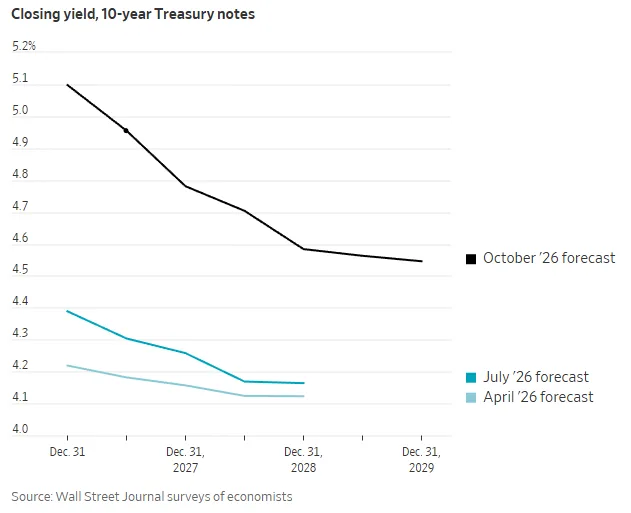
- Economists expect the 10-year yield to finish 2026 at 5.1%, up sharply from July’s 4.4% forecast, and see it easing only slowly, to 4.78% by the end of 2027.
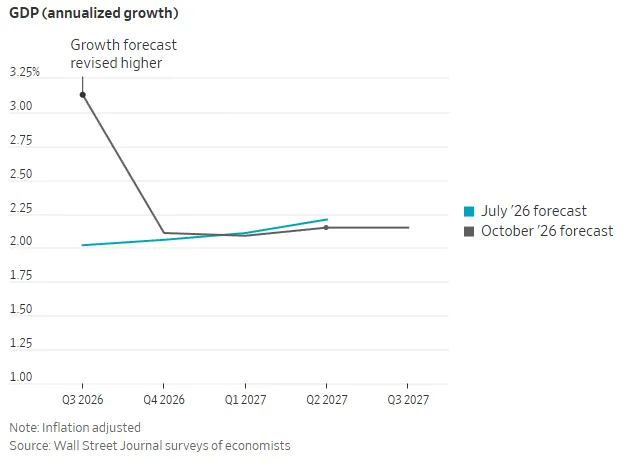
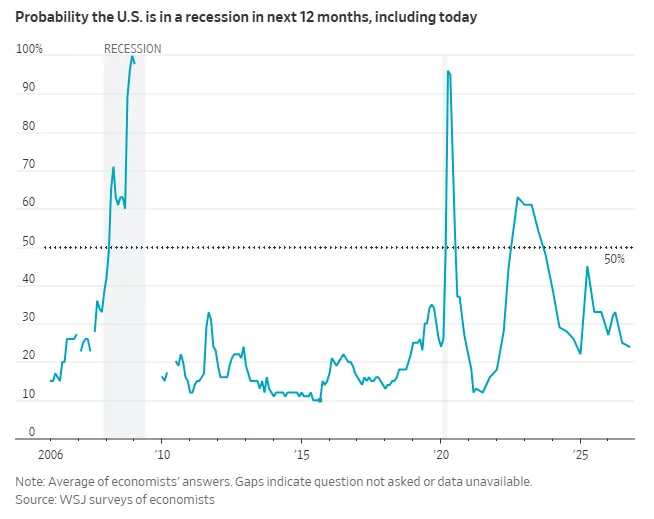
- Forecasters cite firmer growth, new inflation pressure and worries about the federal debt, with 2026 GDP growth projected at 2.4% and a 24% chance of recession over the next 12 months.
- Higher Treasury yields push up mortgage and corporate borrowing costs, so commercial real estate owners should plan around elevated financing costs for years rather than a quick reversal.
A new Wall Street Journal survey of 71 economists, fielded Oct. 2-7, puts the 10-year Treasury yield at 5.1% by the end of 2026, versus the 4.4% they forecast in July.
The bigger message is duration. Forecasters no longer treat the climb in long-term rates as a blip, and expect borrowing costs to stay high well beyond this year.
Get Smarter about what matters in CRE
Stay ahead of trends in commercial real estate with CRE Daily – the free newsletter delivering everything you need to start your day in just 5-minutes
A Slow Glide Lower
Respondents expect the benchmark to ease to 4.96% by June 2027. By December 2027, they see it reaching 4.78%. Both estimates exceed the July survey’s forecasts of 4.3% and 4.26%.
Meanwhile, The Wall Street Journal reports that yields have reached their highest levels in about 25 years. Stronger economic growth and renewed inflation pressures have contributed to the rise. Concerns about federal finances have added to the pressure. As a result, several economists have reconsidered how strongly investors will continue buying Treasurys.
Why Rates May Stay Elevated
Allen Sinai of Decision Economics argues that the Fed remains behind on inflation. This view persists despite September’s hike, its first in three years. The Fed’s own projections also show its policy rate above 4% this year and holding there through 2027.
Sinai expects the 10-year yield to approach 6% in 2027. He also sees it staying above 5% for the rest of the decade. That outlook resembles PIMCO’s 6% warning.
Carl Tannenbaum of Northern Trust takes a less aggressive view. He projects yields near 5.2% through 2028 and 5% in 2029. However, he sees competing forces at work. Rising federal debt and AI-related capital demand could push yields higher. Conversely, a settlement of the Iran conflict could help bring them down.
Growth Up, Inflation Sticky
Forecasters raised their 2026 GDP growth estimate to 2.4%, up from 2.1% in July. A stronger second quarter helped lift expectations. Additionally, signs point to third-quarter growth above 3%. Beyond 2026, economists expect annual growth of 2.1% to 2.2%.
Inflation should gradually ease, according to the panel. Economists project CPI at 3.5% in December, falling to 2.6% by next June and 2.3% by late 2027.
Oil prices are also expected to decline. The panel sees prices falling from about $92 per barrel now to $88 by year-end. By July, it expects oil to drop below $80.
Meanwhile, economists expect unemployment to remain near 4.2% through 2029. They put the odds of a recession within 12 months at 24%.
The Contrarian View
Georgia State economist Rajeev Dhawan sees a weaker labor market than headline figures suggest. He notes that job gains have averaged 66,000 per month over the past six months. However, those gains have largely bypassed high-paying sectors such as finance and technology.
Dhawan expects the Fed to shift back toward rate cuts once labor market weakness becomes clearer. In turn, lower policy rates could pull Treasury yields down.
Why It Matters
As the Journal notes, Treasurys help set borrowing costs across the economy. Their yields directly influence mortgage rates and corporate debt pricing. For CRE owners facing loan maturities, persistently high yields reduce the chances of relief through lower borrowing costs. Furthermore, Fed minutes suggesting another possible hike reinforce that concern.
The consensus also sits well above official projections. In February, the Congressional Budget Office projected that the 10-year yield would remain at or below 4.3% throughout the decade.
What’s Next
Next month’s midterm elections could influence the outlook. Of the 52 economists who weighed in, 48% expect greater inflation risk if Republicans retain control of both chambers. By comparison, just 10% see that risk under Democratic control.
Investors should also watch the Fed’s next move and changes in oil prices. Kevin Warsh took over as Fed chair in May. When asked to grade his performance, 36% of economists said it was too early to judge, while 31% gave him a B.