






- North American REITs delivered a 22.9% year-to-date return through July despite continued unrest in the Middle East.
- Regional disparities are stark, with US-led real estate outperforming European and Asian markets, which remain below early 2026 peaks.
- The persistent conflict highlights REIT resilience and underscores the need to watch market inflection points as geopolitical risk persists.
Resilience Amid Geopolitical Uncertainty
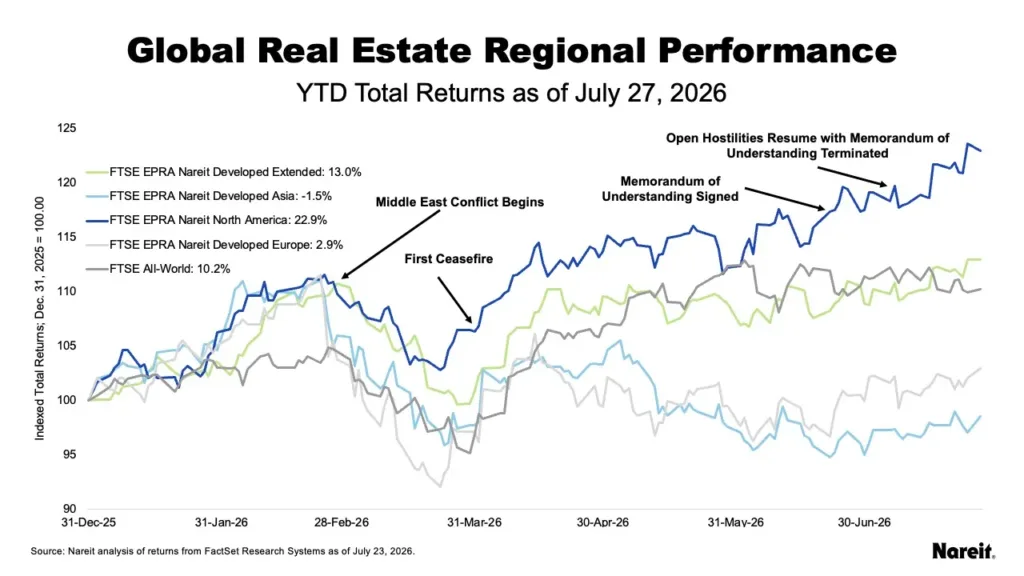
North American REITs are topping global returns in a volatile year shaped by escalating and receding conflict in the Middle East. According to a July 2026 market update from Nareit, the FTSE EPRA Nareit Developed Extended Index has gained 13.0% year-to-date, but North American real estate surged ahead with a 22.9% return through July 27. The region’s resilience comes as periods of relative peace in the Middle East give way to renewed tensions, most recently following the collapse of a US-Iran Memorandum of Understanding earlier in July. This ongoing uncertainty has contributed to fluctuating yields, with the US 10-year Treasury rising from 3.96% at the start of hostilities to 4.65% in late July.
By comparison, global equities lag behind REITs with a 10.2% year-to-date return (per the FTSE All World index), while European and Asian real estate indices have struggled to keep pace, reflecting the divergent impact of geopolitical shocks on different markets.
Get Smarter about what matters in CRE
Stay ahead of trends in commercial real estate with CRE Daily – the free newsletter delivering everything you need to start your day in just 5-minutes
Three Phases, Divergent Outcomes
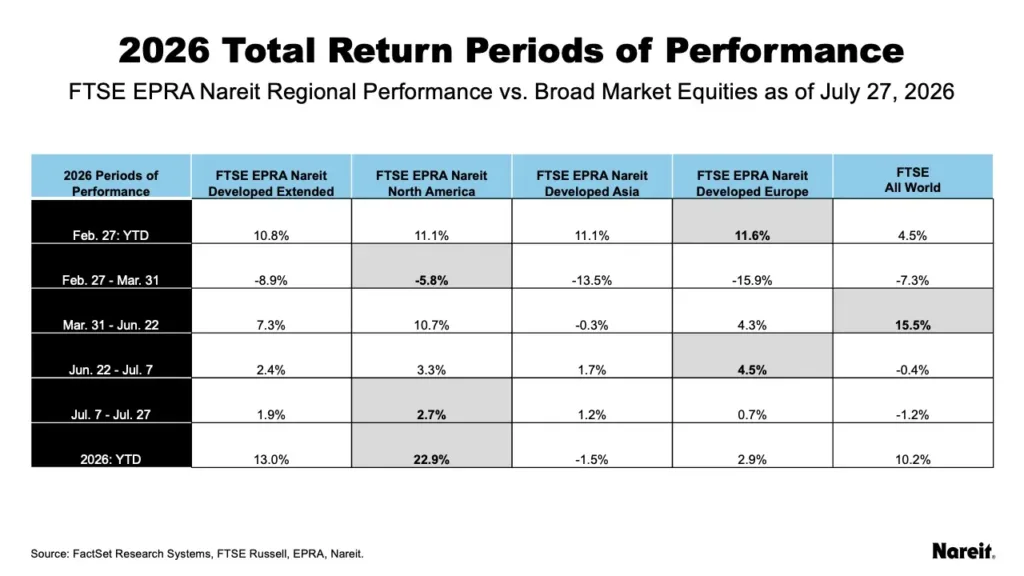
The performance story for global real estate in 2026 splits into three clear chapters. The year opened strong, as all major regions posted double-digit returns by late February — Developed Europe led at 11.6%, with North America and Asia each at 11.1%. The conflict with Iran triggered a sharp correction in March: North America held up best with a drop of 5.8% from pre-conflict levels, while Europe and Asia sank 15.9% and 13.5%, respectively.
As temporary ceasefires and the US-Iran agreement took hold, markets rebounded. North American and European REITs climbed 10.7% and 4.3% between the late March ceasefire and June 22, while Asia remained flat. When hostilities resurfaced in July, North America continued to show strength with an additional 2.7% gain from July 7 to July 27.
The Details
Through July 27, North American real estate posted a 22.9% YTD total return, far outpacing Europe’s 2.9% and Asia’s -1.5%, according to the FTSE EPRA Nareit Developed Extended Index. The rally has been shaped by market swings tied to Middle Eastern events: North American REITs made up ground quickly after each bout of volatility, while their European and Asian counterparts were slower to recover or sank further.
Notably, the FTSE All World index, a proxy for global equities, trailed global real estate, rising just 10.2% YTD. US Treasury yields tracked the turmoil, moving nearly 70 basis points higher since hostilities began, impacting risk appetite and pricing for real assets alike.
Regional Gaps and Asset Class Divergence
The US-led outperformance comes as other regions struggle to regain pre-conflict momentum. While European and Asian REITs began 2026 with strong double-digit gains, their recovery faltered after the March correction. Europe managed a 4.5% uptick in the brief period of calm when the US-Iran MOU was in effect, but remains up just 2.9% for the year. Asia’s persistent underperformance was confirmed with a -1.5% YTD return, despite a modest 1.7% rally during the MOU window. By contrast, North American REITs delivered positive returns in nearly every post-crisis interval, recovering losses and steadily outpacing both global real estate and equities overall.
This divergence highlights a marked return premium for North American real estate at a time when cross-asset volatility and geopolitical risk remain elevated, reinforcing the value investors currently place on relative stability in US property markets.
Why It Matters
North American REITs’ 2026 performance underscores how resilience and liquidity can drive outperformance during periods of macro and geopolitical stress. The 22.9% year-to-date return is well ahead of both the global real estate average (13.0%) and the broader equities benchmark (10.2%), per Nareit and FTSE data. With yields climbing and traditional safe havens offering limited returns, US REITs remain attractive for investors seeking stability. That strength also reflects the growing scale of the listed REIT market, with the FTSE Nareit All Equity REITs Index reaching a record market capitalization this year. The ability of North American REITs to recover quickly reinforces investor confidence.
At the same time, the underperformance of Developed Europe and Developed Asia reveals how global real estate markets are anything but synchronized. For institutional portfolios, the lesson is clear: regional allocation and sector selection matter, especially when geopolitical shocks are in play. The forward-looking risk is that continued volatility in the Middle East — coupled with monetary policy shifts — could create more abrupt swings, demanding that investors monitor both macro and regional signals closely as 2026 unfolds.
What’s Next
The latest chapter of Middle Eastern unrest is unlikely to mark the end of market volatility this year. The collapse of the US-Iran Memorandum of Understanding has left energy prices and investor sentiment on edge. With North American REITs proving their value in turbulent conditions, market participants are expected to continue favoring US property over less-stable regions. Analysts will be watching for policy moves, further escalations, or any diplomatic breakthroughs that could reshape return prospects regionally and across asset classes, making ongoing vigilance critical as the year progresses.