




Q2 2026 Burns + CRE Daily Fear and Greed Index
Capital access worsened across CRE as inflation fears and higher rates pushed investors back to the sidelines.

Nina Dale
June 09, 2026
In partnership with

Good morning. Thank you to everyone who contributed to the Q2 2026 Burns + CRE Daily Fear and Greed Index. This quarter’s report shows investors remain cautiously optimistic, but transaction activity continues to be constrained by tighter capital markets and economic uncertainty.
🎙️ This Week on No Cap: Henry founder Sammy Greenwall explains why AI isn't replacing CRE professionals—it's eliminating the work they hate most.

CRE Trivia 🧠
CBRE Group acquired which Dallas-based real estate services firm in 2006 for approximately $2.2B, adding one of the country's largest commercial development and project management platforms?
IN PARTNERSHIP WITH INVESTNEXT
Ask Claude anything about your investors. Instantly.
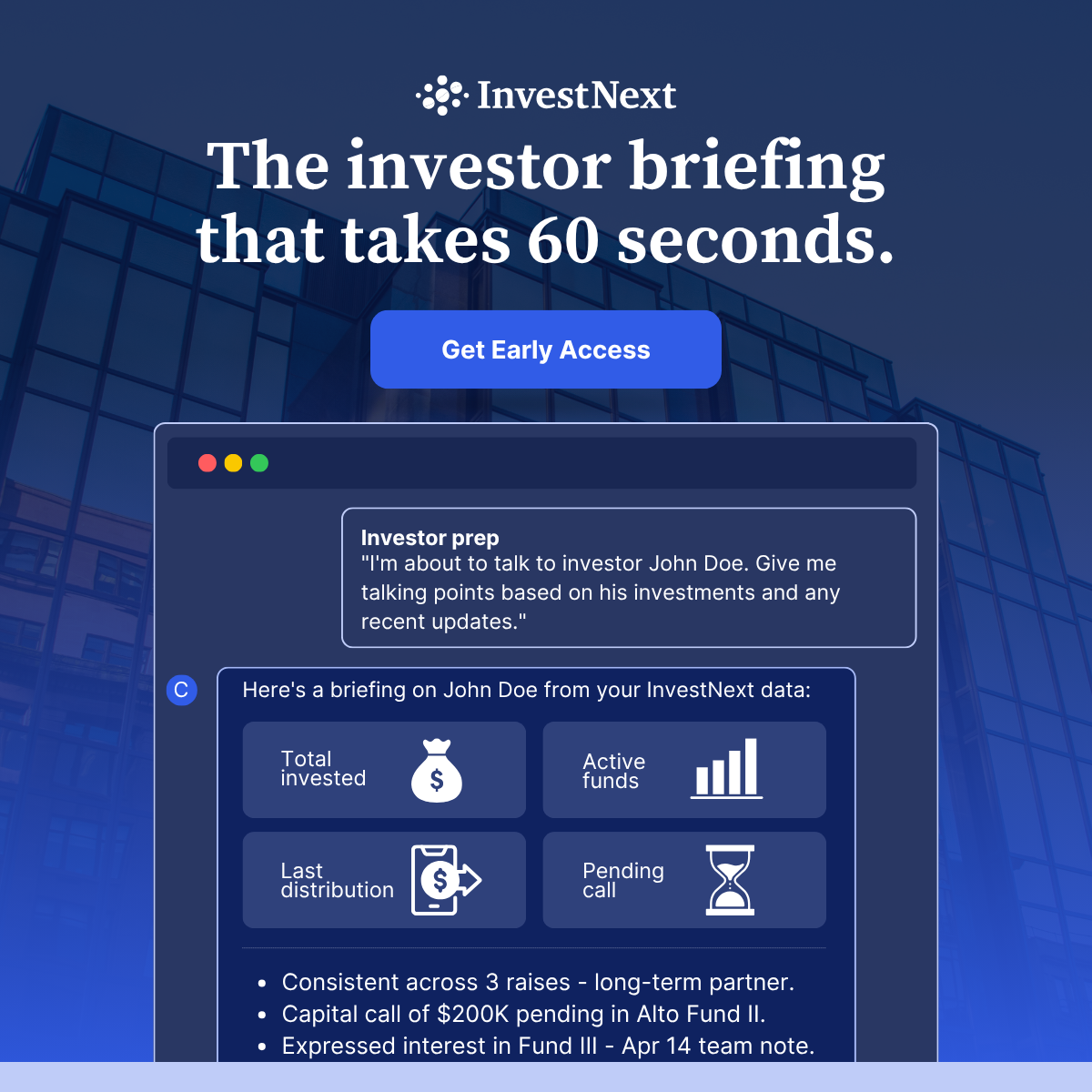
GPs are already using Claude to prepare, think, and operate. The gap is that Claude has never had access to the data that actually runs their business. InvestNext MCP closes that gap. Ask who your top investors are. Ask how your fund is tracking. Ask for talking points before a call.
Every answer pulled directly from your InvestNext data. Read-only, permission-aware, and built for the way you already work.
*This is a paid advertisement. Please see the full disclosure at the bottom of the newsletter.
Market Snapshot
|
|
||||
|
|
*Data as of 06/08/2026 market close.
Investor Sentiment
Q2 2026 Burns + CRE Daily Fear and Greed Index
The latest Q2 2026 JBREC + CRE Daily Fear & Greed Index reveals a more cautious investment environment as rising inflation concerns, higher borrowing costs, and policy uncertainty weigh on commercial real estate sentiment.
By the numbers: The Fear & Greed Index declined from last quarter as investors reported the most challenging capital market conditions since 3Q25. Capital access tightened across property sectors, with multifamily investors among the most cautious. Higher Treasury yields and renewed inflation concerns have pushed many investors to reassess underwriting assumptions and delay new investments.
For context: Index values below 45 indicate a contracting commercial real estate (CRE) market, while readings above 55 suggest expansion. Values between 45 and 55 reflect a market balanced between buyers and sellers.
Capital markets tighten: Investor sentiment deteriorated as financing conditions worsened during the quarter.
-
CRE investors reported significantly more difficulty accessing capital compared to Q1.
-
For multifamily, 33% of investors said capital conditions tightened quarter-over-quarter, versus just 16% who reported improvement.
-
The 10-year Treasury yield climbed into the mid-4% range during the quarter, increasing the cost of long-term CRE debt.

Underwriting shifts: Inflation concerns are reshaping investment decisions. Roughly 72% of investors reported modifying acquisition underwriting, most commonly by increasing reserve and operating expense assumptions, raising financing cost expectations, and revising rent growth forecasts.
Multifamily sentiment remains muted: Investors remain cautious on multifamily as elevated supply and softer demand persist. Nearly 65% expect rent growth in high-supply Sunbelt markets to stay below 3% through 2028, and 63% remain on the sidelines. Multifamily is also the only major CRE sector expected to see value declines over the next six months.
Policy uncertainty: Build-to-rent investors largely hit pause during the quarter as uncertainty surrounding the 21st Century Road to Housing Act weighed on new investment decisions. Nearly two-thirds of investors paused future allocations, while 28% redirected capital elsewhere. Recent revisions to the House version of the bill removed a controversial disposal requirement, potentially opening the door for some sidelined capital to return to the sector.

➥ THE TAKEAWAY
Big picture: Investor sentiment cooled in Q2 as inflation concerns and higher borrowing costs slowed the recovery in capital markets. While most investors remain cautious—particularly in multifamily—greater policy clarity and stable interest rates could help improve confidence later this year. For now, caution remains the dominant theme across CRE.
💻 Join us on live on Thursday, June 11th at 2:00 pm ET as we walk through the results of our Q226 Fear & Greed Survey. Register Now.
A MESSAGE FROM CREXI
Crexi AI. See it work on a real deal.

Crexi AI is the intelligence layer built into your workflow — enriching data, reading markets, and producing deal materials without switching tools. Two live sessions, each built for a different role in the deal. Watch it run through a real CRE workflow start to finish.
Every output sourced. Every step on screen. Pick your session at crexi.com/ai.
*This is a paid advertisement. Please see the full disclosure at the bottom of the newsletter.
✍️ Editor’s Picks
-
Leasing funnel truth: The lease-up bleed isn't your tour rate, it's the response gap that comes before it. Authentic's audit finds yours. Subscribers save 50%. (sponsored)
-
Maturity mirage: CRE maturity stress reflects tighter refinancing conditions and negotiated loan resolutions rather than widespread lender efforts to delay loss recognition.
-
New terrain: Real estate is moving beyond recovery into a new phase where AI, operational expertise, and asset selection are driving performance, while investors focus on high-growth sectors and scalable platforms.
-
Service strongholds: Neighborhood retail centers are benefiting from rising demand for service-based tenants, limited new supply, and strong rent growth, making them an increasingly attractive CRE investment.
-
Spread squeeze: CLO issuance surged in May as tightening AAA spreads and stronger refinancing activity signaled renewed investor confidence and a rebound in both U.S. and European credit markets.
-
Liquidity lifeline: Brookfield raised $900M for a new real estate solutions fund focused on recapitalizations and equity investments, underscoring growing demand for liquidity as owners navigate a challenging CRE market.
🏘️ MULTIFAMILY
-
Subsidy standstill: NYC’s Neighborhood Pillars program has not closed a single deal more than a year after relaunch despite rising housing distress and affordability pressures.
-
Market shift: Multifamily markets show mixed improvement, but affordability remains a long-term challenge that will take decades to resolve even with multiple policy approaches.
-
Demand wave: Multifamily demand is now set to outpace new supply, giving owners occupancy stability and operational breathing room even as rent growth remains muted amid ongoing supply pressure.
🏭 Industrial
-
AI infrastructure: Prologis is positioning data centers as a major growth driver, with CEO Dan Letter calling them a key value-creation opportunity as AI demand accelerates.
-
Midwest techhub: Columbus is rapidly transforming into a major Midwest hub for AI, manufacturing, and data centers, driven by large-scale corporate investment, policy support, and infrastructure growth.
-
Cleveland revival: Cleveland’s Midline project will convert 350 acres of vacant industrial land into a connected employment and green space district near major transit routes.
-
IOS financing: Alterra secured a $244M debt package from Blackstone to expand its industrial outdoor storage portfolio across multiple U.S. logistics markets.
🏬 RETAIL
-
Grocery bet: TPG, Norges Bank, and Canadian pension funds are leading a $2B acquisition of Echo Realty, expanding their exposure to grocery-anchored retail across U.S. Midwest and Southeast markets.
-
Global beauty: Global brands and Gen Z demand are reshaping U.S. beauty retail through rapid international expansion and experiential in-store strategies.
-
Retail rebound: Limited new development and mall repositioning are tightening supply and pulling institutional capital back into retail, compressing cap rates.
🏢 OFFICE
-
D.C. retreat: Brookfield is scaling back its Washington, D.C. operations through layoffs and asset sales, including a planned disposition of part of The Yards.
-
SF office: Strada acquired Samsara’s 133K SF Showplace Square headquarters in San Francisco for $103M, signaling continued selective investment in well-leased office assets.
-
Chicago discount: The former Citadel Center in Chicago sold for $137M, a 76% drop from its 2006 price, highlighting continued steep losses in downtown office valuations.
🏨 HOSPITALITY
-
Hotel lag: U.S. World Cup host cities are trailing Canada and Mexico in hotel bookings, as high prices, visa concerns, and travel friction dampen international demand.
-
Hotel slowdown: U.S. hotel investment sales fell 35% as investors grow more selective amid rate uncertainty, political volatility, and narrowing price expectations.
📈 CHART OF THE DAY

According to the Q2 2026 Burns + CRE Daily Fear and Greed Index, market research is the most common use of AI among CRE investors.
CRE Trivia (Answer)🧠
Trammell Crow Company. Founded in 1948, the firm had grown into one of the most prolific commercial real estate developers in the United States before the acquisition.
More from CRE Daily
-
📬 Newsletters: Stay ahead of the market with local insights from CRE Daily Texas and CRE Daily New York.
-
🎙️Podcast: No Cap by CRE Daily delivers an unfiltered look at the biggest trends—and the money game behind them.
-
🗓️ CRE Events Calendar: The largest searchable calendar of commercial real estate events—filter by city or sector.
-
📊 Market Reports: A centralized hub for brokerage research and market intelligence, all in one place.
-
📈 Fear & Greed Index: A fully interactive sentiment tracker on the pulse of CRE built in partnership with John Burns Research & Consulting.

You currently have 0 referrals, only 1 away from receiving Multifamily Stress Test Model.
What did you think of today's newsletter? |