



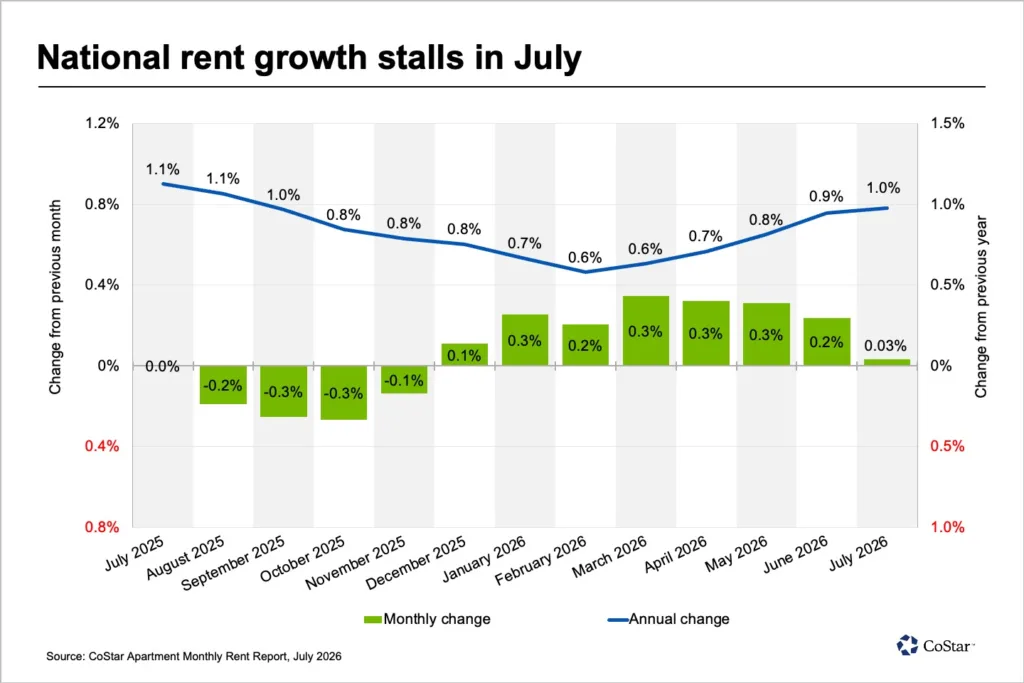
- National US multifamily rents edged up just 0.03% in July 2026, per Apartments.com.
- Annual rent growth stands at 1.0%, with significant variation across regions and metros.
- Elevated supply continues to restrain rent momentum, especially in markets with substantial new deliveries.
Summer Leasing Season Momentum Wanes
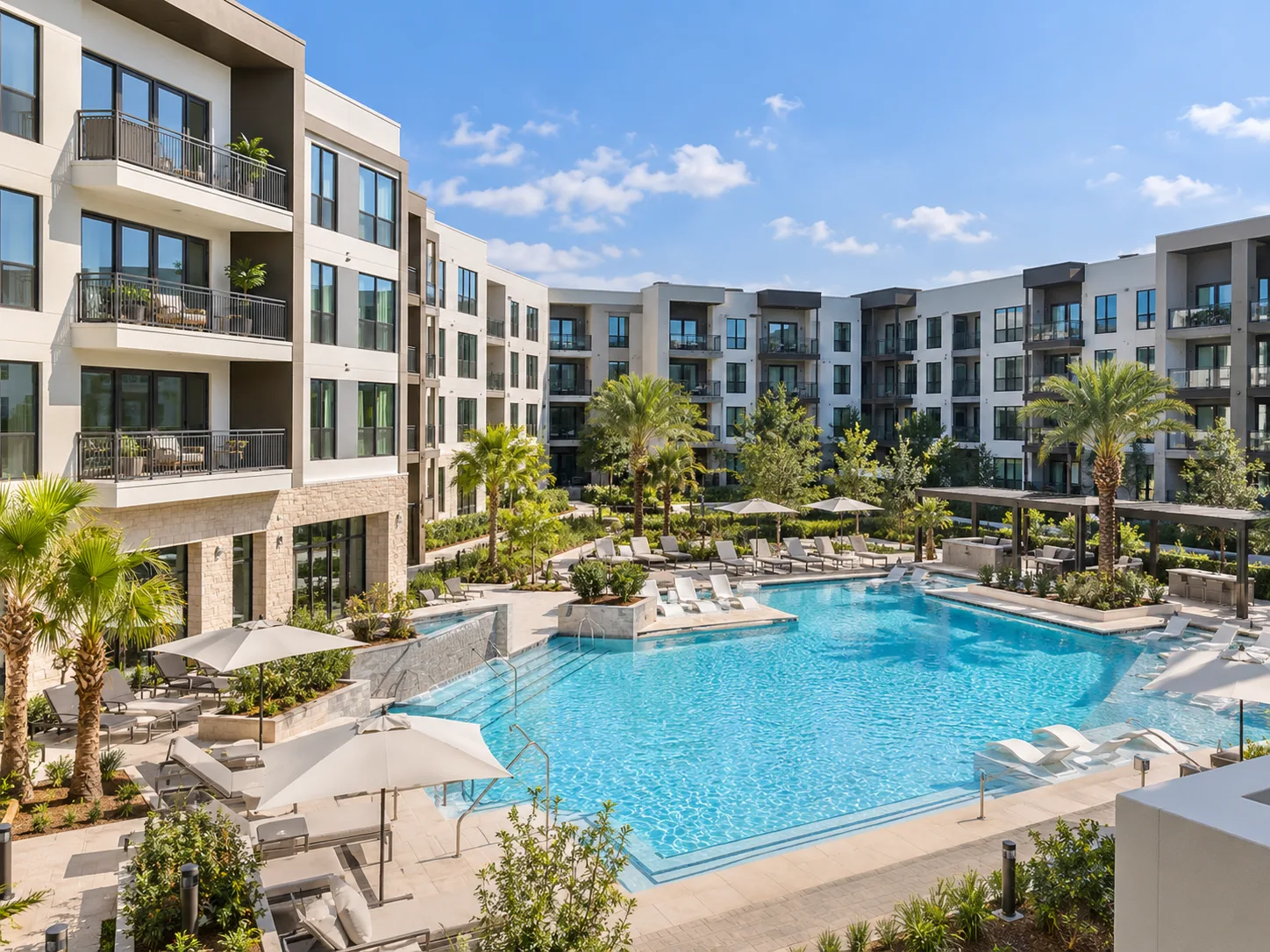
According to Apartments.com’s July 2026 multifamily rent report, the US apartment market posted its eighth straight month of rent growth. However, momentum continued to slow. The national average rent edged up to $1,747 from June’s revised $1,746. That marked a monthly increase of just 0.03%.
Apartments.com, powered by CoStar Group, tracks rent trends across major US markets in real time. Summer leasing activity usually slows. Still, July’s increase fell well below the modest gains seen during spring. Annual rent growth reached 1.0%, up slightly from June but below July 2025’s 1.1%.
Get Smarter about what matters in CRE
Stay ahead of trends in commercial real estate with CRE Daily – the free newsletter delivering everything you need to start your day in just 5-minutes
The Details
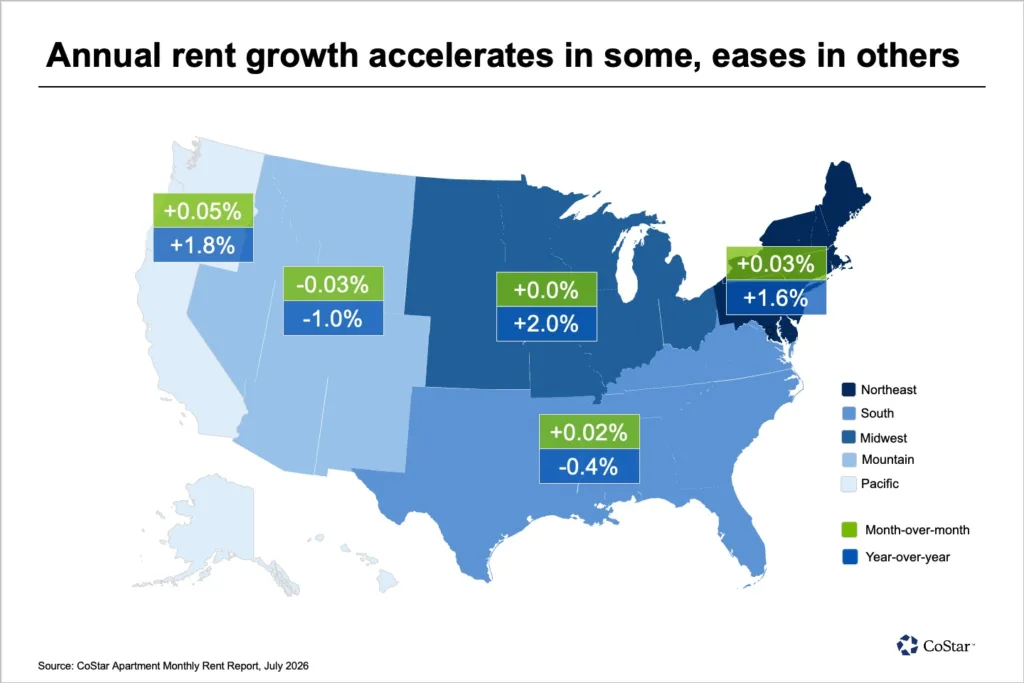
Monthly rent growth stayed weak after Apartments.com revised June’s increase to 0.2% from 0.1%. The Pacific led with a 0.05% monthly gain. The Northeast followed at 0.03%, while the South rose 0.02%. The Midwest stayed flat, and the Mountain region slipped 0.03%.
Results split evenly across the top 50 metros. Twenty-five markets posted gains, while 25 recorded declines. San Francisco led with 0.59% monthly growth. San Jose followed at 0.39%, Oklahoma City at 0.28%, and Norfolk at 0.26%. Salt Lake City fell 0.28%, Las Vegas declined 0.25%, and Tampa dropped 0.21%. Annually, San Francisco posted 10.9% growth. Supply-heavy San Antonio fell 3.0%, while Denver declined 2.1%.
Uneven Regional Performance Continues
Regional performance continued to vary. The Midwest led annual rent growth at 2.0%. The Pacific followed at 1.8%, while the Northeast reached 1.6%. Meanwhile, annual rents declined 0.4% in the South and 1.0% in the Mountain region. Both regions continue absorbing excess inventory.
Metro trends also reflected local supply conditions. San Francisco and San Jose benefited from limited new construction. Austin, Phoenix, and Las Vegas continued to struggle with heavy development pipelines. That imbalance has also shifted negotiating power toward renters across several Sun Belt markets. As a result, local supply remains the biggest driver of rent performance across the US multifamily market.
Why It Matters
July’s report shows new apartment deliveries continue limiting rent growth despite steady demand. National rents increased just 0.03% during the month. As a result, owners and operators have little pricing power outside supply-constrained markets.
Half of the top 50 metros posted flat or declining rents. That suggests absorption still trails new deliveries across many markets. Developers and investors in the South and Mountain regions should expect weaker rent growth until inventory normalizes. Institutional owners also face tougher capital allocation decisions as coastal markets outperform many Sun Belt metros.
The report also suggests slower construction alone will not quickly boost rents. Excess inventory continues weighing on market averages. Property managers will likely keep relying on retention strategies and leasing incentives through the second half of 2026.
What’s Next
As the summer leasing season ends, Apartments.com expects rent growth to remain muted while markets absorb elevated inventory. Most markets have already passed peak deliveries. However, clearing the remaining supply could take several more quarters.
Owners in supply-heavy metros should prepare for continued concessions and weak rent growth through late 2026. In contrast, supply-constrained markets, including San Francisco and the Bay Area, could continue outperforming if tech hiring improves. CRE professionals will watch closely for stronger leasing momentum as the market moves into fall.