



- Limited-service hotels have a 10.34% nonperforming rate, versus 5.86% for full service and 3.89% for extended stay.
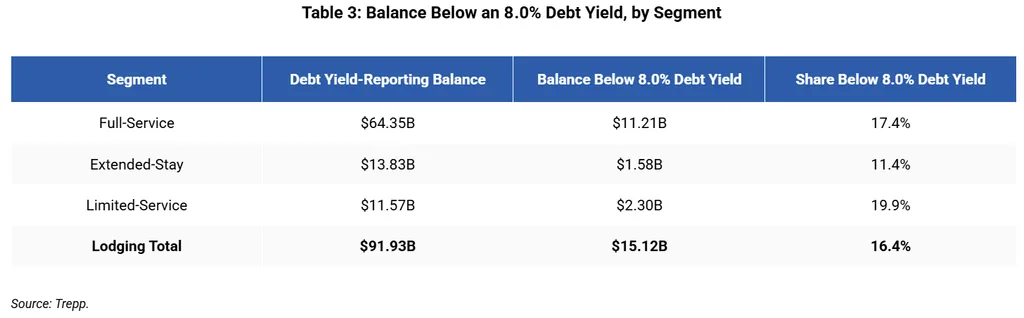
- About 19.9% of limited-service balance falls below an 8% debt-yield threshold commonly used for refinancing.
- Limited-service loans face $5.43B of hard maturities through 2028, exceeding their $5.16B of stated maturities.
Limited-service hotels carry the highest nonperforming rate in the securitized lodging market. Trepp’s analysis of CMBS lodging loans found that limited service represents $11.58B, or 12.6%, of the $92.18B lodging book. Yet the segment accounts for $1.20B, or 21.8%, of all nonperforming lodging balance.
Its 10.34% nonperforming rate exceeds both full-service hotels at 5.86% and extended-stay properties at 3.89%. Full-service hotels still hold the largest nonperforming dollar balance because that segment is much larger. Its $64.38B balance represents 69.8% of the lodging book and includes $3.77B of nonperforming loans.
Get Smarter about what matters in CRE
Stay ahead of trends in commercial real estate with CRE Daily – the free newsletter delivering everything you need to start your day in just 5-minutes
Coverage Has Weakened Most
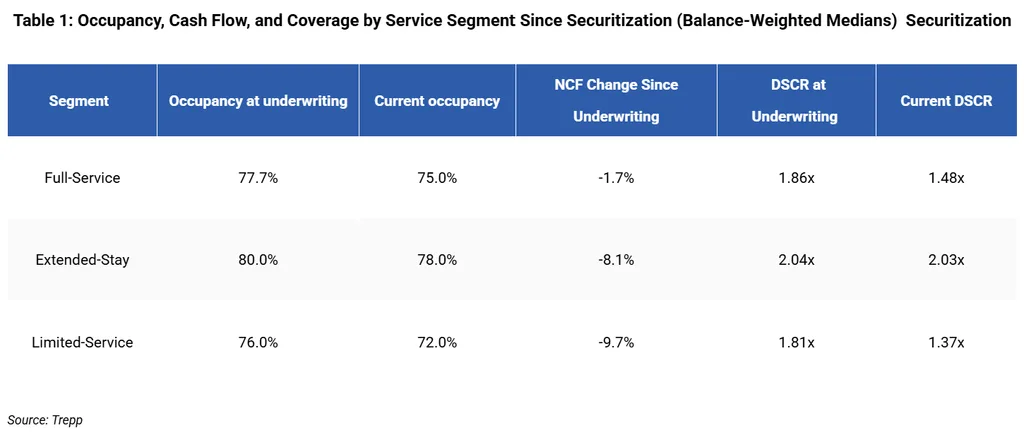
Limited-service hotels have also lost the most debt-service coverage since securitization. Their balance-weighted median DSCR fell from 1.81x at underwriting to 1.37x. Median net cash flow is 9.7% below underwriting, while occupancy declined from 76% to 72%.
Full-service hotels moved from 1.86x DSCR at underwriting to 1.48x currently. Extended stay remained much closer to its original coverage, moving from 2.04x to 2.03x. Its median net cash flow is still 8.1% below underwriting, while occupancy slipped from 80% to 78%. Full-service occupancy declined from 77.7% to 75.0%, while its median net cash flow is 1.7% below underwriting. The extended-stay segment has held coverage best despite lower cash flow. Those differences show that current stress is not evenly distributed across lodging formats.
The Details
Refinancing metrics add another layer of pressure. Trepp uses an 8% debt yield as a common refinancing threshold. Balance below that level may require a principal paydown, more equity or different loan terms to refinance fully.
Limited service has $2.30B below the threshold, equal to 19.9% of reporting balance. That compares with 17.4% for full service and 11.4% for extended stay. Across lodging, 16.4% of debt-yield-reporting balance falls below 8%.
Maturity timing is also less flexible. Limited-service loans have $5.16B of stated maturities through 2028, but $5.43B reaches a hard maturity in that period. Some loans are already beyond their stated dates and are using extensions that expire by 2028. Full-service stated maturities are 2.51 times their hard maturities through 2028.
Extended stay has a 1.83x ratio. The lodging sector has $15.12B below the 8% threshold across $91.93B of reporting balance. Full service contributes $11.21B of that amount because of its scale. Extended stay contributes $1.58B. Limited service has fewer dollars below the line than full service, but a larger share of its own balance falls there.
Why It Matters
Limited service is not the largest lodging segment, but its loans are more likely to be nonperforming. Limited-service lodging stress is concentrated in refinancing risk rather than total balance alone. Full-service hotels still hold 68.5% of nonperforming dollars because that segment is much larger. Limited service stands out on rate, coverage erosion and debt yield.
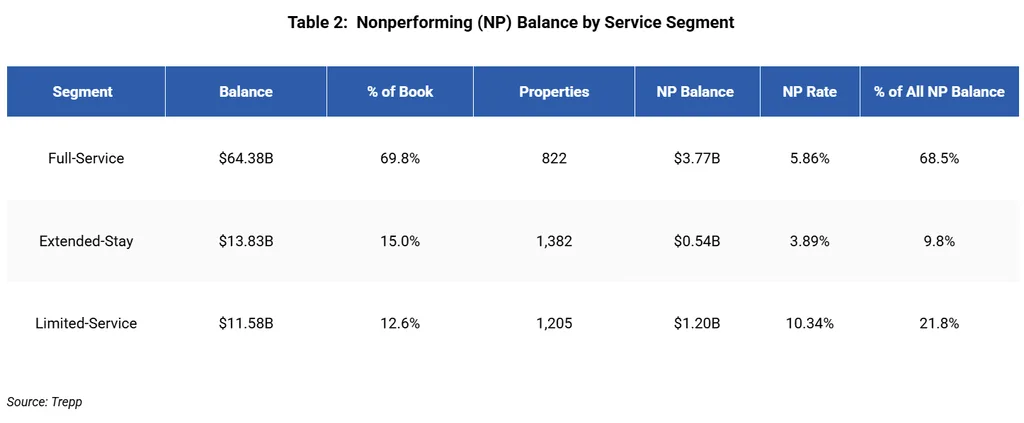
The hard-maturity pool adds another concern. Of the $5.43B reaching a hard maturity by 2028, $1.69B is below an 8% debt yield. That equals 31.1% of the hard-maturity balance. Those loans would generally need a paydown, added equity or altered terms to refinance in full. Limited service also has 1,205 properties in the securitized book, compared with 822 full-service properties and 1,382 extended-stay properties. The issue is therefore not a small number of isolated loans. Stress is spread across a meaningful property count within a comparatively smaller balance segment.
What’s Next
Trepp identifies limited service as the segment to monitor for nonperformance and refinancing capacity. Full service remains important because of the large individual loans behind its dollar balance. For limited-service borrowers, the 2026 through 2028 maturity window will test whether current cash flow can support new debt.
The combination of lower DSCR, weaker net cash flow and limited extension capacity leaves less room to defer the refinancing decision. Extension options will matter as loans approach their final contractual dates. Full-service and extended-stay borrowers have more capacity to push maturities beyond 2028. Limited-service borrowers have less room, which concentrates refinancing decisions inside the next several years.