



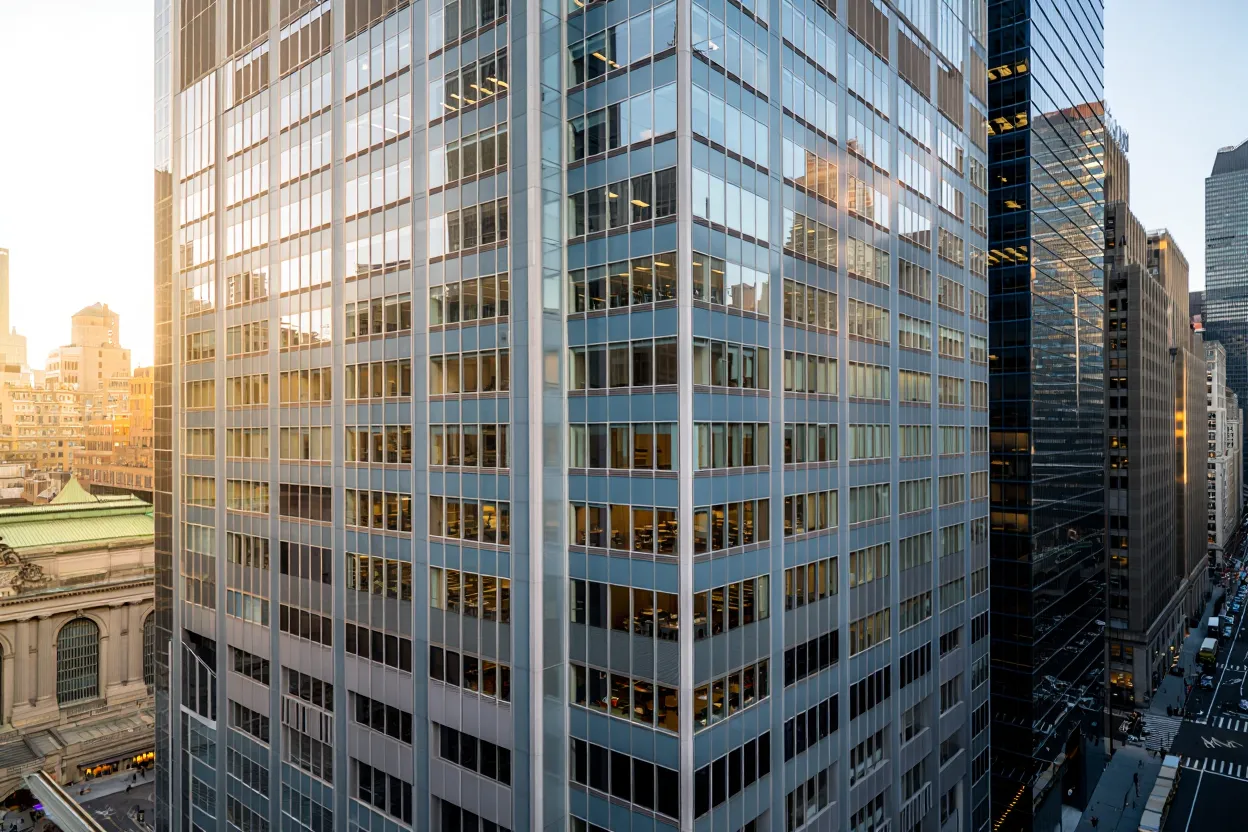
- David Werner Real Estate closed on One Dag near Grand Central for $270M, a steep discount from Rockpoint’s 2019 price.
- J.P. Morgan provided $250M in acquisition financing, and the transaction was arranged by Newmark.
- The deal lands as Midtown leasing outpaces the decade average, indicating shifting investor strategies in Manhattan’s office market.
Discounts Reshape Midtown Office Valuations
David Werner Real Estate Investments’ acquisition of One Dag follows a pattern of major discounts on Midtown office assets. According to Globe St, Werner previously purchased a Hell’s Kitchen property for just over $40M, $90M below its 2018 sale price. In One Dag’s case, Werner paid $270M for a 50-story, 870,000-SF tower that Rockpoint acquired for roughly $600M in 2019. The $330M drop underscores the magnitude of New York office repricing since the pandemic, especially for trophy assets near transit hubs such as Grand Central Terminal. Investors flush with capital and stomach for risk are stepping in where institutional owners are opting out.
Get Smarter about what matters in CRE
Stay ahead of trends in commercial real estate with CRE Daily – the free newsletter delivering everything you need to start your day in just 5-minutes
The Details
Werner’s deal for One Dag, spanning between 47th and 48th Streets, includes approximately $250M in financing from J.P. Morgan, with Newmark brokering the arrangement. The deal values the capitalization at more than $330M. The Class A building features a flagship retail concourse, up to 33,000-SF floorplates, and over $20M in recent capital upgrades. Its proximity to Grand Central and Midtown retail corridors positions the asset well for future leasing or redevelopment. No specific repositioning plans have been announced, echoing a wait-and-see approach as Werner also controls a major East 42nd Street office-to-residential conversion.
Manhattan Leasing Rebounds Amid Discounted Trades
Werner’s purchase arrives as Manhattan’s office leasing market shows signs of resilience. According to Colliers, total Manhattan office leasing activity hit 4.24M SF in May, a 17.3% increase from April, with year-to-date signings reaching 19.63M SF. Midtown led the surge, more than doubling its April leasing volume and surpassing its decade average by nearly 75%.
A nearby Midtown tower recently attracted a joint venture bet from institutional investors, reinforcing confidence in well-located office assets near Grand Central. However, average asking rents ticked down slightly to $84.15 PSF. The disparity between sales prices and leasing momentum signals that well-located, upgraded buildings continue to draw occupier and investor interest, even as values reset.
Why It Matters
Werner’s steep discount at One Dag is emblematic of New York office distress—and the new wave of opportunistic capital targeting wounded trophy assets. Rockpoint, which paid about $600M for the property in 2019, exits at less than 50% of its basis. For lenders and owners across the city, the trade sets a market comp that recalibrates expectations on value and marks a decisive shift from the ‘extend and pretend’ approach many used post-pandemic. This level of write-down also highlights the severity of the correction in Midtown’s office corridor, especially for buildings, even with significant capital improvements, that must now compete in a tenant-favored market.
On the leasing side, the Colliers data points to a budding recovery in office demand, specifically for prime, transit-rich locations. Despite only modest rent declines, the surge in activity suggests deep discounts are drawing both occupiers and value-hunting investors. If momentum holds, this could signal the start of more rational pricing and deal-making, with distressed owners finally ceding ground to fresh capital willing to bet on New York’s office revival. Still, what Werner and similar buyers do with these discounted towers—rehabilitation, conversion, or simply leasing up—remains a critical variable for Midtown’s long-term trajectory.
What’s Next
With investor appetite for discounted New York offices returning, expect more deals that mirror the Werner-helmed playbook—deep discounts, quick closings, and creative capital stacks. For One Dag, the lack of announced repositioning plans keeps options open: Werner’s track record includes blockbuster office-to-resi conversions, signaling the potential for transformative plays. Manhattan’s office leasing pipeline, now at its strongest since 2020, suggests that Prime Midtown may be entering a more dynamic period, as new pricing realities draw in capital ready to reset the city’s investment thesis.