





- Manufacturing produced about $2.4T in real value added in Q3 2025, equal to roughly 9.5% of US GDP.
- The sector’s employment share fell from about 25% in 1976 to roughly 10% by June 2025, driven mainly by fewer young workers entering manufacturing.
- Robot density climbed from below 0.5 installations per 1,000 workers in the 1990s to nearly 30 per 1,000 by 2023.
US manufacturing remains economically large, but its role in employment and productivity has changed substantially. A Federal Reserve Bank of Cleveland Economic Commentary on manufacturing trends says the sector generated about $2.4T in real value added in Q3 2025. That equaled roughly 9.5% of US GDP. Manufacturing was the third-largest private sector behind professional and business services and real estate and rental and leasing.
Get Smarter about what matters in CRE
Stay ahead of trends in commercial real estate with CRE Daily – the free newsletter delivering everything you need to start your day in just 5-minutes
Manufacturing Stays Large but Slower
The US remains the world’s second-largest manufacturing economy by global value added, accounting for about 15% in 2023. However, manufacturing’s GDP share is far below its roughly 25% level in the mid-20th century. Real output grew at an average annual rate of about 1.6% from 1998 through 2023. The Cleveland Fed also found that manufacturing output growth has largely stalled over the past decade. Both durable and nondurable production flattened beginning in the 2010s.
The Details
Productivity has weakened alongside slower output growth. Manufacturing total factor productivity once matched or exceeded the broader private economy. The paths diverged beginning in the mid-2000s. Manufacturing productivity began contracting while private nonfarm productivity continued rising.
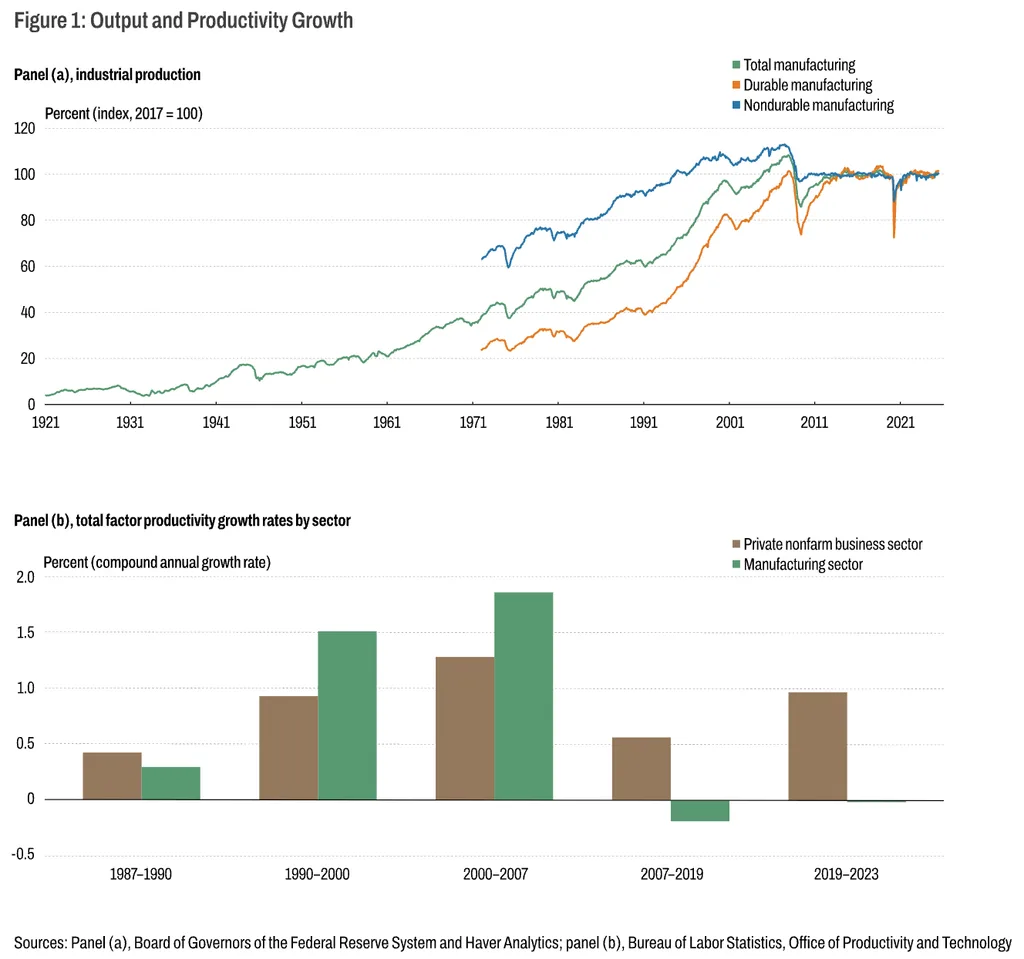
That long-run shift provides context for today’s US manufacturing growth even as new investment remains active in selected markets. The slowdown is therefore not explained only by weaker labor or capital inputs. The report points to a decline in the sector’s underlying efficiency as well.
Employment Share Keeps Shrinking
Manufacturing is the only major sector in the report with a sustained decline in employment share. Its share of the workforce fell from about 25% in 1976 to roughly 10% in June 2025. Manufacturers still report difficulty finding labor. More than one-fifth said insufficient labor prevented full capacity utilization in Q3 2025. More than half also identified attracting and retaining qualified employees as a relevant business challenge in a separate Q4 2025 survey. The Cleveland Fed said the long-run employment decline was driven mainly by fewer young workers entering the sector.
The Workforce Gets More Educated
In 1976, almost 80% of manufacturing workers lacked a college degree. By June 2025, that share had fallen to 39.4%. Workers with at least some college education made up the remaining 60.6%. The gap between workers without a college degree and those with at least a bachelor’s degree also narrowed sharply.
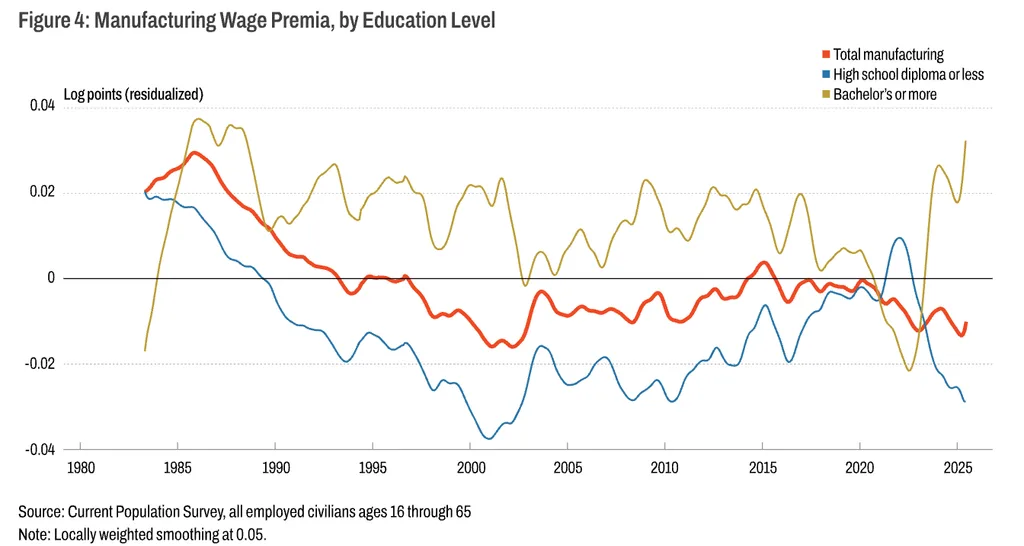
Wage patterns shifted at the same time. Manufacturing workers had a positive wage premium in the 1980s, but the overall premium turned negative in the early 1990s. College-educated workers generally retained a positive premium, while less-educated workers did not.
Automation Reshapes Labor Demand
Robot adoption increased sharply beginning in the early 1990s. Robot density rose from fewer than 0.5 installations per 1,000 workers to nearly 30 by 2023. Research cited by the Cleveland Fed links automation with higher value-added output and labor productivity. The same research found lower labor demand in local markets with greater robot exposure. Each additional robot per 1,000 workers was associated with a 0.45-percentage-point decline in the employment-to-population ratio in more exposed commuting zones. Manufacturing accounted for 0.16 points of that decline.
Why It Matters
The report describes a structural transformation rather than a collapse in manufacturing. The sector still contributes heavily to US output, but it employs a smaller share of workers. Its workforce also requires more education, and the historical wage premium no longer applies broadly. Automation has changed how output growth translates into labor demand. Together, those trends explain how manufacturing can remain large in absolute economic terms while offering fewer jobs and different earnings opportunities than it did decades ago.
What’s Next
The Cleveland Fed’s conclusion points to the same structural forces continuing to shape the sector. Workforce entry, education mix, productivity and automation remain central measures of manufacturing’s changing role. The paper does not project a specific employment or output path. Instead, it shows that future manufacturing performance will need to be read through both production data and the changing labor market that supports it.