






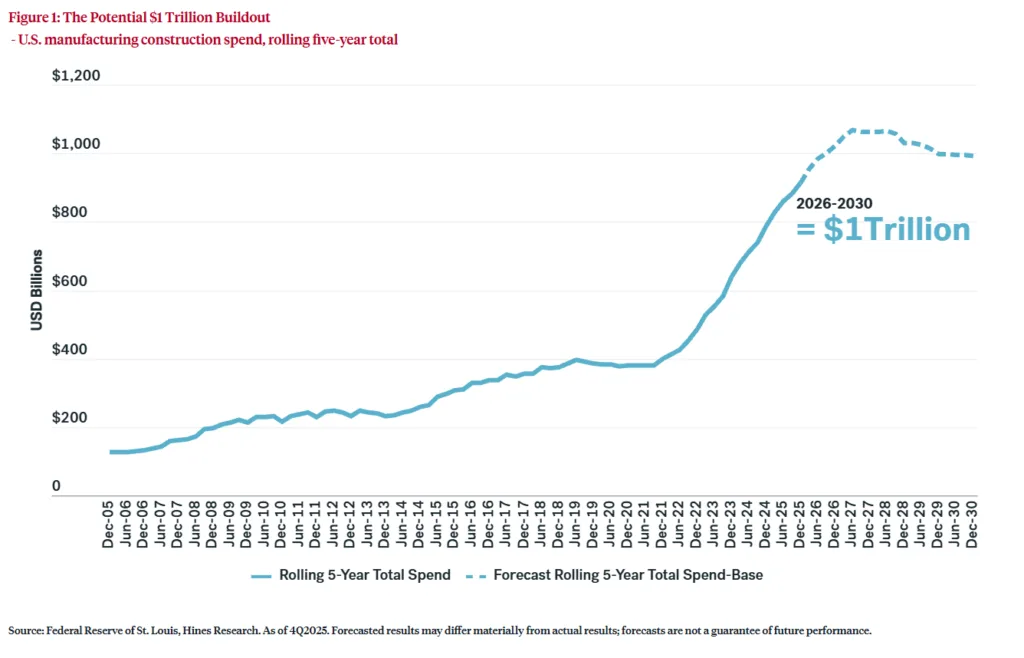
- US manufacturing construction spending may reach $1 trillion from 2026–2030, with growth concentrated in select industrial submarkets.
- Advanced manufacturing and ‘New Companies Doing New Things’ are driving leasing demand in regional hubs such as Dallas–Fort Worth, Houston, Phoenix, Atlanta, Chicago, and San Jose.
- A Hines study identified just 167 ‘high-conviction’ submarkets out of 1,500 nationwide as best positioned to convert manufacturing investment into sustained rent and demand growth.
Rise of the Advanced Manufacturing Ecosystem
The US manufacturing surge is sharpening investor focus on a small group of emerging and established industrial hubs. According to Hines Research, manufacturing construction spending could reach roughly $1 trillion between 2026 and 2030. Cyclical rebounds will contribute, alongside a structural shift toward advanced manufacturing.
Hines analyzed about 1,500 submarkets and found that outperformance remains highly concentrated. Winning markets have deep industrial ecosystems or supply constraints that strengthen tenant demand and rent growth. Wholesale reshoring remains limited, but federal incentives and supply chain resilience continue driving capital into US manufacturing. These forces reinforce regional clusters and attract industrial occupiers seeking capacity for next-generation production.
Get Smarter about what matters in CRE
Stay ahead of trends in commercial real estate with CRE Daily – the free newsletter delivering everything you need to start your day in just 5-minutes
The Details
Hines Research applied its proprietary Manufacturing Market Growth Score (MMGS) across submarkets in 75 US metros. The score weighs manufacturing stock at 48% and five-year manufacturing employment growth at 47%. Current manufacturing workforce size accounts for the remaining 5%. Only 167 submarkets, or roughly 12%, scored above 70, highlighting concentrated investment opportunities.
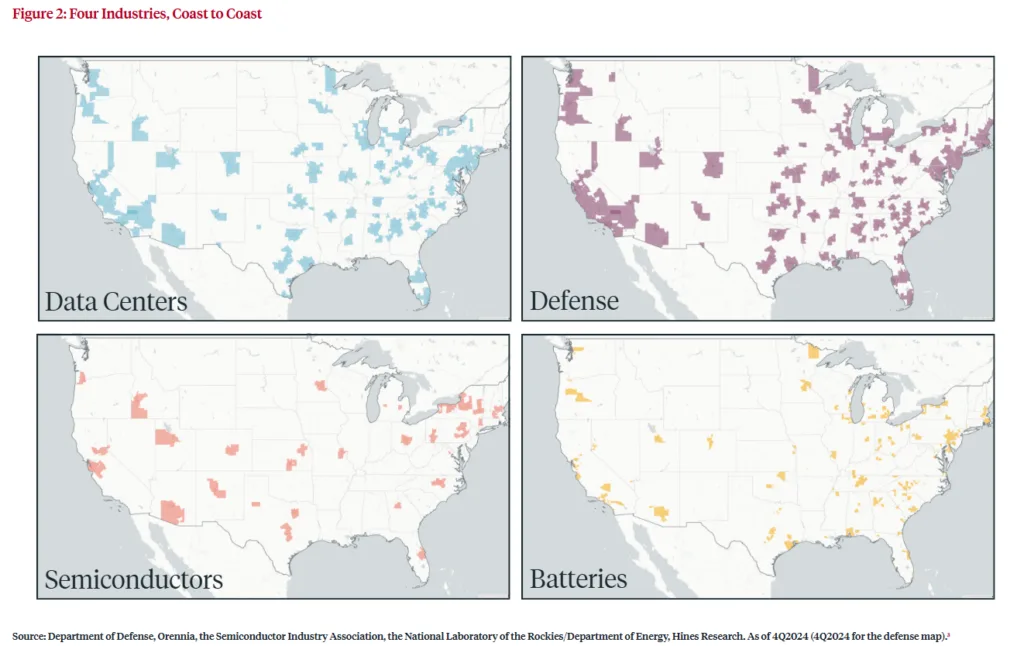
Dallas–Fort Worth leads as a logistics and defense hub, while Houston stands out in energy and petrochemicals. Phoenix and San Jose excel in semiconductors. Data centers also attract logistics companies and advanced component providers, despite falling outside traditional manufacturing. Meanwhile, battery hubs stretch from the Great Lakes through Tennessee and the Southeast. Many overlap with Opportunity Zones, adding another consideration for tax-sensitive capital.
Concentration, Not Uniformity, Defines Growth
Despite the $1 trillion forecast, Hines found that capital and tenant demand remain tightly clustered. Of 167 high-conviction submarkets, 162 have significant defense and data center footprints. Those sectors now function as industrial table stakes rather than meaningful differentiators. Semiconductor and battery clusters remain more selective. Battery activity concentrates across 54 submarkets that also qualify as Opportunity Zones.
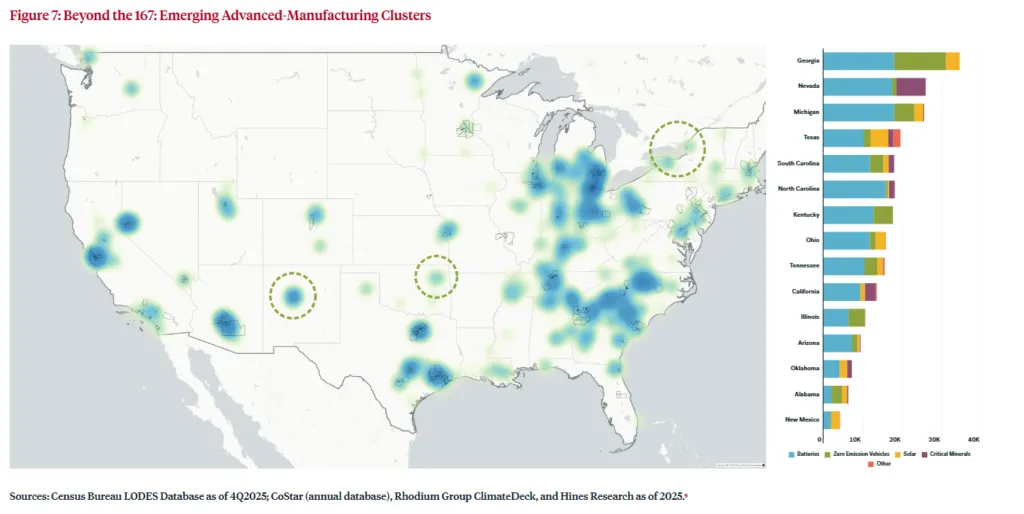
Spillover activity is emerging along the Great Lakes-Tennessee corridor and in upstate New York, Tulsa, and New Mexico. These markets offer lower-cost alternatives for manufacturers seeking available land and power outside highly competitive metros. Recent shifts in Austin battery facility plans also show how quickly manufacturers can adjust investment and production strategies. Data centers follow different site-selection patterns, favoring power-rich markets like West Texas and Iowa. That trend creates parallel industrial demand across regions with limited historical manufacturing density.
Why It Matters
Investors must determine which markets can translate manufacturing investment into durable rent and demand growth. Hines analyzed Census Bureau and CoStar data through 2025 to measure historical performance. Top-scoring submarkets recorded stronger five-year rent growth and occupied SF gains than lower-scoring peers. The demand gap proved especially significant. Highest-scoring markets gained occupied space, while the bottom quartile recorded net declines.
Institutional capital can gain more by targeting established ecosystems than broadly chasing the manufacturing boom. Scale, infrastructure, and supply chain depth create a virtuous cycle that supports additional investment. Supply constraints can amplify rent growth in tight clusters. New industrial nodes offer potential upside but carry greater oversupply risk. Opportunity Zones can further improve risk-adjusted returns for tax-sensitive investors near battery and semiconductor clusters.
The advanced manufacturing buildout also changes CRE demand fundamentals. Companies and government entities increasingly prioritize supply chain resilience alongside operating efficiency. Large projects can create self-reinforcing hubs of investment, skilled labor, and supplier networks. This agglomeration effect expands demand beyond manufacturers to logistics, infrastructure, and component businesses. In turn, those supporting industries strengthen the competitive advantages of leading submarkets.
What’s Next
Federal policy and private capital could sustain the manufacturing expansion and intensify investor focus on Hines’ 167 high-conviction submarkets. Developers will likely pursue emerging corridors with affordable land and sufficient grid capacity. Areas near new data centers and battery plants could attract particularly strong interest.
However, investors must carefully manage exposure in tertiary markets. Rapid construction could outpace tenant absorption and weaken rent growth. The strongest markets will combine supply constraints, established industrial ecosystems, and infrastructure capable of supporting additional investment. Those fundamentals offer the clearest path for converting the $1 trillion manufacturing boom into durable CRE returns.