



- Knox/Henderson apartments now command a 17% premium over the surrounding submarket, the largest dollar gap RealPage tracks, as Southern Methodist University enrollment grows faster than its on-campus bed count.
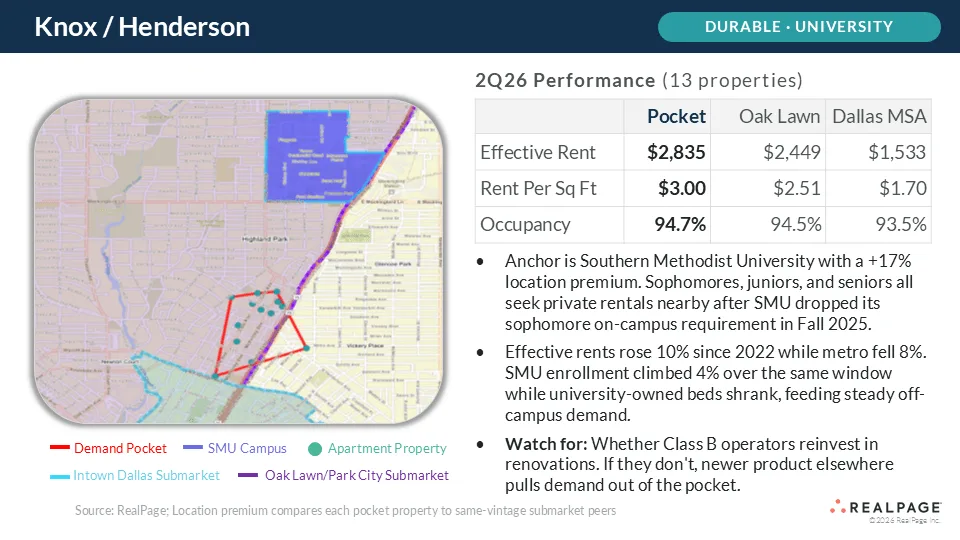
- Effective rents in the 13-property pocket rose 10% since the fourth quarter of 2022 to average $2,835 a month, even as Dallas metro rents overall fell 8% over the same stretch.
- SMU’s decision to drop its sophomore on-campus housing requirement starting fall 2025 is pushing more upperclassmen into the private rental market, adding a demand source insulated from typical apartment-market cycles.
Rents in Dallas’s Knox/Henderson neighborhood have climbed 10% since late 2022 even as the broader metro’s rents fell 8%, a divergence RealPage traces directly to Southern Methodist University. SMU’s full-time undergraduate enrollment has grown roughly 4% over the past four years while its on-campus bed count has shrunk, pushing more students into the surrounding rental market. The result is one of the more durable rent premiums RealPage has identified in its ongoing series on Dallas demand pockets.
Get Smarter About What Matters in Texas
Subscribe to our free newsletter covering the biggest commercial real estate stories across Texas — delivered in just 5 minutes.
A University-Driven Squeeze
Three factors are converging at once: growing enrollment, shrinking on-campus housing capacity, and looser campus-residency rules. SMU eliminated its sophomore on-campus housing requirement starting in fall 2025, though freshmen are still required to live on campus, pushing a fresh wave of upperclassmen into nearby private rentals each year. RealPage argues that university-anchored demand tends to prove more durable than demand tied to entertainment districts or single corporate employers, since enrollment decisions run on their own calendar, largely independent of the broader apartment-market cycle.
The Details
The Knox/Henderson pocket includes 13 properties. Effective rent averaged $2,835 per unit, or $3 per square foot.
That figure sits well above the $2,449 average in nearby Oak Lawn. It also exceeds the $1,533 metro-wide average.
The pocket carries a 17% premium over comparable properties in the surrounding submarket. That equals a $319 dollar premium.
RealPage measured that as the largest gap among the Dallas pockets in this series.
Uptown/Katy Trail carries an even larger 28% premium. However, its demand comes from different sources.
The district benefits from its entertainment and lifestyle appeal. Knox/Henderson instead benefits from its university anchor.
The contrast shows that Dallas rent premiums do not all come from the same demand drivers.
A Different Kind of Demand Pocket
The Knox/Henderson pattern differs from corporate-anchored Dallas apartment rents elsewhere in the metro.
In those areas, rent premiums often follow hiring cycles at major employers.
Knox/Henderson relies on a different driver. SMU’s enrollment and housing policy provide a fixed, slow-moving source of demand.
A corporate expansion could reverse after a new round of layoffs. SMU’s enrollment and housing needs tend to change more slowly.
That difference helps explain RealPage’s treatment of university-anchored pockets. The firm considers them a separate category worth tracking.
Corporate and entertainment districts make up much of the metro’s demand analysis. University-driven pockets follow a different pattern.
Why It Matters
Owners in the pocket still face a challenge. RealPage warns that the premium depends on continued investment in Class B properties.
Owners must reinvest in renovations to capture student demand. Otherwise, older units could lose tenants to newer properties elsewhere in North Dallas.
The demand may be durable. However, owners still need to spend capital to capture it.
Proximity to campus alone does not guarantee strong performance.
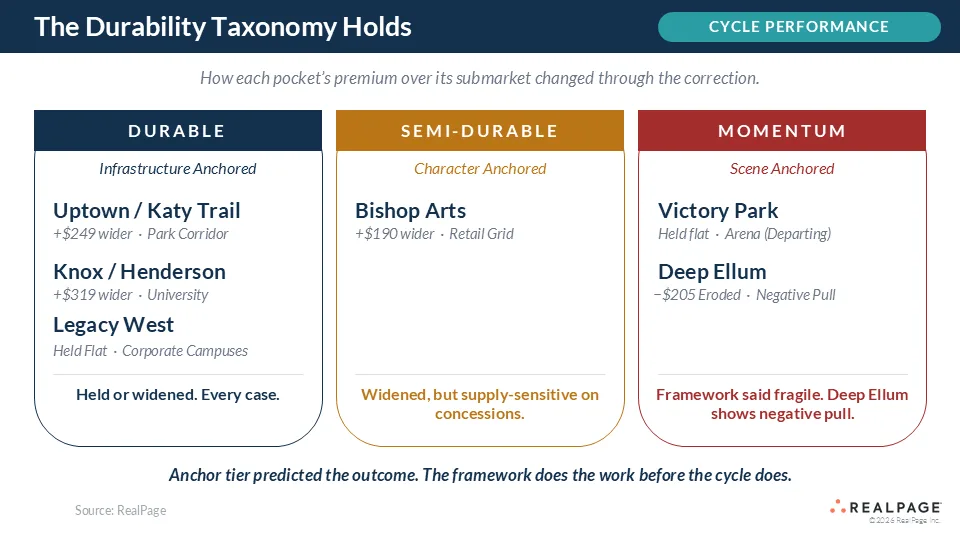
RealPage also uses a broader durability framework for Dallas demand pockets. The firm ranks submarkets as durable, semi-durable, or momentum-driven.
That ranking depends on how long a pocket can maintain performance after its initial demand catalyst matures.
Knox/Henderson falls firmly into the durable category. Legacy West also ranks in that group.
SMU enrollment drives Knox/Henderson demand. That demand follows an academic calendar rather than a hiring or leasing cycle.
As a result, the pocket can avoid some of the rapid reversals seen elsewhere.
Momentum-driven pockets face a different outlook. Their rent premiums often compress faster once the original trend fades.
What’s Next
With SMU’s enrollment growth showing no signs of reversing and on-campus capacity unlikely to expand quickly, RealPage expects Knox/Henderson’s premium to hold, and potentially widen further, as more upperclassmen move off campus each fall. The bigger question for owners will be whether renovation spending keeps pace with that demand, or whether newer product in North Dallas starts pulling tenants away from older buildings in the pocket. RealPage plans to keep tracking Knox/Henderson alongside Uptown/Katy Trail and Legacy West as part of its ongoing series on what actually makes a Dallas demand pocket durable versus fleeting, and which owners are positioned to capture it.