








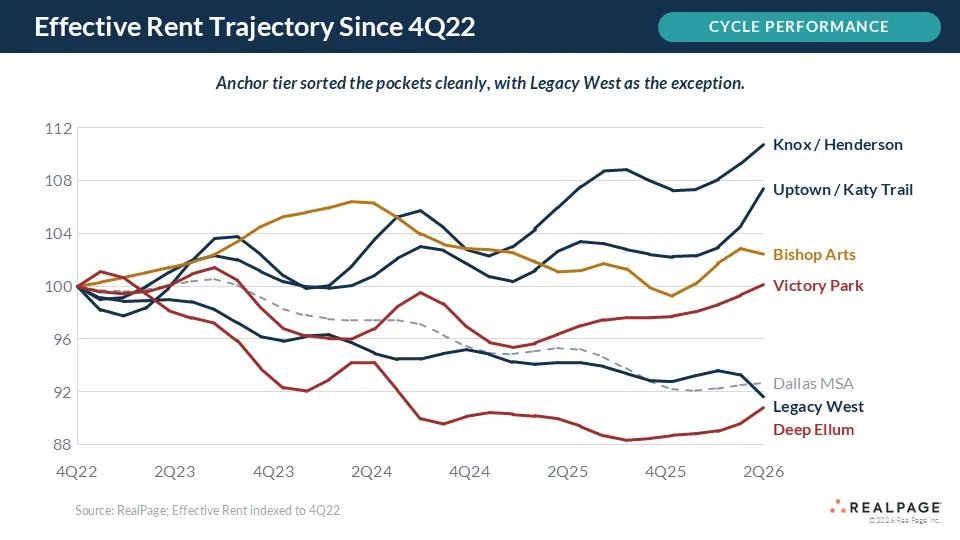
- RealPage data shows effective rents in a 64-property Uptown Dallas pocket rose 7% since late 2022 while Dallas metro-wide rents fell roughly 8% over the same span.
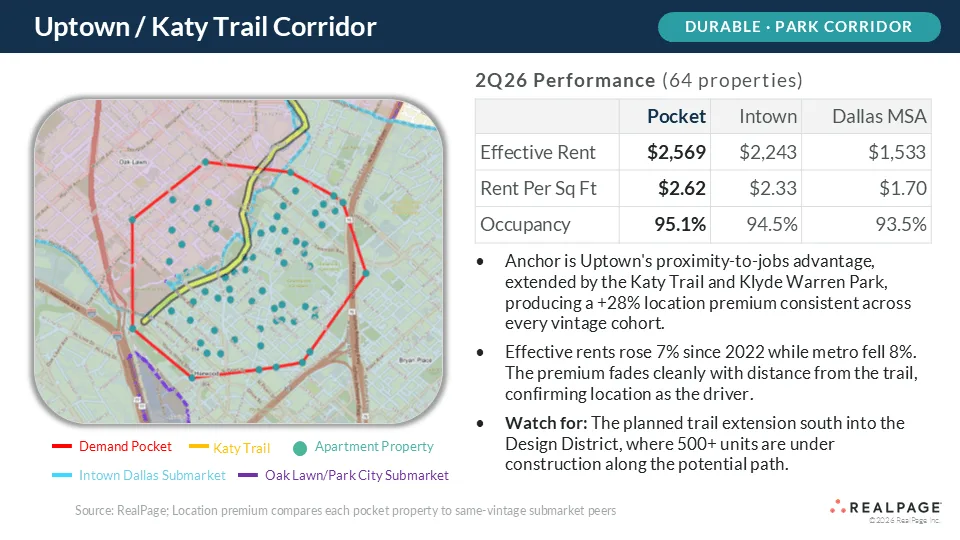
- The pocket’s properties average $2,569 in effective rent versus $2,243 for the rest of Intown Dallas, a gap that widens to 28% once adjusted for building age.
- The findings suggest submarket-level benchmarking, based on zip codes rather than amenities like parks and trails, can understate or overstate how individual properties actually perform.
Apartment rents in a 64-property Uptown Dallas pocket rose 7% since the end of 2022 even as effective rents across metro Dallas fell roughly 8% over the same three years, according to RealPage. The gap is now among the widest in 20 years between the metro’s strongest and weakest-performing pockets, trailing only the pandemic period.
Get Smarter About What Matters in Texas
Subscribe to our free newsletter covering the biggest commercial real estate stories across Texas — delivered in just 5 minutes.
Why Zip-Code Benchmarking Misses the Story
Two apartment properties can share a street name and still perform in opposite directions, RealPage analyst Adam Couch notes, because standard benchmarking compares properties against submarket boundaries drawn around zip codes and highways rather than how renters actually choose where to live. Uptown sits at the intersection of two such submarkets, split by the three-mile Katy Trail, which runs directly through the corridor and closely follows the line dividing them.
That boundary problem matters more when performance diverges sharply between neighboring areas, which is exactly what has happened across Dallas since 2022 as the metro absorbed more new apartment supply than any market in the country, pushing rents down broadly while pockets with durable demand held firm.
The Details
Properties in the Uptown/Katy Trail pocket average $2,569 in effective rent, a 15% premium over the $2,243 average for the rest of Intown Dallas. Normalized by building vintage, comparing each property against same-age peers nearby, that gap widens to 28% and holds across every age cohort. On a per-square-foot basis, the pocket commands $2.62, against $2.33 for Intown Dallas and $1.70 for the Dallas metro overall.
RealPage attributes the pocket’s resilience to three reinforcing anchors: dense nearby employment, the Katy Trail itself, and Klyde Warren Park at the corridor’s southern edge. Because those three anchors reinforce one another, the pocket holds up even if one weakens on its own. The premium over the surrounding submarket has grown by $249 a month since the fourth quarter of 2022.
RealPage’s rent-trajectory data, indexed to the fourth quarter of 2022, shows the Uptown/Katy Trail pocket and the nearby Knox/Henderson pocket both climbing well above their 2022 baseline, tracking closer to Bishop Arts than to Victory Park, Legacy West, or Deep Ellum, all of which have trailed the Dallas metro average. RealPage says the advantage shrinks the farther a property sits from the trail itself, reinforcing that location, not the building product, is doing the work.
Zooming Out
The pocket’s strength stands in contrast to broader North Texas multifamily performance this year, as owners like S2 Capital shed North Texas apartment assets amid softer metro-wide fundamentals. RealPage’s data suggests investors evaluating Dallas assets need submarket detail well below the zip-code level to separate genuinely defensive locations from ones that only look strong in aggregate reporting.
Why It Matters
The findings arrive as capital returns to major multifamily metros nationally, and they offer a framework investors can apply beyond Dallas: identifying permanent anchors, such as parks or job cores, versus temporary ones, like a bar scene, that fade once a trend moves on. RealPage argues that distinction determines whether a location’s rent premium survives a downturn or evaporates with it.
What’s Next
A planned extension of the Katy Trail south into the Design District, where more than 500 units are already under construction, could test whether the Uptown premium travels with the trail. If the pattern holds, RealPage says, the interesting outcome will be whether the pocket’s boundary simply shifts south with it or whether the premium instead spreads more broadly across the Design District.
RealPage says its full webcast session on demand pockets covers all six identified Dallas submarket pockets and how the framework should inform site-selection decisions, arguing that owners and lenders who keep using zip-code-level comps risk mispricing acquisitions in either direction, either overpaying for a weak building inside a strong submarket or passing on a strong building wrongly averaged down by its neighbors.