




- Dallas, Tarrant, and Collin county records show 1,197 commercial and multifamily loans totaling $13.3 billion maturing over the next 12 months, with another $12.5 billion in loans already past their maturity date.
- Only 3 of the 1,197 forward-maturing loans carry a recorded distress filing, underscoring how little of the real risk shows up in public records before a loan actually fails.
- The wall stems from two colliding loan vintages: roughly $4.3 billion in 2016-2017 peak-era loans and $2.6 billion in short-term bridge debt originated since 2025.
DFW loan maturities over the next 12 months total $13.3 billion, according to a county-by-county read of deed of trust records by Circlemark. That’s on top of $12.5 billion in loans that have already passed their stated maturity date and remain open. Circlemark, which reads scanned county clerk instruments rather than relying on servicer-reported data, calls its own $13.3 billion figure a floor, not a ceiling.
Get Smarter About What Matters in Texas
Subscribe to our free newsletter covering the biggest commercial real estate stories across Texas — delivered in just 5 minutes.
How the Wall Breaks Down by County
Dallas County carries the largest share of the forward wall. It has 573 loans worth $5.6 billion, with a median loan size of $2.8 million.
Tarrant County follows with 424 loans totaling $4.75 billion. Collin County has 200 loans worth $2.99 billion.
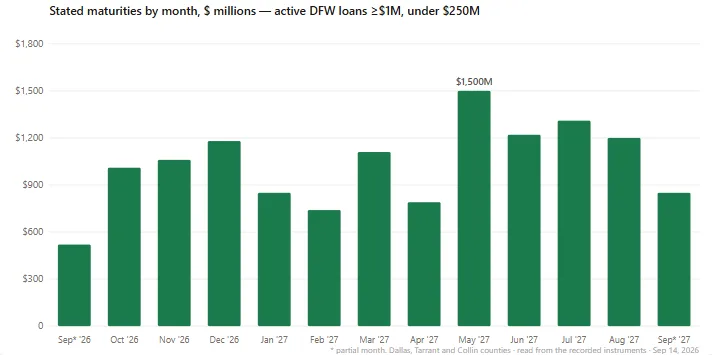
Across all three counties, the typical loan is $3 million. Roughly 90 loans mature each month.
Circlemark describes that pace as closer to a steady drip than a single cliff. The busiest stretch comes in May and June 2027.
During those two months, 212 loans worth $2.72 billion come due.
The Details
The wall comes from two loan vintages that overlap. About 302 loans worth $4.28 billion originated in 2016 and 2017.
That period marked a peak underwriting era for 10-year agency, life-company, and conduit debt.
Another 419 loans account for $2.59 billion in short-term construction and bridge debt. Borrowers originated those loans since 2025.
A separate group includes 200 loans worth $2.45 billion in five-year floating-rate debt from 2022.
By property type, unclassified commercial loans make up the largest slice at $4.03 billion. Multifamily follows at $2.63 billion.
Other categories include land, one-to-four-family portfolios, industrial, lodging, and retail.
A Check on Prior Estimates
CRE Daily’s Texas newsletter previously cited a Transwestern estimate of $2 billion in DFW multifamily loan maturities for the second half of 2026.
Circlemark’s county-record count shows a smaller total. The firm found 31 loans worth $590 million.
Those loans cover 5,640 units across Dallas, Tarrant, and Collin counties. They also have stated maturities during that period.
Circlemark attributes the gap to data visibility rather than a contradiction.
Roughly 59% of active DFW loans above $1 million show no maturity date in recorded documents. Many loan terms instead appear in unrecorded notes or securitization filings.
Why It Matters
Only three of the 1,197 loans maturing over the next year have a recorded distress filing. Meanwhile, the broader market shows signs of strain.
Commercial Observer reported that CLO distress rates jumped from 19% to 28% in August. Texas, Florida, and Georgia account for 44% of the distressed balance nationwide.
That gap matters because Texas foreclosure notices follow a unique process. Courthouses post the notices and withdraw them once a sale occurs.
As a result, the process leaves little digital evidence. Circlemark argues that maturity dates offer a better signal than current delinquency numbers.
The state’s visible debt wall also reflects how Texas records loans. It does not necessarily indicate a larger debt load than other markets.
Texas’s non-disclosure rule protects only the sale price on a deed. It does not protect loan terms.
A Texas deed of trust can therefore show the original principal and lender. About 41% of these instruments also show a maturity date.
New York records show maturity dates on roughly 9% of comparable instruments.
Circlemark’s New York analysis found $5.9 billion in stated maturities. That figure sits well below DFW’s $13.3 billion.
However, Circlemark also models loans with no stated maturity. With those estimates included, New York has about twice as many upcoming maturities as DFW.
That difference shows why Texas’s larger headline number can be misleading. Better recordkeeping accounts for part of the gap.
What’s Next
Most upcoming maturities involve middle-market debt below $5 million. Garden apartments, industrial flex space, strip retail, and land back these loans.
Trophy assets make up a much smaller share.
An “open” loan on the record does not necessarily mean a default. Some borrowers will extend or refinance their loans.
Others may quietly work out the debt before maturity.
Still, borrowers face elevated interest rates. National CLO distress rates are also rising.
As a result, Circlemark expects more workouts, recapitalizations, and note sales tied to this maturity wave through 2027.