






- Private credit and insurers now fund $1.2 trillion, or 18.3%, of the US CRE market, per Moody’s Ratings.
- CRE debt funds hold a record $56B in dry powder and raised about $16B in H1 2026.
- Moody’s estimates private credit lending to CRE could climb to $2.7 trillion from $1.7 trillion.
Falling Values Pull Private Credit Into CRE
Lower property values have drawn both traditional and private credit lenders toward new lending, per Moody’s Ratings. Banks and insurers pulled back after rates rose in 2022. They have since returned with lower-leverage loans, while also lending to private credit funds. That shift is redistributing risk and adding opacity to the CRE market.
Get Smarter about what matters in CRE
Stay ahead of trends in commercial real estate with CRE Daily – the free newsletter delivering everything you need to start your day in just 5-minutes
Record Dry Powder Backs New Lending
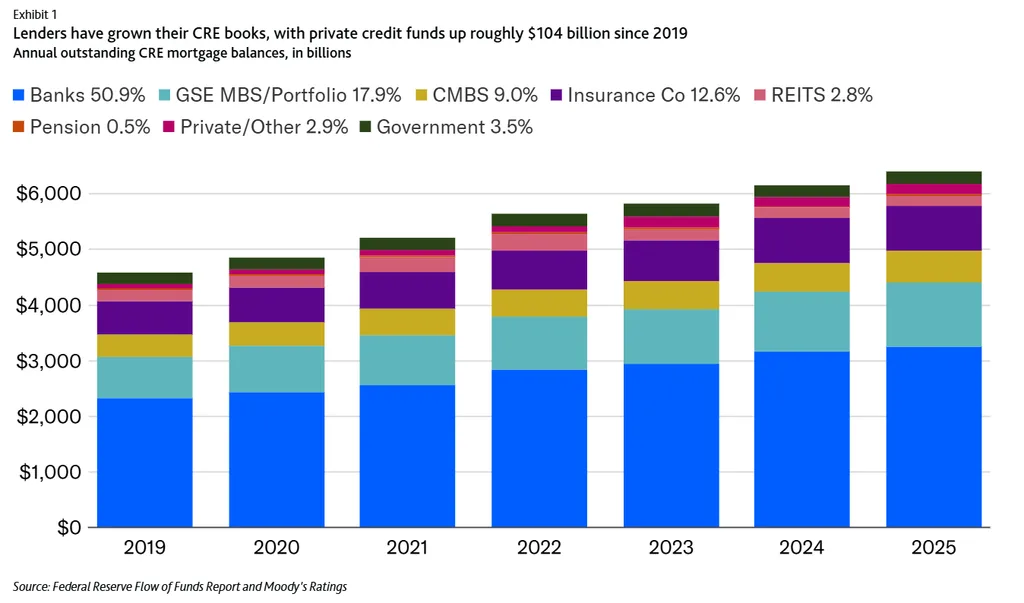
Private credit keeps raising money for CRE even as unspent capital piles up. Firms hold a record $56B in dry powder for CRE deployment, per Green Street News’ Real Estate Alert. They raised about $16B in the first half of 2026, according to PERE. Private credit funds have grown their CRE books by roughly $104B since 2019. The buildup suggests either fewer opportunities or a more selective stance.
The Details
Excluding CMBS holdings, insurers and other private credit lenders now fund $1.2 trillion of the US CRE market. That is 18.3% of the $6.4 trillion total. Insurers hold $807B in CRE mortgages plus $522B of CMBS. Many borrowers now refinance through split capital structures. A lower-leverage senior mortgage from a bank pairs with junior debt, mezzanine financing, or preferred equity from private credit. Refinancing at higher rates has often required borrowers to reset primary loan-to-value ratios below 60%.
Banks and Insurers Share the Risk
Banks supply warehouse financing to private credit firms against pools of CRE loans, usually on renewable one-year terms. Those loans often become collateral for CRE collateralized loan obligations. Private lenders increasingly compete with banks through flexible structures and faster execution.
Bank lending to nondepository financial institutions has grown since 2024. Mortgage lending to that group reached $309B in the first quarter of 2026. Insurers increasingly buy senior mortgage debt and rated notes from feeder funds.
Why It Matters
The trend hands private credit a growing role in a market long dominated by banks. Risk transfer tools are spreading too. The European market for such protection reached €13B to €21B in 2025. That was up 37%, per the International Association of Credit Portfolio Managers. Proposed US Basel III rules could push more banks to move CRE risk to private credit. For investors, the layering of lenders makes exposure harder to trace.
What’s Next
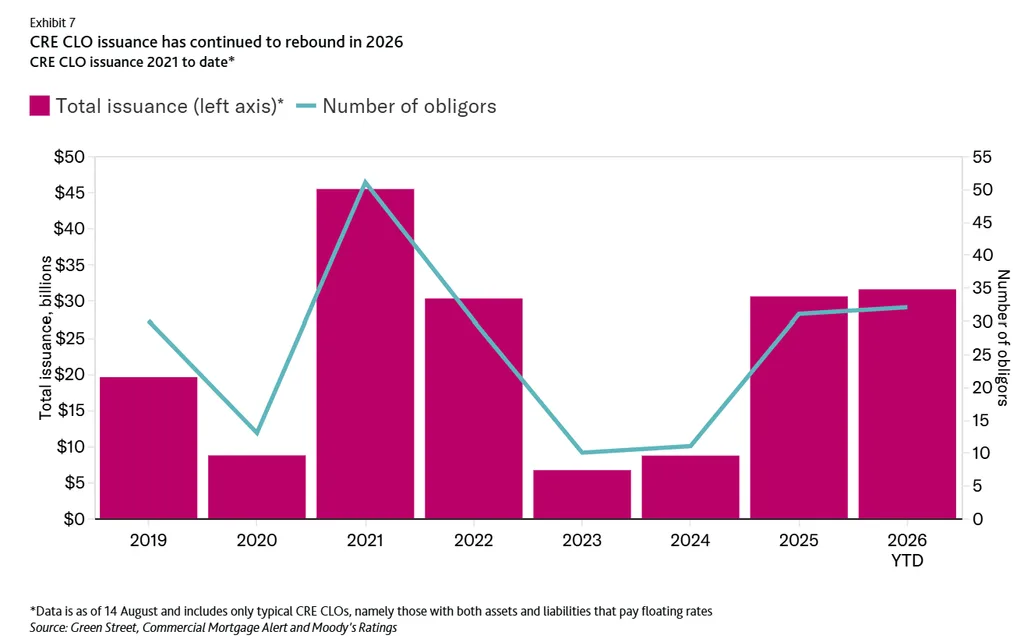
Moody’s estimates global private credit lending to CRE could grow to $2.7 trillion from $1.7 trillion. That path could absorb another $1 trillion of CRE debt over time. CRE CLO issuance has rebounded and may top its 2021 record this year.
If values fall further, private credit could step up purchases of distressed loans. Even so, it remains a small player in the combined $9 trillion US and European CRE markets.