








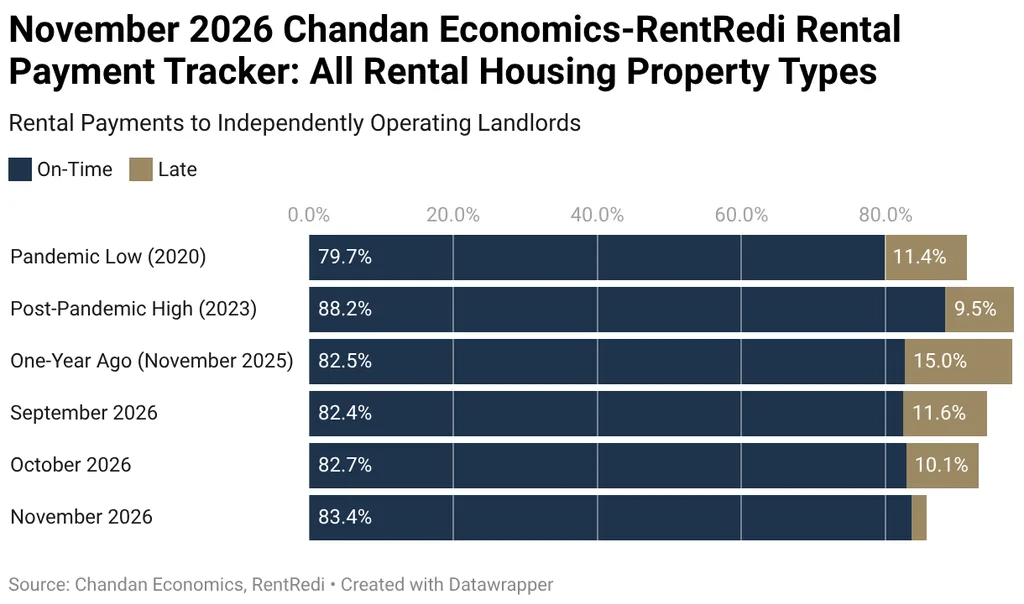
- November’s on-time payment rate at independently operated rentals reached 83.4%, a 69-basis-point monthly gain and the fourth straight month ahead of the prior year.
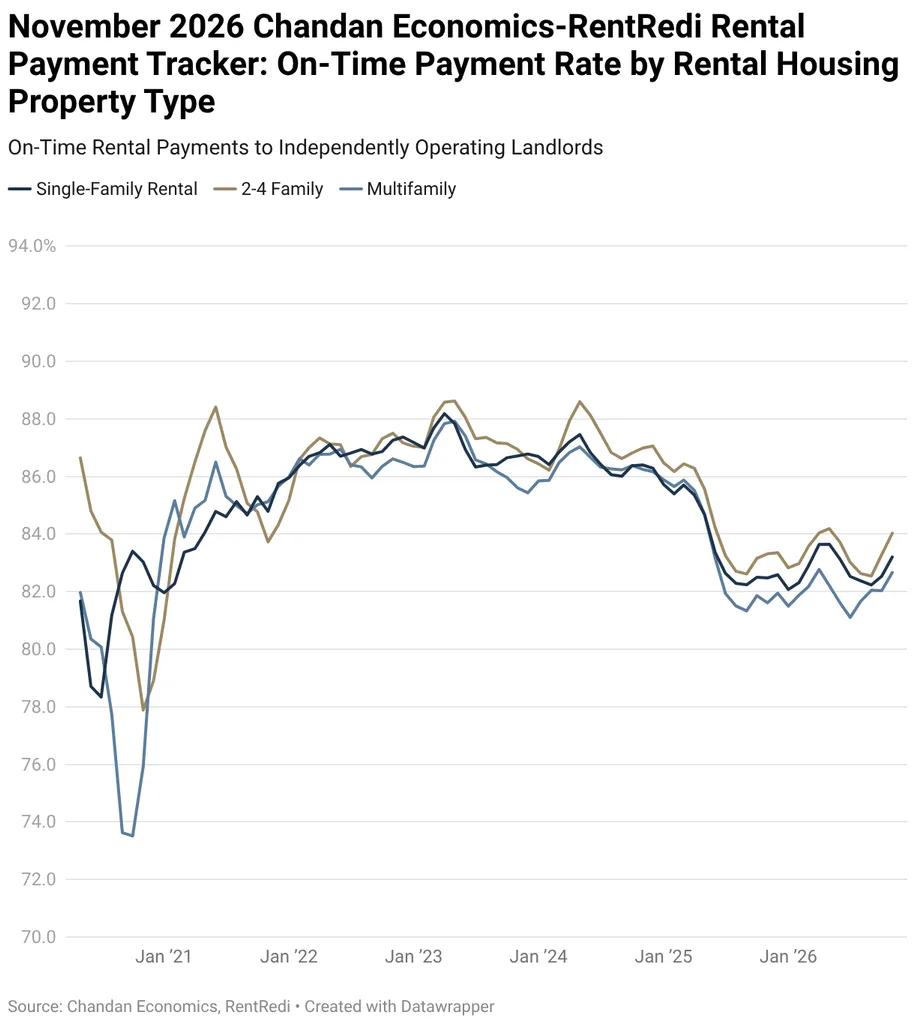
- Two- to four-family properties led at 84.0%, while multifamily trailed at 82.7% but posted the largest annual improvement of any segment at 105 basis points.
- Late payments covered 12.8% of September rent, so small landlords still rely on tenants catching up, and the on-time rate sits about 4.8 points under its 2023 peak.
Mom-and-pop landlords collected more rent by the due date in November: the on-time payment rate climbed to 83.4%, according to the latest Chandan Economics-RentRedi tracker.
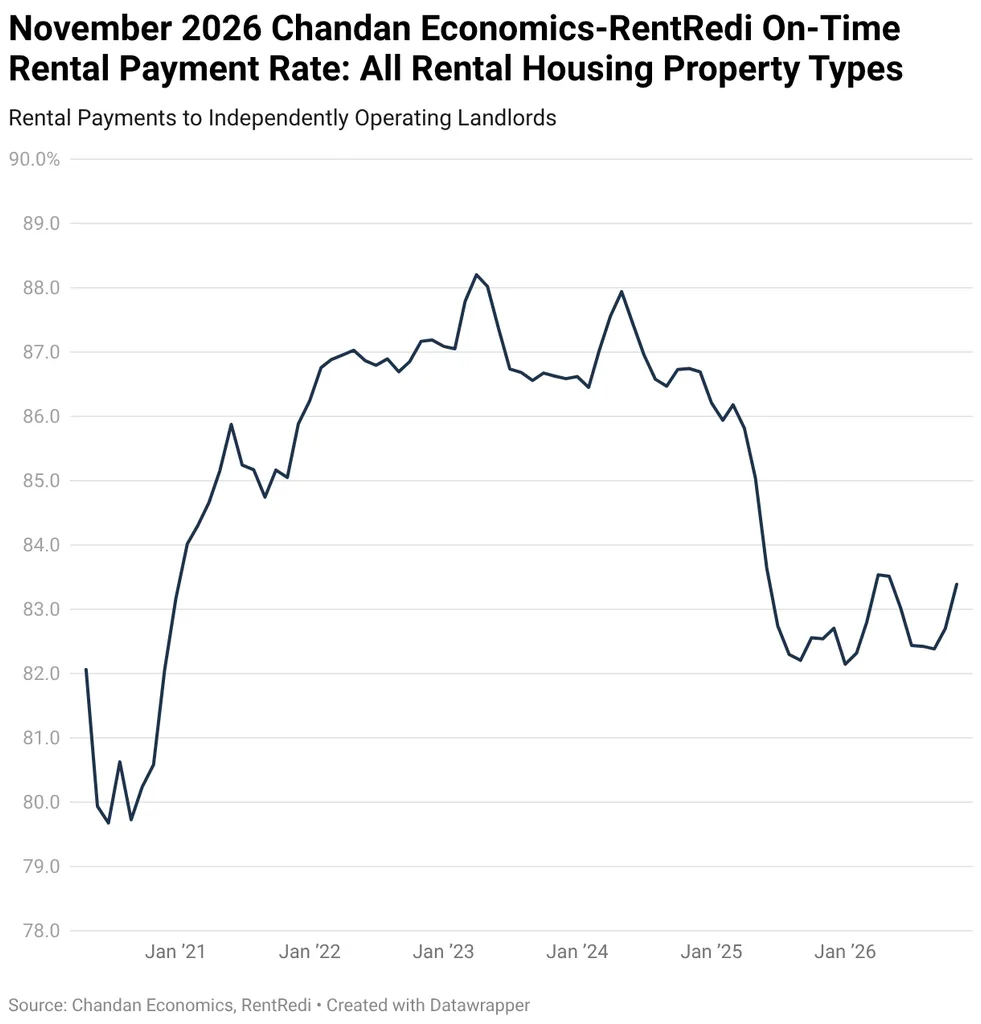
That beats October by 69 basis points and November 2025 by 85.
Get Smarter about what matters in CRE
Stay ahead of trends in commercial real estate with CRE Daily – the free newsletter delivering everything you need to start your day in just 5-minutes
The Big Picture
Fall has been a steady climb, from 82.4% in September to 82.7% in October and now 83.4%.
The year was bumpier: a strong spring, a soft summer, then the autumn rebound. Chandan says that looks like a more familiar seasonal pattern, though the rebound hasn’t closed the gap with earlier years.
The annual gain is the first sizable one in this run. August, September and October came in just 13, 18 and 14 basis points ahead of 2025.
Chandan calls it stabilization at a subdued level. Last year was weak, so the bar is low.
For scale, 83.4% is roughly 3.7 points better than the 2020 low of 79.7% and about 4.8 points short of the 88.2% peak in 2023. With no pre-pandemic benchmark, the firm says the strong 2022-2024 readings shouldn’t be taken as normal.
On-Time Rent Payments by Property Type
Every segment improved, both month over month and year over year. Two- to four-family rentals led at 84.0%, a 74 bps monthly gain.
Single-family rentals reached 83.2%, up 67 bps. Multifamily sat last at 82.7%, up 63 bps.
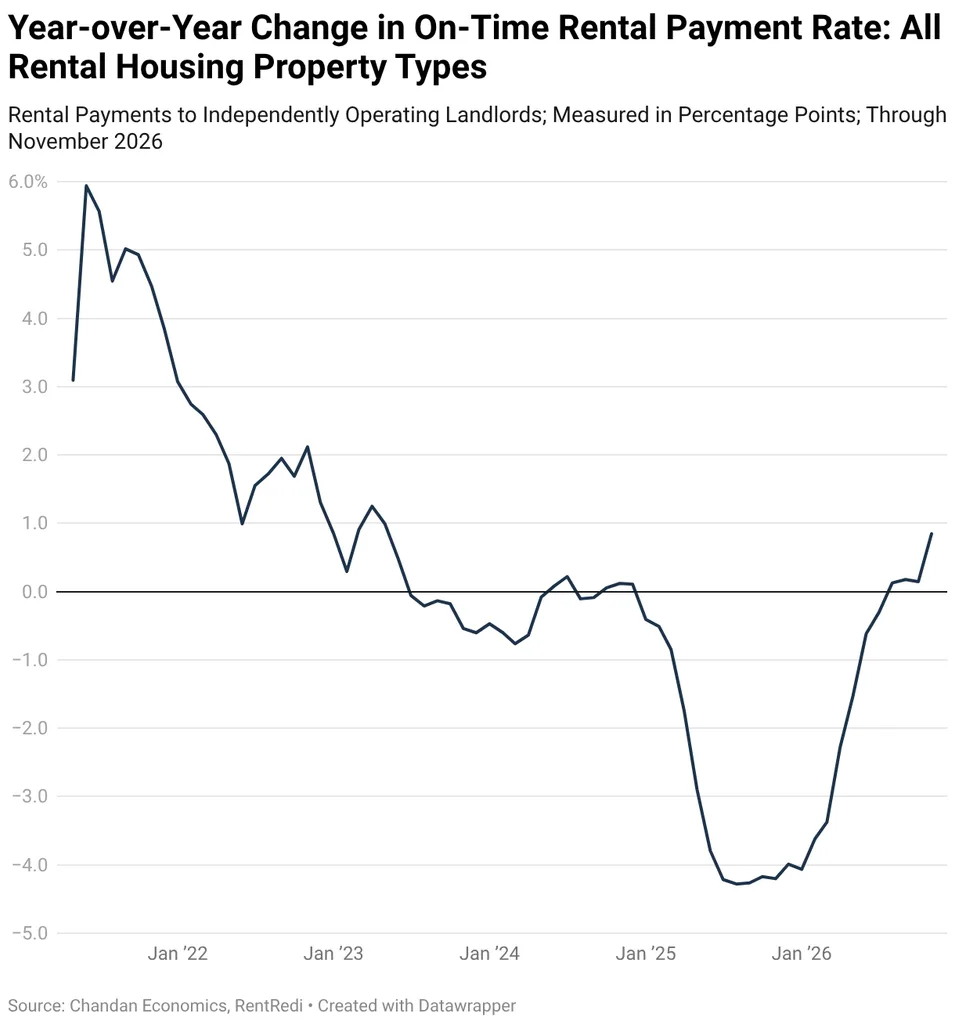
The laggard is closing ground fastest. Multifamily improved 105 bps from a year ago, against 73 bps for single-family and 71 bps for two- to four-family.
Single-family tenants look different than they used to. Chandan research we covered Nov. 11 found single-family renters now earn 60.9% of what single-family owners earn, up from 53.9% in 2005.
Late, Not Lost
Most rent that misses the due date still shows up. September’s full-payment rate, the latest available, was 95.2%: 82.4% paid on time plus 12.8% paid late.
That’s about where August stood at a similar point in collections, 95.3%, so Chandan reads collections as broadly stable.
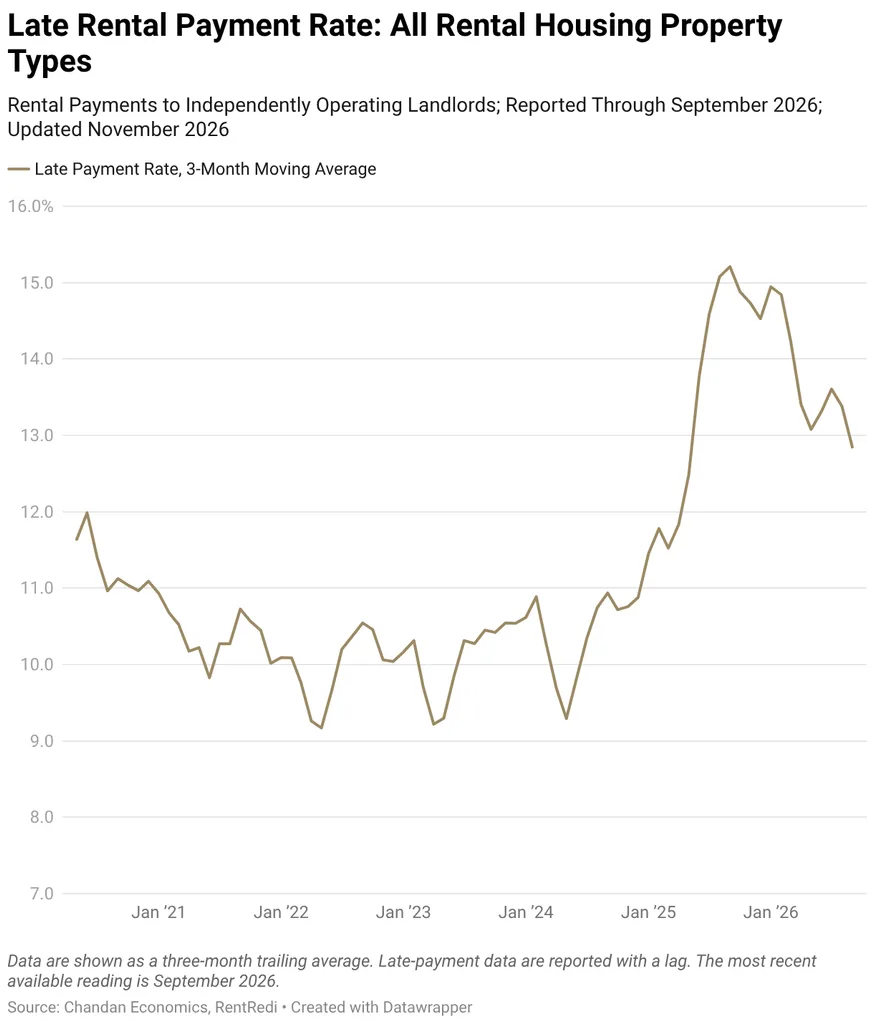
The late-payment number needs the same care. September’s 12.8% looks better than August’s 13.4%, but August also stood at 12.8% at the same stage. Chandan says the dip is little evidence that fewer renters need extra time.
It still matters to a small owner. Rent that arrives late is better than rent that never arrives, but leaning on catch-up payments makes cash flow uneven.
State Lines
The spread between states is wide. Wyoming led at 95.1%, followed by South Dakota at 93.4%, with Utah and New Hampshire both at 92.6%. Washington, DC, was close behind at 92.1%.
Mississippi was lowest at 72.1%. Delaware, West Virginia, Georgia and Tennessee all landed between 77.8% and 79.2%.
One caution from the methodology: single-month state readings can swing sharply, especially where the sample is small.
Why It Matters
Renters haven’t rebuilt a cushion. Chandan points to the Census Bureau’s Household Pulse survey from this past summer, in which about 27% of adults in households earning under $75,000 said covering usual expenses was somewhat or very difficult.
The New York Fed’s Q3 household debt report adds to the picture: 12.9% of credit-card balances were 90 or more days delinquent, versus 11.1% two years earlier. Chandan notes those surveys don’t track the same households as its sample.
Rents keep rising on those budgets. The firm’s November rent update, which we covered Nov. 18, had national multifamily rents 2.7% higher than a year earlier as of October, after 2.4% in September.
What’s Next
The question for December is whether the on-time rate holds above 83%. Chandan sees limited evidence so far of a sustained recovery.
Keep the sample in mind. The tracker follows 60,527 units on RentRedi’s platform and isn’t designed to be nationally representative, and the late-payment figures run two months behind.
National and property-type rates are three-month trailing averages, while state figures cover a single month. Rent charges under $500 or over $10,000 are left out.