






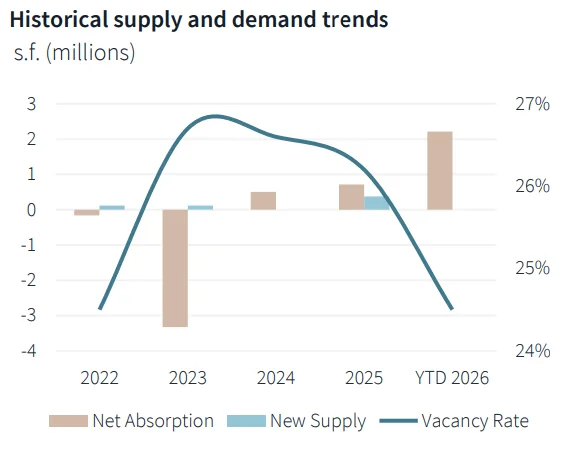
- New Jersey absorbed more than 927,600 square feet of office space in Q3 2026, the sixth straight positive quarter, pushing year-to-date absorption to roughly 2.2 million square feet.
- Nearly 80% of that absorption landed in Class A buildings, and Hudson Waterfront alone posted 699,000 square feet of it, led by Fidelity’s expansion in Jersey City.
- Tenant requirements have climbed to nearly 5.8 million square feet, and one-third now span multiple submarkets, so building quality is outweighing location in site selection.
Northern and Central New Jersey’s overall office vacancy rate slid 50 basis points quarter over quarter to 24.5% in Q3, a low not seen since late 2022.
The market absorbed more than 927,600 square feet in Q3, extending its streak to six straight quarters of occupancy gains, according to JLL’s third-quarter research on the state’s office sector.
Get Smarter About What Matters in New York
Subscribe to our free newsletter covering the biggest commercial real estate stories across the five boroughs — delivered in just 5 minutes.
Class A Sets the Pace
Class A buildings accounted for almost four-fifths of the quarter’s absorption. Overall Class A vacancy peaked near 31.0% in early 2025. Since then, it has fallen to 27.9%. The direct rate, which excludes sublease space, stands at 23.2%.
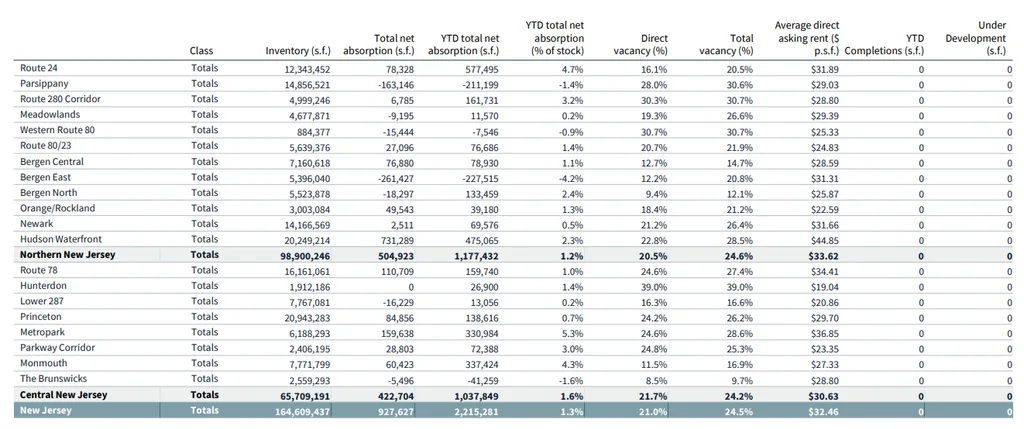
Year-to-date net absorption has reached 2,215,281 square feet. Across the market, direct asking rents average $32.46 per square foot. For Class A buildings, that figure rises to $35.12. JLL also describes concessions as stable.
Hudson Waterfront Leads
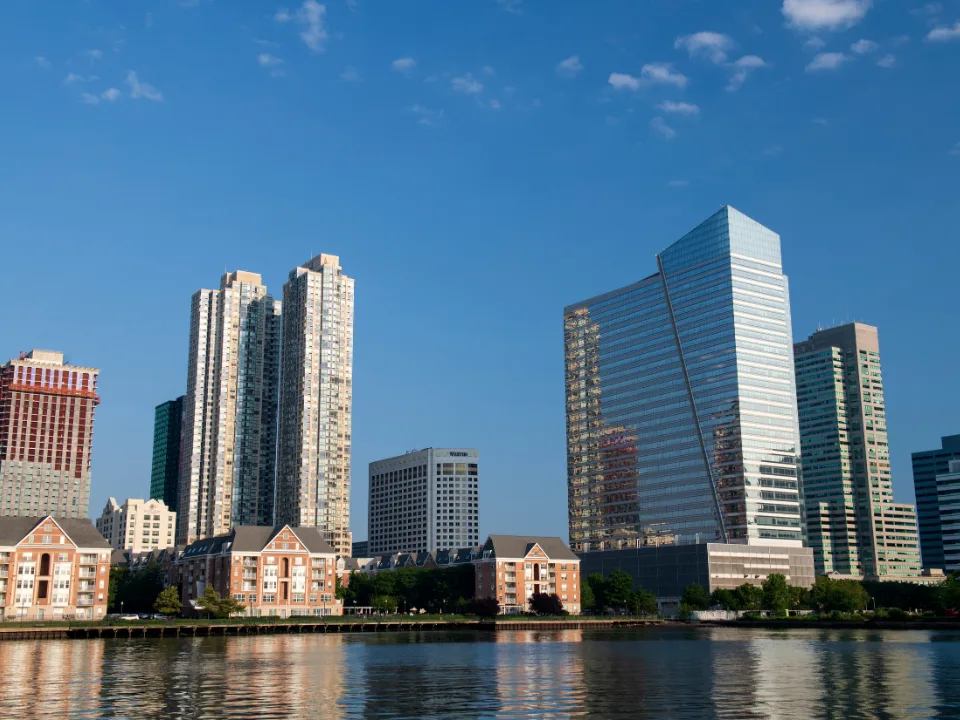
Hudson Waterfront recorded the state’s largest Class A absorption, topping 699,000 square feet. As a result, Class A vacancy fell four percentage points from Q2 to 30.2%.
Fidelity Investments drove much of that activity. The company added 139,080 square feet at 499 Washington Blvd in Jersey City. It was the state’s largest office deal of the quarter.
The submarket also commands New Jersey’s highest average direct asking rent at $44.85 per square foot. That premium reflects the appeal of Class A waterfront properties.
Meanwhile, more than 443,120 square feet left the availability list at 480 Washington Blvd. The upper nine floors of the 29-story tower are slated for residential conversion.
A Recovery With Gaps
However, the gains were not evenly spread. Parsippany and Bergen East both recorded negative net absorption during the quarter. Several suburban submarkets also continue to report Class A vacancy well above the statewide average.
Central New Jersey absorbed roughly 422,700 square feet in Q3. Northern New Jersey added about 504,900 square feet.
The year-to-date figures tell a similar story. Northern New Jersey has absorbed about 1.18 million square feet, while Central New Jersey has reached about 1.04 million. Together, these results show that the recovery spans both halves of the state.
Other markets are also gaining ground. For example, Houston office absorption recently turned positive, offering another sign that office tenants are moving again.
Tenants Widen the Search
Tenant space requirements have rebounded from below 4.0 million square feet in 2021 and 2022. By Q3 2026, they had climbed to almost 5.8 million square feet. About one-third of that demand now spans multiple submarkets.
JLL views this shift as a flight-to-quality trend. Larger occupiers are exploring several markets at once to find premium buildings. As a result, they are placing less emphasis on a specific address.
At the same time, no office space is under development in the state. Existing buildings therefore face no competition from new supply.
Landlords must instead compete on the quality of their current properties. Greiner says tenants want amenities, infrastructure and appealing surroundings to help bring employees back to the office. These features now distinguish stronger buildings from laggards.
Why It Matters
Falling vacancy and residential conversions are tightening the market from both sides. Leasing removes available space, while projects like 480 Washington permanently reduce office inventory. A similar pattern appears in the Midtown office recovery.
Still, the recovery will not benefit every building equally. Tim Greiner, executive managing director at JLL, said older properties without upgrades face a tougher road. Meanwhile, well-located, high-quality assets continue to attract the most interest.
For owners of commodity suburban space, the message is clear. They must consider capital improvements or repositioning to remain competitive.
What’s Next
Greiner expects momentum to continue through the rest of 2026. The 5.8 million square feet of active requirements should help support demand.
Going forward, watch whether Class A vacancy continues to fall from its early-2025 peak. Also monitor whether more obsolete buildings in Hudson Waterfront and the suburbs follow 480 Washington into residential conversion.