


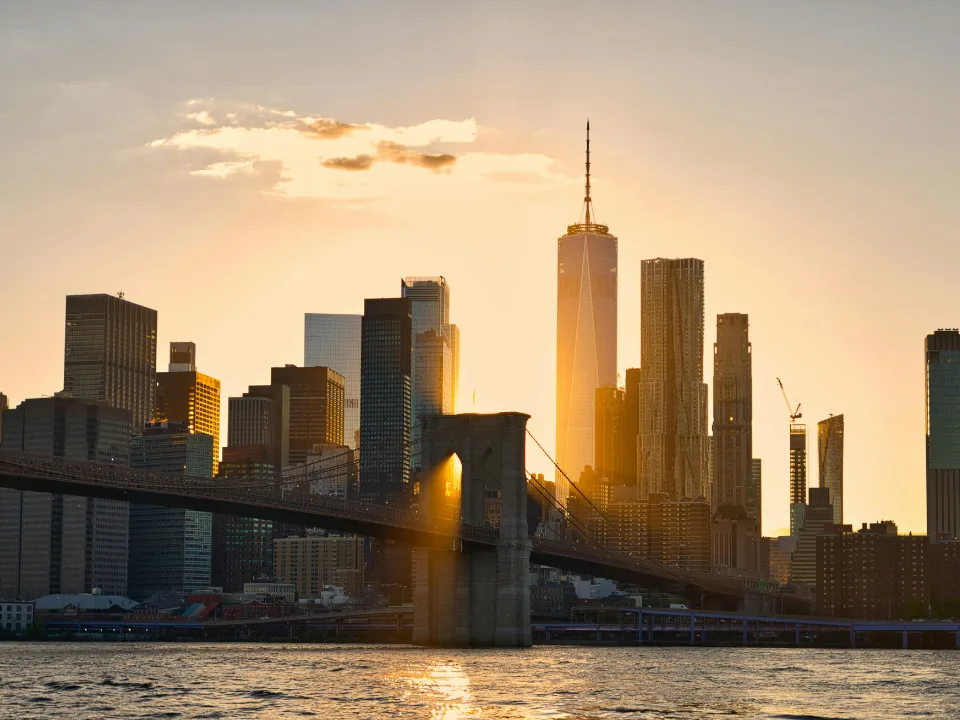




- Manhattan office leasing rose 2.3% year over year in Q3 while vacancy fell to 12.6% from 13.1% in Q2, and direct asking rent climbed to $84.56 per square foot.
- Demand is broad-based across finance, law, tech and other industries, with the year’s marquee deals including American Express at 2 World Trade Center and Anthropic at 330 Hudson Street.
- Only about 7.9M SF is under construction for 2028 to 2032 delivery, so supply is the main constraint, and brokers warn Class B rents are stretching tenants.
Manhattan office vacancy fell to 12.6% in the third quarter, the lowest level since before 2020, according to Commercial Observer. That is down from 13.1% at the end of Q2 and 14.7% a year earlier.
Leasing volume rose 2.3% from the same quarter last year, and direct asking rent reached $84.56 per square foot.
Get Smarter About What Matters in New York
Subscribe to our free newsletter covering the biggest commercial real estate stories across the five boroughs — delivered in just 5 minutes.
Demand Runs Across Industries
JLL says the Q3 gains were broad-based across major industries, so the recovery does not hinge on one tenant group. CBRE’s Neil King said the whole industry base is growing, with big tech returning alongside the finance and law firms that drove leasing for three years.
Rents above $300 per square foot are no longer rare at the top, and $400 is in sight.
The Deals Behind the Numbers
American Express will own its new 2M SF, 55-story headquarters at 2 World Trade Center, a purchase rather than a lease that Commercial Observer named its Office Deal of the Year. Simpson Thacher & Bartlett took 916,000 SF across 26 of 29 floors at Extell’s 570 Fifth Avenue.
Bank of America added 600,000 SF at One Bryant Park on a 20-year term, bringing its footprint there to about 2.4M SF. Anthropic signed for all of 330 Hudson Street.
Landlords Report Steady Momentum
Peter Brindley of Elecor Properties, formerly Paramount Group, said the firm has logged 11 straight quarters of leasing above its five-year quarterly average and eight straight quarters of positive absorption. Its New York portfolio was 91.6% occupied at the end of Q2.
Brindley credits the diversity of Manhattan’s tenant base, which he called underappreciated. Savills’ Nicholas Farmakis added that finance, tech, legal, media and other sectors all still want to be in the city.
Return to Office Adds Space Demand
King said workers are back three to five days a week, and the debate is over. JLL’s Matt Astrachan said employers want everyone in five days while top performers want their own seat, which has left many firms short of desks.
That is driving expansions unrelated to lease expirations across the city, he said, and it has helped push rents up the whole class ladder. Midtown office occupancy has already regained all pandemic losses.
Risks: Supply and Stretched Rents
About 7.9M SF is under construction for delivery between 2028 and 2032, and much is preleased. CoStar’s Victor Rodriguez expects fewer flight-to-quality headlines as options thin out, with rents and occupancy still rising, though more slowly than over the past two years.
Astrachan worries about spillover. Middle-tier space that asked about $75 per square foot a year ago is now priced near $125, he said, and some occupiers cannot sustain that. BK Real Estate Advisors’ Bob Knakal said a jump of 100 to 150 basis points in rates would be a problem, but aggregate demand looks strong.
Why It Matters
Manhattan is the clearest example of a bifurcated national picture, where leasing nationally still trails its pre-2020 norm, as the national leasing average shows. Rodriguez said only a sudden macro collapse has ever caused a large, fast drop in occupancy, and he sees no sign of one.
Knakal put it simply: New York has tended to surprise to the upside.
What’s Next
Watch whether new supply arriving after 2028 relieves pressure on rents, and whether Class B tenants push back at current asking levels. Rate moves remain the main outside variable.