



- Midwestern metros delivered nearly 1.2M SF of new office space through May 2026, per Yardi Matrix.
- Chicago led the region, but Omaha and Milwaukee posted the sharpest inventory additions by share.
- This regional uptick stands out against subdued national office construction and fewer completions elsewhere in the US.
Office Deliveries Gain Momentum in the Midwest
According to Yardi Matrix data reported by Commercial Property Executive, the Midwest’s top five office markets brought almost 1.2M SF of new space online in the first five months of 2026. That volume is a substantial jump from the 580,800 SF delivered during the same period in 2025. While only eight buildings were completed—one fewer than last year—the average size of new deliveries rose, highlighting a trend toward larger projects. Nationally, however, total office deliveries were just 9.9M SF year-to-date, with the Midwest accounting for 11.7% of US volume. The overall pace remains slow, with only 28.7M SF of office under construction nationwide—about 0.4% of total stock—underscoring ongoing caution in US office development.
Get Smarter about what matters in CRE
Stay ahead of trends in commercial real estate with CRE Daily – the free newsletter delivering everything you need to start your day in just 5-minutes
The Details
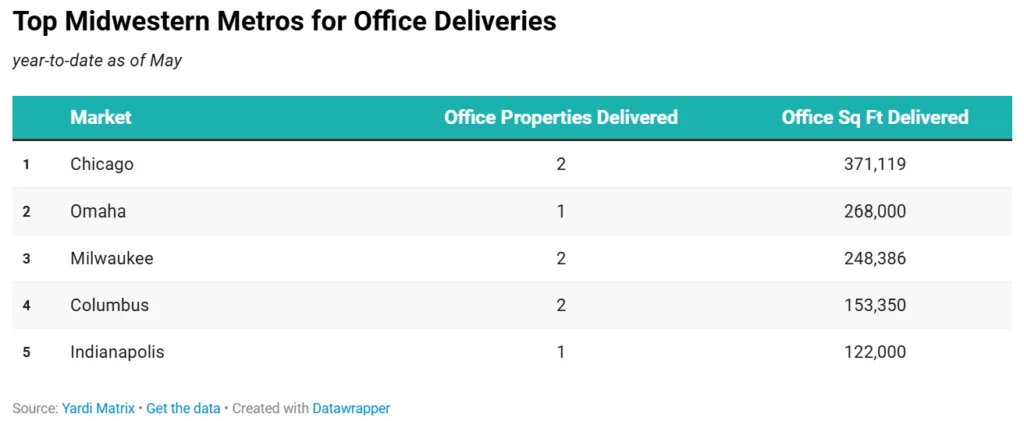
Among Midwestern metros, Chicago topped the chart with two office properties totaling 371,119 SF—nearly double its output during the first five months of 2025. The Fulton, an 11-story, LEED Silver-certified building by Fulton Street Cos., was a major driver, backed by a $112.9M construction loan. Omaha followed with a single 268,000-SF property delivered by Applied Underwriters as part of the Heartwood Preserve development, representing the highest percent increase relative to the existing market.
The city’s expanding office footprint mirrors its growing influence as a logistics and distribution center in the Midwest. Milwaukee added 248,386 SF across two properties, with the 212,000-SF Forensic Science and Protective Medicine Facility anchoring new supply. Columbus delivered two projects totaling 153,350 SF after posting zero completions during the same period last year, and Indianapolis rounded out the list at 122,000 SF, experiencing a moderate year-over-year decrease.
Larger Projects, Fewer Properties
The first half of 2026 saw Midwestern office deliveries accelerate in total SF, despite a slight decrease in the number of properties completed. This suggests developers are favoring larger footprints and flagship buildings in core markets. National benchmarks show a divergent trend: while the Midwest doubled its output compared to early 2025, total US office construction remains tepid.
With only 28.7M SF under construction as of May—less than half of pre-pandemic monthly averages per Yardi Matrix—pipeline momentum is slowing, especially in coastal markets. Midwestern metros, particularly Chicago, Omaha, and Milwaukee, have been able to push projects across the finish line, often due to life sciences or mixed-use anchors, even as broader US office fundamentals remain in flux.
Why It Matters
This midyear surge in Midwestern office deliveries underscores the region’s nuanced resilience amid a challenging US office landscape. According to Yardi Matrix, the five leading Midwest markets accounted for 11.7% of total US deliveries through May, outpacing historical averages for the region. Larger projects, such as Chicago’s The Fulton and Milwaukee’s Forensic Science and Protective Medicine Facility, reveal a pivot toward mission-driven development—often targeting life sciences, state agencies, or major corporate tenants. Omaha’s Heartwood Preserve, including the new 268,000-SF Applied Underwriters headquarters, signals the staying power of amenity-rich, mixed-use environments, especially outside coastal gateway cities.
The pipeline data also present a dose of realism: although Chicago has 1.3M SF under construction and an 18.6M SF pipeline in prospective projects, most other Midwest metros remain disciplined in new starts. With just 28.7M SF of office under construction nationwide as of May—about 0.4% of all inventory, per Yardi Matrix—the US sector is stuck in a holding pattern, waiting for absorption and fundamentals to stabilize. In this context, Midwestern cities bucking the national trend may offer key insights into which office subtypes and project strategies succeed under current market pressures. If secondary cities with diversified tenants and public sector demand continue to drive completions, they could help anchor broader US office market recovery when (or if) demand strengthens.
What’s Next
Looking forward, Midwest office pipelines are varied but not overbuilt. Chicago holds the largest future pipeline with 42 prospective projects totaling 18.6M SF, yet current under-construction activity remains moderate at 1.3M SF. Omaha, Milwaukee, Columbus, and Indianapolis together control a more restrained pipeline—mostly under 1.5M SF in active projects per market. Developers appear cautious, focusing on build-to-suit and life sciences assets versus speculative office.
Nationally, as absorption and leasing activity remain sluggish, the pace of groundbreakings is unlikely to increase sharply in the second half of 2026. These Midwestern success stories will serve as test cases for right-sizing office supply and capturing resilient tenant demand in post-pandemic market conditions.