




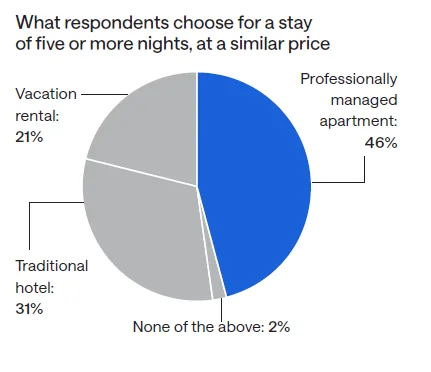
- Nearly half of respondents, 46%, would pick a professionally managed furnished apartment for a stay of five nights or more at a similar price, ahead of hotels at 31% and vacation rentals at 21%.
- Hotels draw complaints about missing kitchens and space, while vacation rentals draw complaints about cleanliness, fees and listings that do not match reality, and 41% of long-stay travelers pay extra when stays fall short.
- Hotel brands and rental platforms are adding apartment-style stays and quality controls, but demand for hotel-level consistency with home-like space points to an opening for furnished, managed apartments.
Long-stay travelers would choose a professionally managed furnished apartment over a hotel or vacation rental for trips of five nights or more, according to a Landing survey of 1,000 U.S. adults.
At a similar price, 46% picked the apartment, versus 31% for a hotel and 21% for a vacation rental.
Get Smarter about what matters in CRE
Stay ahead of trends in commercial real estate with CRE Daily – the free newsletter delivering everything you need to start your day in just 5-minutes
A Market Pulling in Different Directions
Landing, a furnished-apartment operator, commissioned Censuswide to survey U.S. adults who traveled in the past two years. Of those, 853 had stayed away from home for five or more consecutive nights in the past five years, the report’s definition of long-stay travelers.
Travel habits are fragmenting. About 69% of travelers have changed how often they travel, how long they stay, or both, and 11% have increased both. Some 35% of travelers aged 30 to 44 and 35% of those earning $100,000 or more are taking more trips than three years ago, versus 17% of travelers over 60 and 13% of those earning under $50,000.
One in five say part of what changed is the type of place they book. Hotels remain the default, and vacation rentals are a distant second, named by one in four travelers among the accommodations they book most often.
Where Hotels and Rentals Fall Short
Most travelers say current options generally meet their needs, at 74%. The picture changes on longer trips: 55% say hotels are reliable but lack comfort and space, 52% say vacation rentals offer space but lack consistency, and 37% say both have strengths but neither fully delivers.
Past five nights, 51% say hotels are not ideal. The top complaints were no kitchen (45%), no separate living space (26%), feeling cramped (22%) and running out of clean clothes with no laundry option (20%).
Vacation rentals fail on predictability. Respondents cited cleanliness (38%), hidden fees (32%), inaccurate photos or descriptions (29%) and uncertain amenities (24%), and 52% of rental users have booked a property that looked significantly different in person.
The Cost of Settling
About one in five long-stay travelers say they often or always compromise because no option fully meets their needs, and 58% say they settle at least sometimes. Some 41% report spending more on food, backup arrangements or upgrades when a stay falls short.
After a bad rental experience, 43% spend significantly more time researching next time, and more than a quarter retreat to hotels because they know what they will get.
Parents and Business Travelers Feel It Most
Parents are more likely than non-parents to have a bad booking, at 48% versus 34%, and 79% of parents change how they choose accommodations for a five-plus-night stay, against 68% of long-stay travelers without children.
Frequent business travelers send the sharpest signal. About 87% say they settle at least sometimes on longer trips, more than any other group, and a quarter struggled to find a decent place to work during a longer hotel stay, against 9% of everyone else. That group is small, at 39 respondents.
Higher earners, who are among the most likely to be traveling more, also weigh comfort and livability more heavily when they book.
Demand for a Middle Option
Even travelers who book hotels exclusively lean toward the apartment, with 42% choosing it in the similar-price scenario. Across all respondents, 60% said they would often or always choose an option that combines hotel-level consistency with the space, kitchen and laundry of a furnished home at a comparable price.
Two descriptions account for two-thirds of what long-stay travelers want: a reliable, hotel-quality experience with more space, and a place that feels like home. For stays of five or more nights, 73% book differently than they would for a shorter trip.
Price (67%) and location (55%) still lead, but 49% rank comfort and livability among their top factors and 41% prioritize amenities such as a kitchen, laundry and workspace.
Why It Matters
Lodging has not kept pace with how people travel. U.S. Travel Association’s Spring 2026 forecast projects a record $1.37 trillion in travel spending this year, including $909 billion from domestic leisure, so the pool of travelers testing longer stays is large.
Operators are responding. Wyndham and Reside opened a 96-unit Philadelphia property in early 2026 with full kitchens and in-suite laundry, and Marriott and Hilton have expanded extended-stay and apartment-style offerings. The shift also touches residential owners, as subscription housing models court the same flexible-stay demand.
Airbnb, for its part, removed more than 400,000 listings that failed its quality standards. The survey’s authors argue those efforts only partly address the gaps travelers report, since apartment-style hotel options remain limited and quality controls do not erase rental variability.
What’s Next
Landing says 70% of its bookings are for five nights or longer and account for 97% of nights sold, and 23% of those stays get extended. The company, which also partnered with Gopuff to bring instant delivery to 2,500 units, has an interest in the findings, so treat the preference data as a signal of demand rather than neutral market research.